
The Social and Academic Advantages of Homeschooling | 52
Listen to this episode on

Watch this episode on

Listen to this episode on

About this episode
This episode delivers good news for parents, whether you’re already homeschooling or still considering it: the research is on your side. Homeschooled kids tend to do as well as or better than their peers, both socially and academically.
Dr Rebecca English has spent 15 years studying homeschooling, and she also homeschools her own children. She is one of Australia’s most respected researchers in home education.
In this episode, Dr Rebecca and Ellen dive into key things that allow homeschooled children to succeed. This includes giving children a say in how they learn, the freedom to stay with a topic until it clicks, and the choice to lean into what genuinely interests them.
Meet Dr Rebecca English, home education researcher
Rebecca did not set out to research home education. Her first degree was in business, majoring in advertising, and she moved into teaching after deciding advertising was not for her. She taught in schools serving low socioeconomic communities, then completed a PhD on international students in Australian secondary schools.
While pregnant with her first child, she discovered homeschooling was an option in Australia. She proposed it to her university as a research topic and began interviewing families in 2011.
Her perspective matters to a parent weighing this up because she can speak from both sides. She has read the studies, and she has homeschooled her own children.
In the full episode, she gets specific about the parts families worry about most. What the research actually shows about social and academic outcomes and the importance of agency for successful learning.
Key points from this episode
- Why homeschooled students do as well as or better than their mainstream-schooled peers.
- Homeschooled students actually can go to university.
- Agency is a child’s ability to control their own learning experience.
- Why agency is important for intrinsic motivation.
- Running the day based on tasks not time.
- Parent engagement is one of the strongest predictors of educational success.
- Homeschooling allows a child to work towards mastery.
- Teachers are leaving mainstream school for the same reasons students are.
What the research says about homeschooled children’s academic outcomes
This is the part most parents want and rarely get straight. Rebecca’s answer is that the research shows homeschooled young people are advantaged both socially and academically.
The size of that advantage varies. At one end of the range, the effect is mild, and schooling and homeschooling make little measurable difference. At the other end, homeschooled students are clearly ahead of their mainstream schooled peers.
The evidence comes from meta-analyses, which pool the findings of every available study on a topic. Across the key learning areas, homeschooled students tend to do as well as or better than their peers in school. Maths sometimes trails English and the social sciences, but in the main these young people are outperforming their mainstream schooled peers.
Our guide to whether homeschooling is as high quality as traditional school covers this topic in more detail.
Homeschooled students can still go to university
Rebecca names university entry as the second misconception, and her answer is direct. Homeschooled students can go to university, and there are many ways in.
The example she gives is vocational. At the university where she works, a Certificate IV in any subject is enough to be accepted into teaching, which means the pathway does not depend on an ATAR.
Our guide to how homeschooling affects university admissions sets out the Australian pathways in detail.
Why homeschooled students tend to do better
Two things in the conversation explain the pattern, and neither is about the curriculum.
The first is parent engagement. Engagement with a parent is one of the best predictors of educational success we have, and no cohort is more engaged than a parent sitting down one-to-one with their own child.
Rebecca’s example is a child stuck on squared numbers. A parent can trace it back to shaky times tables, fix that, and then explain that the small two does not mean multiply by two. Then they can keep going, because no bell is going to end the lesson.
The second is mastery. In a timetabled day, a subject stops after 70 minutes regardless of where a child is up to.
| “We work towards mastery in homeschooling. We don’t work towards mastery in school. After 70 minutes, maths stops mattering.” – Dr. Rebecca English |
At home there is no rule about how long anything takes. If geography is going well, there is no reason to stop at Australia’s capitals; you could move on to other countries. On the other hand, if a particular topic is not working, you can leave it and come back to it later.
More on this in our guide to learning at your own pace.
Does homeschooling affect social skills? What the research says
Socialisation is the other half of what Rebecca describes as advantaged, and it is the misconception she hears most often.
Some of it comes down to how safe a child feels asking a question. As Rebecca puts it, admitting you do not know your eight times tables at home is not shameful, because there is nobody to be embarrassed in front of.
Ellen’s experience matches, and she is direct that there is no environment as nurturing as home. Families often arrive worried that a child is a year behind in a subject, which is a strange idea in homeschooling, because a child is simply where they are. Once that child is free to say they do not understand something, they frequently go scooting ahead.
What Ellen values most is the change in children’s beliefs about themselves. A child who has decided they are hopeless at maths has usually just missed some steps.
That belief is no longer set by who else is in the room. As Ellen puts it, these children are no longer limited by who is in their class or by what a teacher thinks they are capable of.
More on this in our guide to homeschool socialisation.
What learning agency means, and why it drives motivation
Agency is an academic word for something most parents already understand. Rebecca defines it as your ability to control your world and your surroundings, which in education means your learning experience.
Her view is that this has been steadily withdrawn. Over the past two decades, curriculum and teaching methods have both been overly centralised and standardised.
| “When we’re talking about agency in an academic sense, what we mean is your ability to control your world and your surroundings. And in terms of education, it’s your learning experiences.” – Dr. Rebecca English |
The reason it matters is motivation. Intrinsic motivation is what gets a child to start something difficult that they do not particularly feel like doing, and Rebecca’s believes that control and choice feed it directly.
Tasks, not time: how to give a homeschooled child some say over their day
The practical version is simple enough to try this week. Rather than running the day by the clock, you agree what needs to be done and let the child have some say in the order and the pace. Her recommendation is to set out the work for the day and leave how they arrange their time up to them.
Ellen recognises the pattern from her own parenting. The moment you tell a child they have to do something, it becomes the last thing they want to do. Give them the same list with room to move, and it tends to get done.
Choice can also sit inside the learning itself. Rebecca gives the example of a child who must cover algebra but can do so through something they care about, whether that is cooking, bikes, or anything else.
At Euka, this shows up in how a lesson is built. Alongside the content, there is usually a hands-on activity, a digital activity and a downloadable sheet, so a child has some say in how they learn something and how they show what they know.
The same applies at the weekly level. Families can follow a week plan that moves across subjects, or a subject plan that lets a child stay with science for three weeks if that is where their interest is.
Why working to tasks prepares children for real workplaces
Schools run on time. Most workplaces now run on tasks.
Rebecca’s example is that if you finish your work early while working from home, nobody minds if you put a load of laundry on. The work is done, and that is what is being measured. Her conclusion is that in many ways homeschooling prepares a child better for the world we live in.
It reframes one of the most common objections families hear: what happens when the child gets to the real world. A child who has spent years managing their own workload against deadlines has been practising the exact skill most jobs require. Our guide to how homeschooling prepares children for the real world goes through the other skills that carry across.
How to give choice to a child coming out of school
Ellen raises the obvious complication. A child arriving from school may have had very little say in anything, and handing them a blank day is not a plan.
Rebecca’s answer is that it is gradual, and she compares it to teaching a child to ride a bike. You hold on, you hold on, and eventually you let go.
She names three things that help in the meantime. Allow time to adjust to a workflow that is not organised around a bell, target learning towards things the child is genuinely interested in, and set some limits on screen time.
In her own house, free time does not start until half past three, and only if the day’s tasks are finished. A child can do them first thing in the morning or half an hour before the deadline, and either is fine.
Some children need a deadline to get moving. Others prefer to start immediately and clear it. The point is that they learn which one they are.
When an anxious child needs to settle before starting schoolwork
For many families, the first stretch is not about workload at all. Rebecca notes that school refusal is strongly correlated with anxiety and neurodivergence, so many children arrive carrying a good deal of stress.
A significantly anxious child is not going to move straight into formal lessons that look like school. What they need first is space and time to heal after a very stressful experience.
She is direct that it does not have to look like school. Older, more integrated models have a lot to offer, where a child interested in bikes can reach maths, science, English and history through that one subject.
She is equally clear that this is not something to manage alone. Government data shows that neurodivergence is more common among homeschooled children than in the school population, so working with psychologists and therapists matters.
Our guides to special needs homeschooling and homeschooling with ADHD go further into the practical side, and our episode on school refusal covers what sits underneath it.
If that is where your family is right now, our parent’s guide to school refusal in Australia walks through the options, and bullying and homeschooling covers the case where that is the trigger.
Why teachers are leaving the profession, and how it connects to school refusal
The conversation then turns to a group nobody applies this lens to. Rebecca points out that teachers are leaving the profession in droves, and her reading is that many are unhappy for the same reasons the children are.
As she puts it, we do not talk about teachers as school refusing, or as “school can’t”, but in many ways they are. They are just as anxious as the young people in their care.
She traces it back to agency. Teachers have lost the capacity to shape learning around the children actually in front of them, which is the one thing home educators can still do.
That takes her somewhere unexpected. If a government genuinely wanted fewer families choosing home education, she argues the answer is not aimed at families at all: re-engage teachers with their classes and give them room to manage learning the way home educators do.
She is careful not to lay this at the feet of schools or teachers. The settings have narrowed for everyone inside them, and her view is that teachers would do this differently if they could.
Ellen notes the ground is already shifting. In Queensland, education authorities now meet with homeschooling families regularly and ask how they can support them, and families there describe the relief of no longer feeling like the educational police are on their back.
We have covered the student side of this in far more detail elsewhere. School refusal: unlocking the potential of homeschooling for anxious learners looks at what changes when an anxious child comes home, and our earlier episode asking whether you should force a child to go to school sits alongside it.
What a good education means, according to a home education researcher
Ellen closes by asking Rebecca for her own definition. Her answer is to meet a child in the moment, and to understand that those are just moments and that those moments will change. It is about showing a young person how to love learning.
She does not believe there is a child who cannot learn something, and she has a story that explains why. While teaching a certificate class, she was writing her master’s thesis, and one student, the one flagged on the roll as the hardest to teach, asked what she was working on.
She explained the theory she was using: that your life experiences prepare you to succeed in some settings and not others, so some children arrive at school with what that setting rewards and some do not.
The student immediately connected it to his own life and moved into a genuinely thoughtful account of his own path through school. This was a child who could barely write his own name, engaging with philosophical thought.
| “There is no young person who can’t learn. We just need to communicate with them in the right way. And that’s what education is, it’s communication.” – Dr Rebecca English |
Questions answered in this episode
The research Rebecca cites points that way on average. Homeschooled students do as well or better than their mainstream schooled peers, socially and academically.
She is careful about the size of that advantage, which ranges from negligible to large depending on the study. The two things she credits are parent engagement and the freedom to work towards mastery.
Meta-analyses show homeschooled students performing as well as or better than their mainstream schooled peers across the learning areas. The size of the advantage varies between studies.
Rebecca names socialisation as one of the two biggest misconceptions about home education. Her reading of the research is that these young people are advantaged socially as well as academically.
Yes, and Rebecca is clear there are many pathways in. She gives the example of a Certificate IV in any subject being enough to be accepted into teaching at the university where she works.
Two reasons come up in the episode. Parent engagement is one of the best predictors of educational success, and homeschooling allows a child to work towards mastery rather than stopping when a bell rings.
It is a child’s ability to control their own learning: the order in which they work, how they use their time, and, where possible, how they approach a topic. Rebecca ties this directly to intrinsic motivation.
Enough that they are managing something, and not so much that the day has no shape. The usual starting point is to assign what has to be done and let the child decide when and in what order.
Slowly. Allow time to adjust to a day that is not run by a bell, focus the learning on things they are actually interested in, and set some limits on screens while the habit forms.
That is normal, because the day is no longer padded with bells, recess, lunch, library and handing out sheets. The measure is whether the work is done, not how long it took. Our guide to how many hours a day you should spend homeschooling gives typical ranges by grade.
It can, but Rebecca is clear that the first stretch should focus on settling rather than academics, and that families should work alongside psychologists or therapists where needed.
Why this episode matters
For a parent lying awake, wondering whether they are doing the right thing, this episode offers something specific to hold on to. The research on social and academic outcomes points one way, and the reasons behind it are not mysterious.
A child who has some say in how they learn, works alongside an engaged parent, and isn’t cut short by a bell tends to do well.
It also gives families an answer to the two questions asked most often, about socialisation and about university.
Start the free homeschooling course
If this episode has you thinking about what your own week could look like, our Complete Guide to Confident Homeschooling covers registering legally in your state, choosing and structuring a curriculum, building a daily rhythm, supporting a child who learns differently, and knowing your child is progressing.
It is nine short video modules, about two and a half hours, hosted by Brett and Ellen. Free and self-paced.
Start the free homeschooling course
Related episodes. Do I need to be a teacher to homeschool? and Preparing your children for the real world.
Related reading. Our guide to the signs a child is struggling at school.
Transcript
Other episodes
Episode 052
The Social and Academic Advantages of Homeschooling
Episode 051
You’re Not Alone: Finding Support on Your Homeschooling Journey
Episode 050
Do I need to be a teacher to homeschool?
Episode 049
The Real Benefits of Homeschooling: A Euka Graduate’s Honest Answer
Episode 048
Is Homeschooling Worth It? David’s Story of Homeschooling 3 Kids Over 8 Years
Episode 047
Preparing Your Children for the Real World: 6 Life Skills Homeschooling Can Teach
Episode 046
Starting Homeschooling Mid-Year in Grade 11 or 12: Senior Pathways Available at Euka
Episode 045
School Refusal in 2026: What It Really Is, and How to Help Your Child
Episode 044
Can I Start Homeschooling in the Middle of the School Year?
Episode 043
From School Bullying to Homeschooling Across 40 Countries as a Single Mum with 3 Daughters
Episode 042
How Young Athletes Train Full-Time Without Falling Behind in School
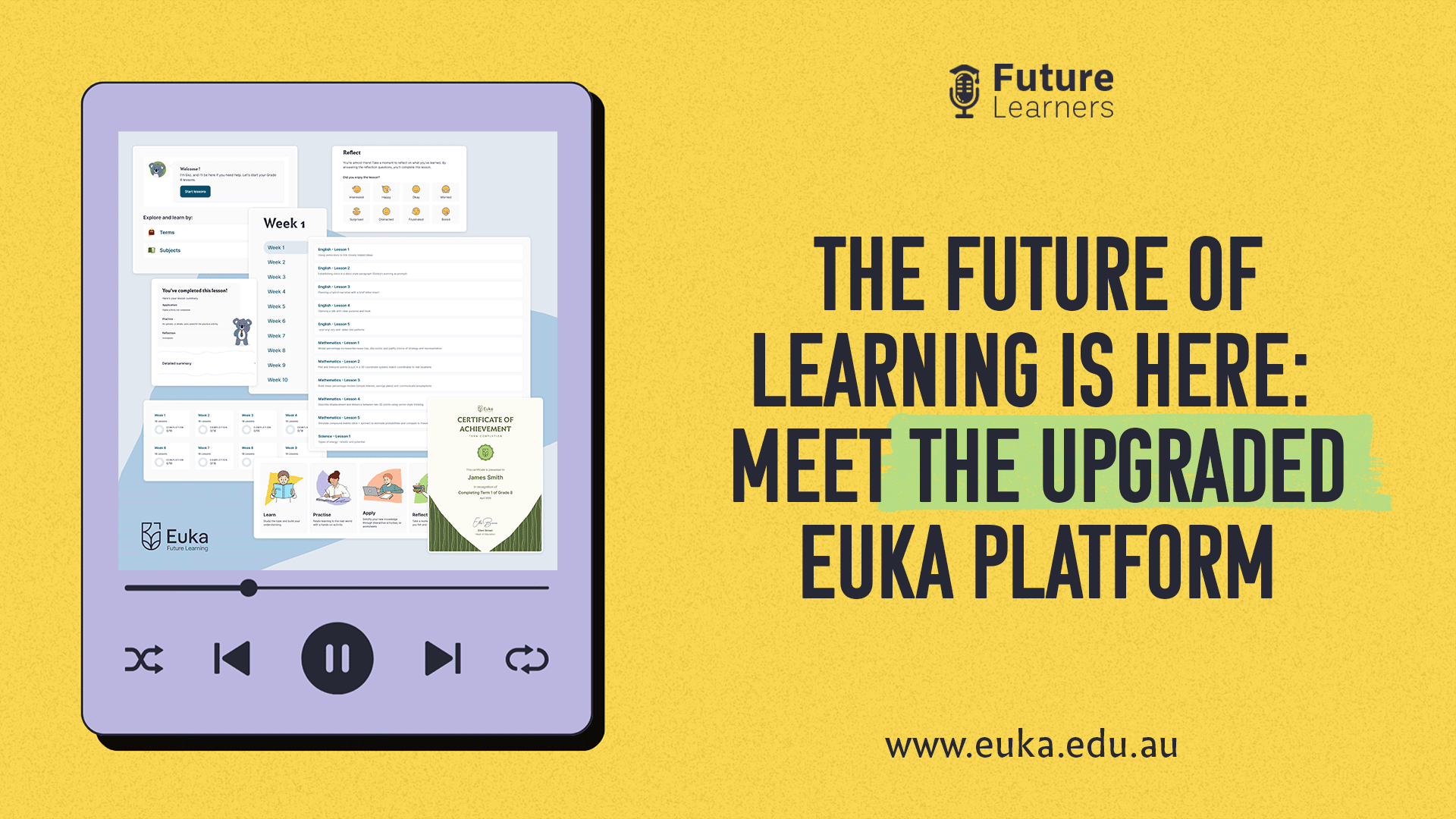
Episode 041
Meet the Upgraded Euka Learning Experience

Episode 040
The World Is Your Classroom: Travel Schooling with The Slow Road

Episode 039
Inside the NSW Homeschooling Audit: What It Means for Families

Episode 038
He earns 30K a year and homeschools

Episode 037
What you need to know about homeschooling in 2025

Episode 036
Is School Going “WOKE”?

Episode 035
The “True” Reasons families homeschool?

Episode 034
What you need to know about Registration and Reporting when Homeschooling

Episode 033
Travel Schooling: Everything you need to know

Episode 032
Raising young boys

Episode 031
Sleep! Are you and your kids getting enough?

Episode 030
Setting your pre-schooler up for success

Episode 029
Should children under 16 be banned from using social media?

Episode 028
Should children learn handwriting in this digital world?

Episode 027
The #1 Skill for children to learn

Episode 026
When should your child do work experience?

Episode 025
How to build a strong family unit

Episode 024
How to retain 90% of everything you learn!

Episode 023
Homeschooling with Dyslexia, ASD, and ADHD: A Mother’s Inspirational Journey

Episode 022
Unlock funding for homeschooling

Episode 021
Moving from School to Homeschooling in term 2

Episode 020
Homeschooling on a budget

Episode 019
The Importance of Raising Risk Takers

Episode 018
Empowering Girls: Building Confidence and Self-Esteem

Episode 017
3 Major Obstacles Parents Face when Homeschooling
Follow Euka on social platforms


Meet our hosts

Brett Campbell, CEO Euka Future Learning
Brett Campbell is a leader in education, serving as the CEO of Euka, an innovative company building the future of education. He’s a successful entrepreneur and author with a passion for lifelong learning. Beyond his professional achievements, Brett is a devoted family man and the host of the Future Learners Podcast, where he shares his ideas about education’s potential to empower people and create a brighter future.
Follow Brett on:


Ellen Brown, Founder Euka Future Learning
Ellen Brown is the founder and driving force behind Euka’s educational philosophy. With over 25 years of teaching experience, she designed Euka’s curriculum for grades 1-12, emphasizing individualized and practical learning. Her expertise is recognized by major media outlets, and she is frequently sought after for her insights on the future of education.