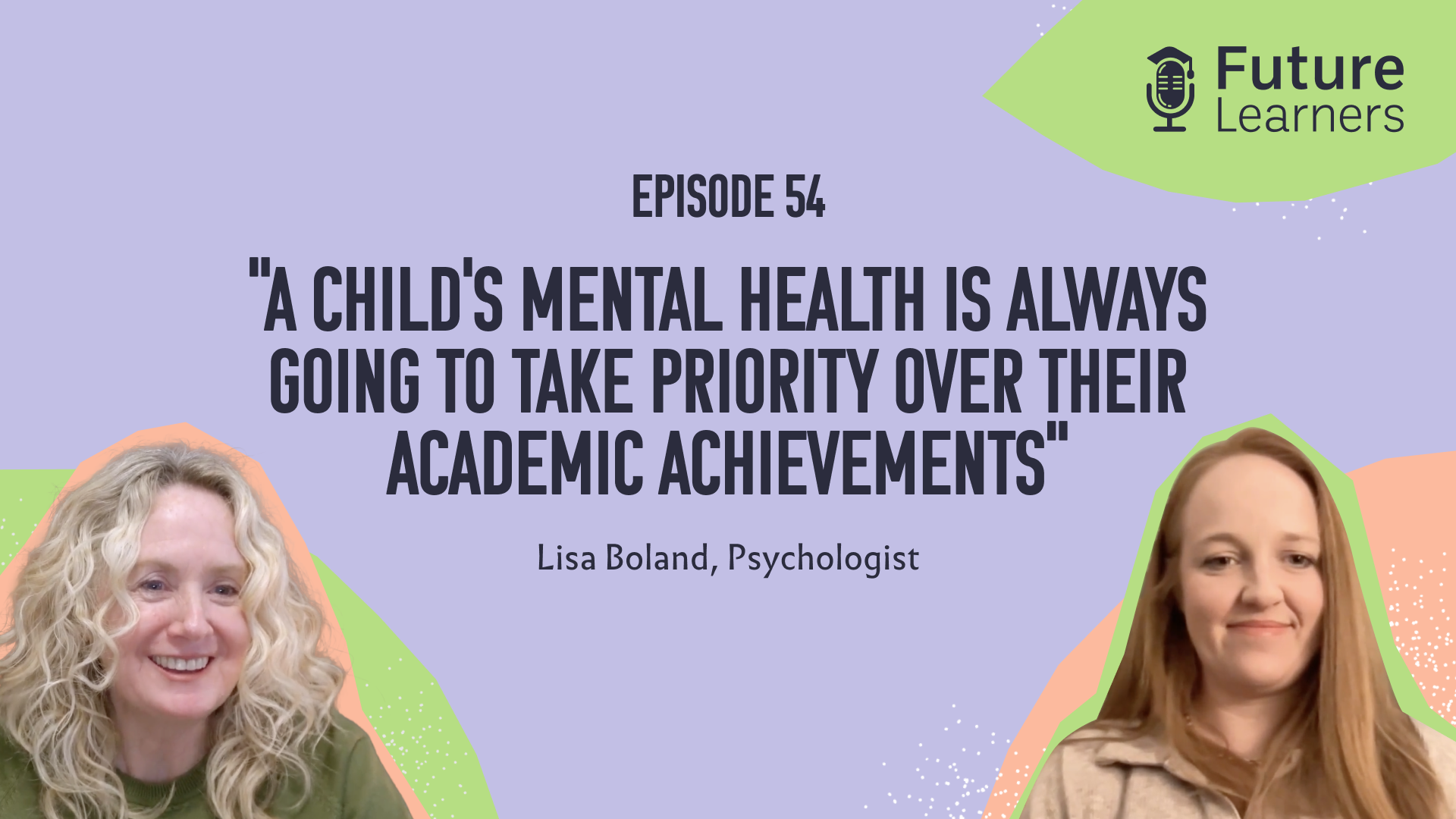
Raising mentally healthy kids: What a psychologist wants you to know | 54

Listen to this episode on

Apple Podcasts

Watch this episode on

YouTube

Listen to this episode on

Spotify

About this episode

A child can be doing well at school and still be struggling.

Ellen Brown talks with psychologist Lisa Boland about how to recognise that child and what to do first. Lisa believes that a child’s mental health should come before their schoolwork and their attendance record.

Ellen and Lisa also discuss what bullying does to a child’s nervous system, what helps children with ADHD and autism learn, and what healthy socialisation actually involves. Much of the conversation applies to any parent, whether their child is at school or learning at home.

Meet Lisa Boland

Lisa runs her own psychology practice in a rural area, which means she sees close to everything a psychologist can see. Her clients range from young children to adults, and many are children struggling to get to school.

She is also a mum to two neurodivergent boys, and she homeschools them.

In the episode, she gets specific: the sign that arrives hours after the school bell, why a child can stay anxious at a new school where everything is going well, and the one thing she would tell every parent about mental health.

Key discussion points

  • “School refusal” is increasingly called “school can’t.” The wording names what is happening: a child who is unable to get there.
  • Pushing through carries a cost. Lisa’s view is that it often worsens existing mental health concerns, and that apparent improvement can mean a child has learned to mask.
  • The clearest signal often arrives after school. Post-restraint collapse describes the child who holds it together all day and falls apart at home.
  • Stress from bullying accumulates in the nervous system. The brain remembers the triggers, so a new school can still set it off.
  • A child who does not feel safe cannot learn. A child in a stress response is on the lookout for danger.
  • Some neurodivergent children love school and thrive there. Others burn out, and Lisa has seen severe cases.
  • Social skills cover much more than making friends.
  • Mental health comes before academic achievement and attendance.

How to tell school refusal from an ordinary bad morning

The advice used to be to push through. Get to the school gate today, get through it tomorrow, and count the attendance as a win.

Lisa’s view is that we know more now. Pushing through often makes existing mental health concerns worse, and the improvement that appears afterwards can be misleading, because children are good at pushing things down to fit in or to spare their parents.

Sometimes a child who could not attend, and now can, has recovered. Sometimes they have learned to mask. Lisa sees that second version often in neurodivergent children, and it tends to surface later.

The signs of school refusal a psychologist looks for

Every child is different, but these are the patterns Lisa watches for:

  • An inability to get there. The child is frozen and anxious.
  • Changes in mood or behaviour around the school day.
  • Losing interest in things they used to enjoy.
  • Food restrictions, or a jump in worries and questions.
  • Post-restraint collapse.

That last one describes a child who holds everything together all day and falls apart the moment they get home. Lisa describes parents and teachers comparing notes and realising they are getting two very different versions of the child.

Why an anxious child struggles to learn, even after the bullying stops

While bullying is happening, Lisa explains, a child spends much of the day in a fight, flight or freeze response. That kind of stress is cumulative, building in the nervous system day after day.

The brain also remembers the triggers. Removing the bully can leave that response in place.

A child might get on well with everyone at a new school and still struggle there, because the setting keeps reminding their nervous system of something else. Lisa gives the example of driving past the old school, or going back for some reason, and watching it resurface. Ellen notes that people generally assume it is over once the bully is gone.

“A child cannot learn if they don’t feel safe.”
— Lisa Boland

Her reasoning is that a child in a stress response is on the lookout for danger, and that is where their attention goes. Decoding a word or working through subtraction asks for attention they are already spending elsewhere.

If bullying is what brought you here, our guide to bullying and homeschooling works through the decision itself, and the signs a child is silently struggling at school covers what to watch for.

What helps children with ADHD and autism learn

Lisa says that plenty of neurodivergent kids thrive at school and love it.

Among her clients and in the homeschooling community, she also sees autistic and ADHD burnout, sometimes severe, in children who presented well right up until they could not hold it together anymore.

These are often the children described as a pleasure to have in class. The effort of masking stays invisible until it runs out. Lisa describes children who reach a point where they cannot leave their bedroom, or cannot bring themselves to switch from one screen activity to another.

She makes an academic point alongside the clinical one. A child learning in a way that suits their brain is a child who can reach their potential.

Key things that help many children with ADHD

Lisa named a few things that help many children with ADHD, with the caveat she repeats throughout: every child is different.

  • Movement and the freedom to get outside.
  • Engagement. She describes the part of the brain needed for schoolwork switching off when a task is boring or asks for long stretches of sitting still.
  • Relationship with whoever is teaching, including some banter back and forth.
  • Snacks on the go while they work.

Some classrooms can accommodate this. Ellen, a former teacher, says it gets hard with thirty children, and Lisa agrees. The dyslexic child needs one thing, the autistic child another, the ADHD child another again, and the rest of the class something else.

Episode 23 covers homeschooling with dyslexia, ASD and ADHD.

Does homeschooling affect a child’s social skills?

Ellen says this is one of the questions they hear most, and Lisa’s answer widens what this includes.

Making and keeping friendships counts. Other considerations:

  • Can your child go into the shop, spend their own pocket money and handle the interaction at the counter? If they cannot find what they need, can they ask someone?
  • Can they sit down to lunch with children and adults of all different ages?
  • If something seems off at the park, do they know what to do, and do they know your phone number by heart?

Lisa’s point is that social skills are much broader than making and maintaining friendships. Those wider skills get practised everywhere a child goes.

Ellen adds that adults choose the people they spend time with based on shared interests. She also notes that for many children who are miserable at school, the social environment is the reason.

Lisa’s own children could be out with friends every day of the week if they wanted, so the opportunity is plentiful and they aren’t missing out on anything.

Is taking your child out of school the right decision?

Ellen describes a guilt she hears from parents new to homeschooling, a sense that a better parent would have pushed harder or stayed longer.

Lisa says choosing to homeschool your child is going above and beyond, and that a child who found the school environment distressing was unlikely to reach their potential there.

She also talks about the practical side. Getting the right support in place can be close to a full-time job: appointments with psychologists and paediatricians, monitoring whether medication is working, and observing your child throughout the day.

For the parent watching their child crying every morning before school, her advice is direct.

“For me, that child’s mental health is always going to take priority over their academic achievement, or worse, their attendance record. That’s something that, as a psychologist, I couldn’t care less about. You know your child. If you can see that your child is suffering, and that environment is going to exacerbate that suffering, prioritise their mental health.”
— Lisa Boland

She adds that the decision is smaller than it feels. Nothing is permanent; you can change your mind in six months, and children are good at catching up. Many families use time at home as a reset while support is put in place, then return to school later.

Both Ellen and Lisa loved school themselves, and both look back and notice a cost they missed at the time.

Asked what she would tell every homeschooling parent in Australia if she had five minutes, Lisa said this.

“I would tell them you’re already doing a brilliant job. If you take care of your mental health, your kids will follow. If you’re good, they’ll be good.”
— Lisa Boland

Why this episode matters

This episode is about recognising when a child is struggling and knowing what to do first.

Lisa puts safety ahead of schoolwork, mental health ahead of attendance, and treats the decision to homeschool as one you can revisit. For a parent weighing up homeschooling, that reframes the question from whether this is the right call forever to what their child needs right now.

Start the free homeschooling course

If you are working out what this could look like for your family, our Complete Guide to Confident Homeschooling covers registering legally in your state, choosing and structuring a program, building a daily rhythm, supporting a child who learns differently, and knowing your child is progressing.

Nine short video modules, about two and a half hours, hosted by Brett and Ellen. Free and self-paced. Start the free homeschooling course.

Questions answered in this episode

They describe the same situation. “School can’t” is the term increasingly used because it names what is happening: the child is unable to get there.

Lisa looks for an inability to get there, where the child is frozen and anxious, along with changes in mood or behaviour, losing interest in things they used to enjoy, new food restrictions, or a jump in worries and questions.

It is the meltdown that arrives after school. A child holds everything together through the day, then falls apart once they are home. Lisa describes parents and teachers who compare notes and realise they are describing two different children.

Lisa’s view is that it commonly makes things worse, and that improvement afterwards can be misleading. Some children genuinely recover. Others learn to mask their difficulties, which she says tends to show up later as poorer mental health.

Stress from bullying is cumulative in the nervous system, and the brain remembers the triggers that set it off. A new school can be fine socially and still carry enough reminders of the old one to keep the stress response running.

Lisa’s answer is that a child who does not feel safe is in a stress response and on the lookout for danger, which leaves very little attention available for schoolwork.

Lisa named movement and time outside, work that is genuinely engaging, a good relationship with whoever is teaching them, and snacks available while they work. She describes these as general things that help many children with ADHD, alongside her caveat that every child is different. She also notes that some schools accommodate this well, and that it gets difficult across a class of thirty.

Lisa’s answer is no. She also describes social skills as much broader than making and maintaining friendships: handling an interaction at a shop counter, asking for help, mixing with people of different ages, and knowing what to do and who to call if something goes wrong.

Lisa believes that choosing to educate your child yourself is going above and beyond, and that a child who found the school environment distressing was unlikely to reach their potential there.

Lisa describes this as a normal outcome. Nothing is permanent; the decision can be revisited in six months, and in her experience, children are good at catching up.

About the host and guest

Ellen Brown is Euka’s co-founder and Head of Education. She is a qualified teacher, a mother of five, and has homeschooled for 12 years.

Lisa Boland is a psychologist who runs Lisa Boland Psychology, a rural practice offering face-to-face and telehealth appointments for all ages. The practice works across anxiety, depression, trauma and more, and also provides autism, ADHD and cognitive assessments. She is a mother of two neurodivergent boys and homeschools them.

You can find Lisa’s practice on Instagram and Facebook.

This article is general information, not clinical advice. If you are worried about your child’s mental health, please speak to your GP or a registered psychologist. You can also reach Kids Helpline on 1800 55 1800 or Lifeline on 13 11 14, free, 24 hours a day.

Transcript

Lisa:

You’re definitely not doing your child a disservice by homeschooling them. You know you’ve decided to go above and beyond, like you’re about to give them the best educational opportunity you could give them.

Ellen:

Now, we always have to balance that. You know, we want them to have grit, but yeah, we want them to be mentally healthy.

Lisa:

A child cannot learn if they don’t feel safe. If they are heightened. And in that stress response, kind of on the lookout for danger, how can they decode a word? How can they, um, you know, do some subtraction with borrowing? You know, where your when your brain is just wired to, to look out for what’s going on? Um, the learning doesn’t happen. It just doesn’t happen.

Narrator:

Welcome to the Future Learners podcast, the home for parents and students thriving with homeschooling in Australia. Your hosts, Brett Campbell and Ellen Brown are the co-founders of Euka Future Learning, Australia’s largest online K-12 homeschooling provider. Join them as they guide you from uncertainty to complete confidence. Let’s get into it.

Ellen:

Hi and welcome to this podcast. So today we’re really lucky to have the opportunity to talk to Lisa Boland about what she does in her everyday life. But on a on a high level, I’ll say, you know, she’s a respected psychologist who works with children and helps many of the children that have got the same kind of situations going on and challenges going on that parents that have got kids with Euka have. So just welcome today and let us know a little bit about yourself. Lisa.

Lisa:

Yeah, sure. Thank you so much for having me. Um, so as you said, I’m a psychologist, um, working in kind of a small rural area. I see every part of what a psychologist can see. I have all types of clients, but I do have a lot of little clients who, um, either are struggling with being able to attend school. Um, what we now refer to as school can’t, but what some people might know more as school refusal. Um, and I kind of sometimes tell family is like, well, be careful talking to me because you might end up homeschooling. Um, I might talk you into it. Um, outside of my practice, which I run, I’m also a mum to two neurodivergent boys, and they are both homeschooled as well.

Ellen:

Fantastic. Well, you’ve certainly got a lot of experience from both sides of the fence, which is really useful. And I know when we I’ve talked to many families and they’ll come to Euka and they’re just at the beginning of this journey and uh, and certainly if they’ve got kids that have got neurodivergent kids or certainly have a lot with anxiety and things like that, it’ll be very helpful to get your perspective from both sides of it. Like, you know, the first, one, which was about school can’t or school refusal. Um. Clinically speaking, what does it do to a child to push through every day when you’re actually in that school system and it’s not actually working for you?

Lisa:

So for a long time, the advice really was to push through, um, and to try and get kids to, you know, get to the school gate today and then get through the school gate tomorrow. Um, and just as long as they’re there, as long as they’re at school and they’re getting that attendance, that’s all that matters. We know more now, and we know that what that probably is doing is exacerbating any of the mental health concerns that might already be going on. Um, kids are really good at pushing things down and kind of hiding them for our benefit or to fit in. So sometimes what looks like a child who previously couldn’t go to school, suddenly being able to go to school in some circumstances. Yes. Great. They’re recovered. They’re doing well. But in a lot of circumstances, especially neurodivergent children, what they’ve actually learnt how to do is to mask their difficulties. And so it looks like they’re doing better and they’re able to attend, but they’re actually just kind of holding it all inside, which can have poor mental health outcomes later on.

Ellen:

Hmm. That’s really interesting, actually. Um, you know, I, I see that you said we’ve we’ve learnt a lot, but that still is the current, uh, way of dealing with things in mainstream school about, you know, pushing through. A, I guess, a tricky thing as a parent is understanding what an ordinary. I don’t want to go to school, um, you know, that. Just that normal. Ordinary. I don’t want to go to school with something that’s beyond that. How do you how do you, as a parent go? You know what? There’s something more here than just. I don’t want to be there. How do you know?

Lisa:

Yeah, it’s very tricky, because every child is so different. But you’re right, every kid at some point is going to say, I don’t want to go to school. Of course, of course they would want to stay home in their pyjamas and spend the day with mum or dad. Um, but when it starts bordering on that, um, school refusal or school can’t, it starts to look more like almost an inability to get to school because they are so frozen. They are so anxious. Um, you might see other behavioural changes or mood changes around that child. Um, they might not enjoy things that they used to enjoy. Um, they might start having food restrictions. Um, they might start asking lots of questions, lots of worries. Um, one big thing that we see is the child may appear to be doing really well in school, and we think, you know, what’s the problem? Why don’t they want to go? They’re bright, they have friends. But then we see this thing after school, which we call post restraint collapse, um, which is when they’re having huge meltdowns and outbursts after school. It’s almost like you’ve got the school version of your child and the home version, and the teachers and the parents are going, who? Who do you know? Because that’s not my kid. Um, because they’re working so hard to keep it all together, to just even be at school, and then everything collapses at home.

Ellen:

Yeah, that actually makes a lot of sense. So you can see when you’re talking about that, you know, in an ordinary situation when a child doesn’t want to go to school and you take that pressure off, the issue stops. You know, you just go, oh good, the pressure’s off. But, you know, in those kind of situations where you’re seeing that taking that pressure off, you think of it somewhere else, like you were saying just after school, having that, um, that’s really helpful for a parent to know because, you know, we always have to balance that, you know, we want them to have grit. But we want them to be mentally healthy. Yeah. You know another big one that we see are children that have been bullied at school. Can you describe what’s happening to a child’s nervous system when they’re in that situation of being bullied and how even sometimes when you take them out of that situation, not out of school, but say changing schools, that bully is not there, but there’s still something going wrong. What’s that about?

Lisa:

Yeah. So during the period where that child is around the other child. So the bully in this situation, um, they’re in this heightened nervous system response, this kind of fight flight freeze response often for most of the day. And that stress is cumulative. So it builds in the nervous system more and more over time. So it’s going to kind of hang around. You’re going to start to see it affecting other things with, you know, little symptoms of anxiety and low mood and that sort of thing. But then the brain and the nervous system kind of remembers those triggers for what set the fight or flight in motion in the first place. And then you might find that that child is highly distressed or having a stress response in similar situations. Um, if you random example, but if their old local school is where you go to vote, you know, or something like that, or they have the local fete or whatever, and you have to go into the school for some other reason. You might find that that child can’t go near the school. Um, they might start talking again when you drive past the school, bringing it back up again, that remember when this and kind of going over and over they might go into a new school. Um, and the children there are great and there’s no problems, but everything around them kind of subconsciously reminds them of how things used to be. And so their nervous system responds to that.

Ellen:

Oh, okay. That makes a lot of sense. It’s really helpful, actually. I don’t think that I think people generally think if the bully’s gone, it’s all over. So why is my child still having difficulties? So for an anxious child or a child that’s been through bullying and that kind of thing, they’ve had that nervous response. How much does the learning environment itself matter? Like the pace, the the feelings of safety, all that kind of thing?

Lisa:

It matters a lot. Um, a child cannot learn if they don’t feel safe. Mhm. If, if they are heightened and in that stress response kind of on the lookout for danger, how can they decode a word. How can they, um, you know, do some subtraction with borrowing. You know, where your, when your brain is just wired to, to look out for what’s going on. Um, the learning doesn’t happen. It just doesn’t happen.

Ellen:

Yeah. That makes that makes a lot of sense. And I think that helps parents because, I mean, it’s a tough job being a parent. And we’re always wondering, am I doing the right thing? Am I doing that? You know, and then there’s the guilt that comes on us. Or, you know, it’s a tough gig being a parent. And sometimes, you know, we’ve had parents that are new to homeschooling that have come out of mainstream school and they’ve had this guilt, like they’ve somehow given up because if they were good parents, they would have pushed harder, they would have stayed longer, or they would have done something different. Um, you know, what would you say to a parent that’s having those kind of feelings?

Lisa:

Um, you’re definitely not doing your child a disservice by homeschooling them. You know, you’ve decided to go above and beyond, like you’re about to give them the best educational opportunity you could give them. And if the school environment was distressing to that child, they were never going to learn and reach their potential in that environment anyway.

Ellen:

Yeah, I totally agree. We often say, and certainly when it comes to something like bullying, for example, we often will find that, um, it may not even be a forever thing. Homeschooling may be, um, for a time while they get some professional help and get strategies to deal with things. And at some point they might want to move back into the school system. So, um, that makes a lot of sense about that whole triggering thing. And, you know, changing schools. Not necessarily the answer, but perhaps taking time out and getting some help, maybe a much better answer than just trying to find another school.

Lisa:

Yeah, absolutely. And look, getting the right support for your child can be a full time job for you and the child anyway. So to take that pressure off of the 9 to 3 educational situation, to be able to find an appropriate psychologist, to be able to go to paediatrician appointments, to be able to, you know, medication is a thing for that child. See? Is it working? I can observe them all day long. How is it affecting them? Um, rather than trying to squish all that in around school?

Ellen:

Yeah, yeah. That’s awesome. I know you do a lot of work with, um, kids that have autism or ADHD. Yeah. What happens to a neurodivergent child when they’re asked to spend their day in an environment like mainstream school, if their brain just wasn’t built that way? What happens to them in that environment?

Lisa:

So again, every child is different. Um, and some neurodivergent kids thrive in school. Um, just absolutely love it. But for many of the kids that I know, through the homeschool community and my clients, it really wears them down. Um, I’ve seen some pretty severe and debilitating cases of autistic and ADHD burnout, um, where the child might be a pleasure to have in class or, you know, the citizen of the year. You know, these kids that are presenting really well at school, but it is taking so much out of them to mask and, and kind of press down their natural way of learning and their natural way of being, um, that eventually they get to a point where they just can’t anymore. And I see these kids, um, then they can’t leave their bedrooms or, you know, can’t even, you know, they might be able to watch YouTube all day, but they can’t even bring themselves to switch screens over and play Minecraft, like, just even the most basic things. So it can have a really, um, big mental health impact. Um, but also, again, that that’s not how they learn. If that is not how they learn, then they’re not going to be reaching their potential academically either.

Ellen:

Yeah. Okay. You said something interesting there about, you know, obviously some like you say, all children are different and some will thrive in school. And they love that whole rhythm of the day and it’s working really well for them. You know, in general, and it’s very hard to have in general. But, um, you know, how. What conditions do you think would be, um, helpful in learning for a child that’s neurodivergent?

Lisa:

So neurodivergence is a really broad, general term that can, depending on who you ask, that can refer to any type of mental health diagnosis. It can refer to, um, personality disorders. It can refer to a brain injury. I’ll condense it right down to autism and ADHD because those are the things that and learning disabilities, those are the things that I know and understand. Um, there are a couple of couple of very broad and generalised recommendations for kids with ADHD, for example. Um, they need to be very engaged. The if something is boring and if they have to sit still for a long time, that part of the brain required to do the schoolwork just switches off. So they need lots of movement. They need to be able to get outside and move around, um, to be able to connect in a relationship with the person that’s educating them and have some fun banter back and forth. Um, having constantly having snacks on the go. So always just having like a little packet of nuts or chips or whatever while they’re doing their work. Um, some schools can be really accommodating with that sort of stuff, but some it’s just it simply isn’t possible when you have 30 kids in the class.

Ellen:

Yeah. It’s tough being a teacher, there’s no doubt about it. And certainly, you know, when you’re a parent, you want the very best for your child. And it is tricky to think this teacher is trying to manage all the different things that are going on in a classroom. It’s an impossible task to be able to give every child exactly what they need. There’s no doubt about it.

Lisa:

Yeah, with other forms of neurodivergence as well. There’s very, very specific ways of learning that are going to be suited to that child. And so if the ADHD child needs one very specific thing, the dyslexic child needs another, very specific thing, the autistic child needs another very specific thing. And then, you know, the bigger chunk of the class, the neurotypical kids need a very specific thing. Um, how does one person do all that? It’s pretty. Yeah, basically.

Ellen:

No. Unfortunately, after teaching for many years, you’ve just got to just try and do your best. But, you know, it is. It’s hard to see that there’s kids that are not having their needs met there. Yeah, yeah. Um, one of the things that we hear a lot when we hear, you know, I suppose even in media sometimes it’ll be the thing they say is that. But what about socialisation? How are they socialising? Like, how are they going to. They’re not going to be out. And it’s funny. And they say, you know, how are they going to cope in the real world?

Lisa:

Yeah. Um. My kids are in the real world all day, every day. They’re not locked in a school for six hours.

Ellen:

So what does healthy socialisation actually require?

Lisa:

So again, it varies. Um, but socialisation isn’t just about sitting next to 20 to 30 other children that were born within a 12 month time frame of you. Yes. That’s then going out onto the playground and playing again with those same children who were born within the same time frame of you. Socialisation means. Yeah, making and maintaining friendships. Yes, definitely. But also, can that child, um, go into the IGA and spend a bit of pocket money and have an interaction with the person working there? If they couldn’t find what they needed? Could they then ask for it. Um, can that child go and have a nice picnic lunch with kids and parents of varying ages? Um. Do they? Do they know what to do if they’ve ridden their bike up the street and something a bit suspect is going on at the park? Can they call you? Do they know how to find a public phone? Do they know your number off by heart? Social skills are so much more broad than just making and maintaining friendships. And in the homeschool world. I mean, my kids could be out socialising every single day if we wanted to. There is that much opportunity for them to see their friends. Um, so they’re really not deprived of that at all?

Ellen:

No, no, that’s right. It’s good to hear. I, I totally agree, I know myself when I’m choosing people to spend time with in my personal life. I don’t check how old they are first.

Lisa:

And when is your birthday? What year was that?

Ellen:

Generally speaking, your deep friendships are with people that you have common interests with, not because you’re the same age, which is a funny one. And the other thing we find often is socialisation in school is often the very negative thing. And the root cause for why a child is absolutely miserable at school. So it is always interesting to me when I when I hear people talk about socialisation. But it’s it’s good to hear from you as a psychologist that, um, that, you know, not being in a classroom with the kids the same age as you isn’t going to be putting them behind in any way, shape or form in their ability to have social skills. Oh, that’s a really that’s a good relief. Anyway. So yeah. Um, so look, if there’s a parent out there and they’re listening right now and their child’s like, you know, they’re having that morning thing started, they’re they’re crying every morning. And we find this by third term. It’s really it can be really ramping up. And the parents terrified about making the wrong call, pulling them out. As a psychologist, what would you say to them at that point?

Lisa:

For me, that child’s mental health is always going to take priority over their academic achievement or worse, their attendance record. That’s something that, as a psychologist, I couldn’t care less about. Um, you know, your child, if you can see that your child is suffering and that environment is going to exacerbate that suffering. Prioritise their mental health, however that looks. You need to take care of their mental health first, and there are many good, supportive general practitioners out there who will back you in that. Um. And look, nothing is forever. Nothing is permanent. You can make this decision now and change your mind in six months time. It’s not. It’s not a big deal. And kids are good at catching up, so prioritise the mental health first.

Ellen:

Yeah, absolutely. I totally agree on that. I think it’s I think sometimes it’s especially hard for a parent who really loved school themselves and found that to be a very positive experience. So I was certainly one of those people. I absolutely loved school. I was the one sitting at the front, sitting up the straightest and hoping for a stamp and all of that. Yeah. Um, but interestingly, in when I look back now and reflect on that, I think some of the things that I learned about how to be successful at that in that environment were actually quite negative. Things that I took with me into adulthood, like, yeah, people pleasing. Yeah. Um, you know, not listening to that inner voice because in order to be very successful in the classroom, you have to bury down your own thoughts about things quite often in, you know, and this is how we’re going to paint a house and this is what we’re going to do and what others like. Yeah. Yes, yes. So I often will think to myself, you know, as a parent then to say, okay, school. It helps to think back on my own schooling journey and think, hmm, sometimes the way we frame it as a parent, um, can be very different. And also school is not the same now as it. Was. You know, many years ago at the school. And that’s another thing to remember, too.

Lisa:

Yeah. That’s right. Um, you know, I was another kid who loved school. And, you know, I was the school captain, and I was in the musicals and all the rest of it. But then when I reflect back, I go, I think, you know, well, I also missed a significant period of time in Year 6 because I was just suddenly too anxious to go to school. And, and, you know, I also, um, would often be the kid that was in sickbay and wanting to go home. And, um. In the early 90s, that was not seen as a mental health concern or a neurodivergence that was like, oh, well, she’s got a sore tummy, so take her home and bring her back tomorrow. And that’s how I got through school. And, um, I loved it, but at quite a cost, I think, to myself.

Ellen:

Hmm. Yeah, that’s really interesting, isn’t it? And I think, um, you know, knowing that times have changed and things have changed. Uh, I often get asked about the significant increase, and I wonder, what do you think? Do you think there’s been an increase in bullying or an increase in anxiety? Like where do you see that’s actually coming from? If you see that there is an increase? Or is it just like they’re just more in tune with our children now? Or what do you think about that?

Lisa:

With regards to the bullying and those kinds of behaviour? Look, I’d have to go and look at some research papers. I couldn’t give you a evidence based answer, but yeah, but my answer is probably that. Look, bullying has always existed. Um, but I think it’s only in more recent years, um, where we’ve stopped and gone. Hang on. Why is this a normal part of childhood again? Why are we just letting this go on? Like, hang on a second. We’ve we’ve just we just tolerated a lot less, and we’re trying to do something about it. Whereas, you know, in the 90s and before, it was just like, yeah, there’s bullies like just yeah, that’s life. Just deal with it. Whereas now I think we’re much more attuned to it. And parents and schools are trying to do a lot more about it.

Ellen:

Mhm. I would actually agree. I mean I’m not a psychologist, but I would agree with the fact that, you know, in the past I don’t think, I think there, you know, we, we had great parents, but I don’t think there was that um, closeness in relationship necessarily. It was there was a distance, like, you know, a distance between who you would share everything with. And yeah, like you said, an acceptance. Well, it’s just part of life. Bad things are part of life. And off you go. But then those same people now as adults are bearing the brunt of that. Now, you know that we see lots of adults now that have really had to really struggle to get their own self-worth to a place that they feel comfortable as an adult because it wasn’t addressed when they were a kid.

Lisa:

That’s right, I see I see them in my clinic every day because I work with adults as well. And we do. We talk about school. What was school like for you? Because bullying, definitely experiencing bullying definitely predisposes someone to developing anxiety and depression later on.

Ellen:

Mhm. Yeah that’s that’s important. All right a final question for you this. So you can take a second to think about it. If you could sit beside every homeschooling parent in Australia for just five minutes. Yep. What’s the one thing you’d want them to know about raising children who are mentally healthy?

Lisa:

Oh, okay. Good question. I would tell them you’re already doing a brilliant job if you take care of your mental health. Your kids will follow. Mhm. If you’re good, they’ll be good.

Ellen:

Yeah that’s great. That’s great I love that I think you’re spot on there. And it’s something I hadn’t thought of before. I really like that. Thank you so much for that. That’s a wonderful wonderful way to finish off. So we really appreciate your time Lisa, and your knowledge and insight into what’s happening for kids at different stages. And, um, we really appreciate you all the very, very best.

Lisa:

Thank you. No, thanks for having me. It was lovely.

Other episodes

Episode 054

Raising mentally healthy kids: What a psychologist wants you to know
Future Learners Podcast Episode 53 - NSW 2026 draft homeschooling policy: what it means for families

Episode 053

NSW 2026 draft homeschooling policy: What does it mean for families?
Episode 052

The Social and Academic Advantages of Homeschooling
Episode 051

You’re Not Alone: Finding Support on Your Homeschooling Journey
Episode 050

Do I need to be a teacher to homeschool?
Episode 049

The Real Benefits of Homeschooling: A Euka Graduate’s Honest Answer
Episode 048

Is Homeschooling Worth It? David’s Story of Homeschooling 3 Kids Over 8 Years
Episode 047

Preparing Your Children for the Real World: 6 Life Skills Homeschooling Can Teach
Episode 046

Starting Homeschooling Mid-Year in Grade 11 or 12: Senior Pathways Available at Euka
Episode 045

School Refusal in 2026: What It Really Is, and How to Help Your Child

Episode 044

Can I Start Homeschooling in the Middle of the School Year?
Episode 043

From School Bullying to Homeschooling Across 40 Countries as a Single Mum with 3 Daughters
Episode 042

How Young Athletes Train Full-Time Without Falling Behind in School

meet-the-upgraded-euka-learning-experience-episode-41

Episode 041

Meet the Upgraded Euka Learning Experience

Episode 040

The World Is Your Classroom: Travel Schooling with The Slow Road

Episode 039

Inside the NSW Homeschooling Audit: What It Means for Families

Episode 038

He earns 30K a year and homeschools

Episode 037

What you need to know about homeschooling in 2025

Episode 036

Is School Going “WOKE”?

Episode 035

The “True” Reasons families homeschool?

Episode 034

What you need to know about Registration and Reporting when Homeschooling

Episode 033

Travel Schooling: Everything you need to know

Episode 032

Raising young boys

Episode 031

Sleep! Are you and your kids getting enough?

Episode 030

Setting your pre-schooler up for success

Episode 029

Should children under 16 be banned from using social media?

Episode 028

Should children learn handwriting in this digital world?

Episode 027

The #1 Skill for children to learn

Episode 026

When should your child do work experience?

Episode 025

How to build a strong family unit

Episode 024

How to retain 90% of everything you learn!

Episode 023

Homeschooling with Dyslexia, ASD, and ADHD: A Mother’s Inspirational Journey

Episode 022

Unlock funding for homeschooling

Episode 021

Moving from School to Homeschooling in term 2

Episode 020

Homeschooling on a budget

Episode 019

The Importance of Raising Risk Takers

Follow Euka on social platforms

Meet our hosts

Brett Campbell, CEO Euka Future Learning

Brett Campbell is a leader in education, serving as the CEO of Euka, an innovative company building the future of education. He’s a successful entrepreneur and author with a passion for lifelong learning. Beyond his professional achievements, Brett is a devoted family man and the host of the Future Learners Podcast, where he shares his ideas about education’s potential to empower people and create a brighter future.

Follow Brett on:

Ellen Brown, Founder Euka Future Learning

Ellen Brown is the founder and driving force behind Euka’s educational philosophy. With over 25 years of teaching experience, she designed Euka’s curriculum for grades 1-12, emphasizing individualized and practical learning. Her expertise is recognized by major media outlets, and she is frequently sought after for her insights on the future of education.