The Real Benefits of Homeschooling: A Euka Graduate’s Honest Answer | 49

Listen to this episode on

Apple Podcasts

Watch this episode on

YouTube

Listen to this episode on

Spotify

About this episode

What are the real benefits of homeschooling, from someone who actually lived it? Not the marketing version. The honest one, from a graduate looking back.

In this episode of Future Learners, Ellen Brown sits down with Jessica Garner, who was homeschooled with Euka from Grade 7 through to Grade 12, then went straight from graduating into a career at Euka, helping other families work through the exact decision her own parents once made. Jessica is one of the rare guests on this show who can answer the questions parents quietly worry about, because she has been the child on the other side of them. She is warm and clear about what made her homeschooling years so good, candid about the one thing she found hard, and revealing about why almost every family she has spoken with arrives with one reason and stays for a completely different one. If you are weighing up home education and you want a real answer from someone who has genuinely been through it, this is the conversation to listen to.
Want to have a positive impact on thousands of families like you?

Leave us an audio question or share your homeschooling journey — anonymously if you like. Real questions from real families help us bring more value to every episode. 

Key Discussion Points

  • The benefit she rates highest: following your passions. Jessica used homeschooling’s flexibility to get years ahead in biology, which set her on the path to studying nutrition.
  • Socialisation came easily. Far from the isolated stereotype, Jessica’s week was packed with groups, sport, and community.
  • Mixing with all ages, adults, older kids, and younger kids, taught her to communicate far more broadly than a single-age classroom would have.
  • A childhood not ruled by someone else’s schedule. Jessica describes an enriching childhood with the freedom to travel, work, and follow her interests.
  • Homeschooling made Jessica and her siblings the reliable hires who could work during school hours.
  • How Jessica’s friends moved into TAFE, university, and careers, often earlier than their mainstream-schooled peers.
  • The real reason families stay. From thousands of enrolment conversations, Jessica saw families arrive for one reason and stay for a completely different one.
  • From student to staff. Jessica went from graduating Euka’s senior program to helping thousands of new families through their own questions.

The Benefit She Rates Above Everything Else

When Ellen asks Jessica for the real upside of homeschooling, the thing you would tell a friend rather than read on a website, her answer is not about convenience or flexibility for its own sake. It is about depth.

My favourite thing about homeschooling is being able to prioritise things from a young age. For example, I loved biology, so I got years ahead in that, because that’s all I really wanted to do. And now I’m studying nutrition.
— Jessica Garner

This is the part of the homeschooling benefit that rarely gets named. In a mainstream classroom, the bell rings after forty minutes and the class moves on whether or not a child has found what they love. Homeschooling let Jessica follow a genuine interest as far as it would take her, and that interest became a career direction before she had even finished school.

It is also worth noting what this says about how homeschooling actually works day to day. This was not passive box-ticking. As Jessica got older, she describes taking the reins of her own learning.

As you get to year seven and get older, you start to get that independence and realise what you actually want to focus on. So as soon as we started to become our own people, we were able to just focus on the subjects we really loved.
— Jessica Garner

If you want the fuller picture of what families gain, our guide to the benefits of homeschooling your child walks through them in detail.

Socialisation: Busier and More Social Than School Kids

The single biggest worry parents raise about home education is socialisation, and Jessica has been answering it her whole life. Her answer flips the stereotype on its head, because people are genuinely surprised when they learn she was homeschooled.

I’ve had actual people surprised when I tell them I was homeschooled, because they go, oh, you’re not, you seem to be able to have a conversation relatively well.
— Jessica Garner

Far from being isolated, Jessica’s problem was almost the opposite: her week was so full she jokes there were more social events than days in it. And it came easily, because her mum made it part of everyday life.

We had a million social events because my mum was a social butterfly, so she just filled our week.
— Jessica Garner

That week was ice skating every fortnight, basketball, a homeschool group that ran a different sport every term, and Monday and Wednesday groups doing drama and debate. Jessica and her sister even played basketball on a team through a mainstream school, made real friends there, and stayed with the team for years. The only awkward part, she laughs, was walking through the school in their own clothes rather than a uniform.

The deeper benefit she describes is who homeschooled children learn to talk to. Because homeschool groups mix everyone together, she was comfortable with adults, older kids, and younger kids from a young age, and she credits that for how well it prepared her for life after school.

We were actually able to learn to socialise with all age groups from a very young age, which prepared us so much better for the real world. You don’t just sit with your age group the whole day listening to a teacher, instead you’re actually supposed to be able to communicate with lots of different people.
— Jessica Garner

Jessica is honest that this depends on a family staying open to the world, and the one time she has seen homeschooling go wrong is when families cut themselves off and stop socialising. But in her experience, a connected, social homeschooling life is not just possible, it is the norm. If you want to see both sides before you decide, our piece on the disadvantages of homeschooling is an honest read.

Working From Fourteen, and Why Homeschoolers Get Hired

One benefit that surprises people is how well homeschooling sets a young person up for work. Jessica and her siblings all found jobs early.

As soon as we turned fourteen, we were looking for work, and I got a job at Subway. My boss would keep asking me if I had any homeschool friends that wanted to work there too, because we were hard workers, and we could work during school hours, unlike school kids.
— Jessica Garner

The flexibility that lets a child go deep on biology is the same flexibility that lets a fourteen-year-old take a shift on a weekday morning. It is a small example of a bigger pattern: homeschooled young people are used to managing their own time.

Life After Homeschooling

For many parents, the real fear underneath everything is the future. Will my child fall behind? Will they be able to get into university? Jessica’s answer is grounded in what she watched her friends do.

I had tons of friends who finished school quite early, then they immediately started a TAFE course, and then they got into university the next year, starting university earlier because they could work at their own pace.
— Jessica Garner

She makes an argument that many parents do not expect: that homeschooling is actually good preparation for university, precisely because of the independence it builds.

Homeschooling is actually a better preparation for university when it comes to the independent side of it. You’re kind of meant to show up as an adult, you go to your classes, no one’s going to remind you if you’re not showing up.
— Jessica Garner

If the after-school pathway is your worry, our resource on how homeschooling affects university admissions lays out the options clearly.

From Homeschooled Student to Helping Thousands of Families

The full-circle part of Jessica’s story is what makes this episode rare. After Subway and a bit of work experience in Euka’s Sydney office, she joined the support team and spent her days helping families work through their questions.

I feel like I’ve been defending homeschooling my whole life. So that passion, coupled with the desire to work hard, went really well.
— Jessica Garner

That vantage point gave Jessica something no single family story can: pattern recognition across thousands of conversations. And the pattern she describes is one every hesitant parent should hear. Most families arrive with one reason, often that their child was being bullied, but that is almost never why they stay.

That was never the reason they stayed homeschooling. Their family got to spend more time with their kids, they got to learn the way they learnt best. It only took a couple of terms to get up to speed, and they were finally learning in the way that works for them.
— Jessica Garner

Why This Episode Matters

If you are a parent researching home education, you have probably read plenty of provider websites and still felt unsure. This episode is the thing that is hard to find: an honest, first-hand account from a graduate, followed by the perspective of someone who has since heard your exact worries thousands of times over.

Jessica’s message to a nervous parent is the heart of it.

No one is going to care about your child succeeding more than you. You don’t need to worry about having a teaching degree. Your child is going to succeed best with somebody like you backing them up every step of the way. So don’t stress about it.
— Jessica Garner

And that is exactly why we built our free course. You do not have to piece all of this together alone.

Ready to feel confident about homeschooling? Our free, self-paced course, A Parent’s Guide to Confident Homeschooling, covers everything we wish someone had told us in week one, from the practical side of registration and reporting through to understanding your child’s learning needs and planning their pathway. Nine short video modules, hosted by Ellen and Brett, completely free. Start the free course today.

Answered Questions

Real questions Australian parents ask about the genuine benefits and challenges of homeschooling.

The opposite, in Jessica’s experience. Her week was so full she jokes there were more social events than days in it: ice skating, basketball, drama, debate, and homeschool groups. Because her mum kept them out and about, socialising came easily, and mixing with all ages meant she learned to talk comfortably with adults, older kids, and younger kids from a very young age.

For Jessica it was active and self-directed. As she got older, she chose her own focus and drove her own learning, getting years ahead in the subjects she loved.

“As soon as we started to become our own people, we were able to just focus on the subjects we really loved.”
— Jessica Garner

Jessica’s candid answer is that the risk sits with the family’s effort and openness, not the model itself. Families who cut themselves off from the world and stop socialising are, in her view, not homeschooling well. You can read a fuller, balanced take in our resource on the disadvantages of homeschooling.

Yes. Jessica had friends who finished school early, moved into TAFE, and got into university the next year, often starting earlier because they could work at their own pace. She argues homeschooling is actually good preparation for university, because students are already used to managing their own time. See how homeschooling affects university admissions for the pathways.

From thousands of conversations, Jessica found most families arrive with one reason, often bullying, but stay for completely different ones: more time together, and their child finally learning in a way that works for them.

“It was never the reason they stayed. They stayed for all those other reasons.”
— Jessica Garner

Jessica’s message is reassurance grounded in both sides of the experience: you do not need a teaching degree, and no one will care about your child’s success more than you. A good first step is our free course, A Parent’s Guide to Confident Homeschooling, which walks you through it module by module.

Your Family, Your Journey

Jessica’s story demonstrates that the real benefits of homeschooling are less about avoiding the downsides of mainstream school and more about what becomes possible when a child has the freedom to follow their interests deeply, learn at their own pace, and build connections across the whole community rather than just within a single-age classroom.

If you are weighing up home education and want to understand what it actually looks like day to day, our free course walks you through everything: how to register, how to choose a curriculum, how to build a rhythm that suits your family, and how to know your child is progressing. Start the Complete Guide to Confident Homeschooling today.

Transcript

Ellen:

Welcome to the Future Learners podcast, the home for parents and students thriving with homeschooling in Australia. Your hosts, Brett Campbell and Ellen Brown, are the co-founders of Euka Future Learning, Australia’s largest online K-12 homeschooling provider. Join them as they guide you from uncertainty to complete confidence. Let’s get into it.

Hi and welcome to the Euka Future Learners Podcast. Today we have got a wonderful opportunity to talk to somebody who I think a lot of you will be interested in hearing from. It is Jessica Garner who was a Euka student and I think, well, first of all, welcome, Jessica.

Jessica:

Thank you. We’re excited to be here.

Ellen:

Great. Look, I think that this is important to a lot of families because, you know, as a parent, when you’re going into homeschooling, you often will be thinking, you know, what do I need to do as a parent? And how can I help my child? And what are the tricky parts? And as a parent, you’re trying to navigate all of that. But this is a really good opportunity for a parent and maybe even students that are listening to this podcast to be able to hear from somebody who’s actually lived it, the homeschooling life, and to find out from a student’s perspective what that journey feels like. So thank you for coming today to have a chat about these things with us. All right. Let’s start off by asking, how long were you homeschooled? Obviously, you’re finished now, and we’ll get to what you’re doing now a bit later on. But how long did you homeschool for?

Jessica:

With Euka I homeschooled in high school. So years 7 to 12.

Ellen:

And what about prior to that?

Jessica:

Prior to that, it was mostly Ace Books, which were just ace books you order online. It’s a Christian homeschooling program.

Ellen:

Okay. So I guess the things that people will be interested in here is that you actually went right from five years old all the way through high school homeschooling. So you didn’t spend time in mainstream school, did you?

Jessica:

Not once. The only time we went to mainstream school was when we went to teach scripture with mum.

Ellen:

Okay. That must have been a really interesting experience. Walking into the classroom when you’ve yourself never been to school. So that’s kind of interesting. Okay. So let’s talk about your homeschooling experience. Why did your family choose to homeschool? Where did that decision come from?

Jessica:

What I remember my mom telling me when I was little, it was there was a lot of different reasons, but the main one was time. She knew she was never going to get time like this with us again, because as soon as the kid turned 17 and even before that, they start becoming independent. But once they get their license, they have their own life, they’re doing their own things. They don’t really need you as much anymore. And they just wanted to spend many of those precious years they could with us.

Ellen:

Oh, that is so beautiful. I think one of the things as a parent can sometimes be that when once you start sending them off to school, they start having their own way of thinking and doing things. And so then you get to the school holidays, and they’re so used to the rhythm of school and the time of school, that downtime can be really hard and holidays can be really tricky. But I’m guessing for you, homeschooling along and not having that holiday—home holiday—home must have been, I guess a lot more even in your growing up years.

Jessica:

Yeah.

Ellen:

Then you could tell us about siblings. Who’s in your family?

Jessica:

I’m one of four. I’m the third child. And yeah, we didn’t—we had no idea when terms were ending or going on. We just knew when things got busier because we’d always be out during the day doing some sort of activity, and there were more kids around. We’re like, oh, it must be school holidays. Yes, yes. But my mother was still a very routine woman. You know, she went to me out the door as early as possible because, again, she’s a very social lady. So we had to get everything done. As soon as we woke up, we would normally be up by quietly, like I’d say we were getting stuff started by seven and then out the door by 10-11 to go do something for the day.

Ellen:

Okay, so for people who are thinking homeschooling are people who sit at home with a book, you would say, it’s definitely not like that. What did a day as a homeschooler look like for you? Or even just some of the things you had in your week?

Jessica:

Yeah, no, it was exactly that. So mom had worked up early so that we got school done as soon as we were up or not as soon as we’re up. But at seven we started done by 10 or 11. And then we were off to a social event, and we had more social events in the week than days of the week. I swear we had ice skating on Friday every fortnight. We had a bunch of class school stuff we did. We had a homeschool group that did a different sport every single term. We had a Monday group, a Wednesday group where you’re just getting together doing different activities like drama, debate. Yeah, it was just so many different things. We were very busy.

Ellen:

So that’s kind of interesting when I suppose one of the big questions that parents often have is, you know, what about socialization? You know, won’t your children be isolated? What would you say about that?

Jessica:

I’ve had actual people surprised when I tell them I was homeschooled because they go, oh, you’re not. You seem to be able to have a conversation relatively well. They genuinely I think a lot of people expect you to be socially awkward if you were homeschooled. But the truth is, we had a million social events because my mom was a social butterfly. So she just filled our week and the homeschool groups you get to be around all different ages. So we were around the adults, of course, the kids—older, older than us, our age, younger age. So we were actually able to learn to socialize with all age groups from a very young age, which prepared us so much better for the real world. The real world, you don’t just sit with your age group all day listening to a teacher or whatever it may be. Instead, you’re actually supposed to be able to communicate with lots of different people, and that’s what we were able to learn.

Ellen:

Oh, that is fantastic. Oh, must have been interesting. You mentioned basketball there, so I’m assuming I know you did homeschooling sports and you had clubs and things like that, but you actually played basketball with kids after school who were in school. Did you find any difficulty there or was it—how did that feel?

Jessica:

I think the only thing I did—I did this with my sister were on the same team for the school. The only thing we found awkward was for practice. We had to walk through the school and we were only people not in uniforms or anything like that. So we felt like we stuck out like a sore thumb. But other than that, you would not be able to tell that we were different or we weren’t a part of this group. We had great friends on that basketball team. So yeah, it was a really great experience. We were with them for, I want to say, at least three years.

Ellen:

Yeah. Okay. So one of the things that I know that I found really helpful for my own kids homeschooling was when they got to the teenage years and they wanted to do a bit of work as well as doing their homeschooling. Is it something that you navigated as well?

Jessica:

Yes, we all found work very easily. Me and my siblings, we all want to work as soon as we could as well. So as soon as we turned 14, we were looking for work and I got a job at Subway. And during my time at Subway, my boss would keep asking me if I had any homeschool friends that wanted to work there too because we were hard workers. And we could work during school hours, unlike school kids.

Ellen:

Yes, that’s exactly right. That’s one of the nice bonuses, certainly for homeschoolers. They don’t have to worry about whether they can actually find work or not. So what would you say was hard compared to friends that went to mainstream school? Did you find anything that was difficult?

Jessica:

I struggled to come up with anything. I struggled, okay, the one thing I struggle with as and I think most people would just say they’d struggle with this is I hated to read aloud with a group of people. Yes. And perhaps school kids are better at that because they have to do that more often. But other than that, I felt like I had a very enriching childhood. We were doing new things all the time. We had way more time than all those school kids, and we were just going on holidays randomly because there was a cheap cruise that we could book, and we were all free for it. But yeah, our life was just not ruled by someone else’s schedule. We got to dictate all that and then school worked around that, so I don’t feel like I was jealous of mainstream school kids at any point.

Ellen:

Sure. I’m sure you weren’t. Okay, so this is going to be a really tricky one. A question about and this is and it’s totally up to you what you want to share here. But if you said there was a downside, are you able to think about what a downside of homeschooling was for you?

Jessica:

I already mentioned the I struggle to read with a lot of people, read out loud with a lot of people in the classroom or, you know, in a group setting, but… I think the only time I’ve seen a questionable homeschooling style is generally the effort on a family side. And I don’t think this is dependent on whether or not you go to school or your homeschool. But some families, they kind of wanted to just be apart from the rest of the world. They wanted to learn all their own thing. They didn’t really feel like socializing, and that that would be a downside. I think if you want to do that, that’s not a great way to homeschool. In my personal opinion. We had a lot of exposure to a lot of different things, and that taught us to be, you know, open minded people. But yeah, I guess if you’re going to do that, I would say that would be the downside, if that makes sense.

Ellen:

I totally agree with you on that. And I think that’s that’s probably one of the things where homeschooling is probably changed too, since you were growing up, where now the number of homeschooling groups and Facebook groups. I mean, of course, there wasn’t even Facebook when you were young homeschooling, but now the amount of contact that people have with each other, it’s not even unusual for us. You know, in the Euka Family Facebook page, we will find people saying, hey, I’m in this particular town in this state, is there any other people around and someone else will say yes, yes, and then they’ll meet up and, you know, so I guess there’s even more of that now that there’s so many more people homeschooling. And there was when you were young, I suppose, but it still sounds like you were just constantly busy.

Jessica:

It did.

Ellen:

So. All right, what’s the real upside that you think that nobody really mentions or that you may think, yeah, that was one of those great things?

Jessica:

So many. But my favorite thing about homeschooling is being able to prioritize things from a young age. So once you’ve kind of gone through the primary years, you’ve done a little bit of everything, which is a really good way to learn about yourself, what you do and don’t like. But you, year seven and as you get older, you start to get that independence and realize what you actually want to focus on. And so yes, as soon as we started to become our own people, we were able to just focus on the subject we really loved. For example, I loved biology, so I got years ahead in that because that’s all I really wanted to do. And now I’m studying nutrition so I can be a nutritionist. And that actually played a really big part in it. So I get to start that journey from a super young age, which is something you don’t always get to do when you’re in school because you have so many other subjects you have to keep up on.

Ellen:

Absolutely. That’s been fascinating. I love that. I think the being able to take the time to really delve into subjects is something that is unique to homeschooling. Because otherwise the bell rings 40 minutes you’re out the door and that’s the end of that. And it’s really hard. That’s I think one of the big problems with kids finishing mainstream school and just not even knowing what they want to do, because they actually haven’t had a chance to find out what they even love yet. So I think I’d go along with that. All right. So fast forward this. One of the exciting things about Jessica is that we fast forward a few years, and we got an email here at Euka from Jessica asking if she could do a bit of work experience with us. So at the time we had an office in the city in Sydney, and Jessica came in to do some work experience, having come from Subway and wanting to get into, you know, trying something new.

And we absolutely loved having Jessica because, you know, like you said, Jess, you know, you were so yeah. Through those homeschooling years, you had developed such great communication skills and a real insight into homeschooling journey. And you just jumped into the Euka office and learning everything you could. And so some of the families that are watching this podcast or listening to this podcast might remember Jessica, because Jessica ended up being really important in our support team and working with families as they were, you know, onboarding into the new Euka program or whether they were having questions about lessons. So I bet you anything there’s families out there that remember Jessica, or you might have had emails from Jessica years ago because as you know, she’s now studying nutrition. But you may have heard from her in the past and they get to see her today. So that’s really that was just such a thrill for us because to see, you know, to have someone who was a student and then move into actually working for Euka.

And so this gives you some more insight that you can share with families as well, because you’ve actually not only been a student, but you’ve been on the front lines with Euka as well. So how is that for you? When you came in and started actually working with Euka?

Jessica:

It was my first step in the big world and I was quite young, like, you know, I started when I was 18 and I loved it. I was I think the best part about working for Euka is I got to do something I genuinely was very passionate about and believed in, because I feel like I’ve been defending homeschooling my whole life when people would ask me questions about it. And so that passion, coupled with the desire to work hard and actually make a career, went really well. And yeah, I love Euka and the opportunities that were fantastic.

Ellen:

So let’s talk a little bit. It might be interesting for families a little bit about behind the scenes that you like. What kind of conversations did you find that you were having with families? What were their burning questions that that you found? Can you think of any of those?

Jessica:

A lot of the main concerns, because that’s what we were dealing with most days. A lot of people don’t actually understand homeschooling or why you homeschool. Everyone I spoke with thought there had to be some sort of special reason for you to homeschool. Either you’re traveling or your child has to be a learning need or something. It had to be so extreme and or they were getting bullied, and I have conversations with them about it. And I’d actually I’d help them to understand that there doesn’t need to be some special reason to homeschool. It can purely be because this is better suited for your child and your family. Because either your child wants to learn, they learn quite quickly, or they learn slower, or they learn differently. Because often a classroom can only teach a lesson in so many ways. With the Euka program, it includes all the different learning styles and everything lesson to make sure we’re catering for that. So.

Ellen:

That’s interesting actually, because like you say, sometimes a family will come to you and I’ll say, oh, we’re coming because of learning challenge that our child’s got. But when you spend time really digging down and talking that through, sometimes underneath, there’ll be, like you said before, just that desire to be able to have a more flexible, more peaceful lifestyle, to be able to spend time together as a family more often and not spend your life rushing between. So, like you said, there might be one thing they said, this is the reason, but there’s often a lot of flow on reasons why homeschooling works for families. And sometimes you don’t discover those until you actually start homeschooling.

Jessica:

Exactly. I’d always tell families that, like the main. Unfortunately, when I was first starting, the main reason people would come to homeschooling was because they were getting bullied. But that was never the reason they stayed homeschooling. They learned what you just said, that their family got to spend more time with their kids. They got to learn the way they learn best. A lot of the time, the subjects they were feeling challenged in, it only took them a couple of terms to get up to speed with that, and they were no longer challenging those subjects. They were finding learning in the way that works for them. And so, yeah, it was never the reason they stayed. They stayed for all these other reasons.

Ellen:

I love that. That’s absolutely the truth of it. It is. It’s certainly very addictive. Once you get into that lifestyle and you realize, oh, this is just such a peaceful way to be able to grow your kids. It is. Yeah. Something it’s hard to go back from. So what would you say is the biggest misconception that people have about homeschooling? So you’ve like you said a minute ago, you said you’ve had to be an advocate for homeschooling since you were tiny. And people go, you’re homeschooled, which is probably different now to what it used to be. But what would you say is a misconception or a surprise people have when they’re talking to you about homeschooling?

Jessica:

The two main ones is the social side and but and the other one is that they’re going to be somehow hurting their child’s future and they’re not going to be able to succeed in life. They’re going to be able to get into university. They’re not going to be able to get a good job or anything like that. And it’s just not true. When it comes to university, there’s a million different avenues you can go down. I had tons of friends. They finished school quite early, I’d say around 16 or or even 15, some of them. And then they immediately started a TAFE course, and then they got into university the next year. So they were actually starting university earlier because they could work at their own pace.

Ellen:

That’s it. And look, exciting times. Since you have moved off to your next journey, Euka has now partnered with I think there’s definitely over 50 different university colleges that we’ve partnered with. So students can go straight from Euka and into that college pathway or university college pathway, which makes it a very smooth transition into uni. So yeah, you say that that whole misconception of you know, but what about after school is not even a thing anymore. Is it?

Jessica:

And the other thing is homeschooling. The way homeschoolers learn where they kind of have to be more independent themselves, get it done like their parents give them that to do. But you kind of dictate the time in which you do it. It’s so much more similar to the style of university, where you’re kind of meant to show up as an adult. You go to your classes, no one’s going to remind you if you’re not showing up. And so I feel like homeschool is actually a better preparation for university when it comes to the independent side of it.

Ellen:

So interesting. You should say that we actually do get that feedback from the university that our students are always at the top 10% because they are ready for it, they know what they’re doing. And so when you’re thinking back, just an interesting one, when you think back and you had to pick one thing that you think was the best thing for you as a homeschooler, what would you say it is? Could you sum that up?

Jessica:

It really was time and getting to fully enjoy my childhood. We had horses. We had a million the groups that I mentioned, we went to a caravan park every other week. We—it just felt like I got to have a full childhood that was so enriching and so precious, and I can’t feel more grateful for my parents for that. They also gave me so much they were able to teach me the really important stuff. Like my father taught me a lot of problem solving. My mom taught me that I can do anything as long as I’m willing to work hard enough for it. And so I never felt like not having that school—that, that full academic learning behind me ever stopped me from doing anything. I was like, as long as I’m willing to work for it, I can do it. So that’s I’m just so grateful for my parents for that.

Ellen:

That is so beautiful. This is not going to be a surprise. Do you plan to homeschool your own kids?

Jessica:

One million percent!

Ellen:

I’m not surprised. That was a silly question. All right. So if there was a parent and there is if there’s a parent out there listening or even a student, a high school student, let’s start with a parent. If a parent’s out there listening and they’re feeling, you know, anxious about it and, you know, what advice would you give them?

Jessica:

No one is going to care about your child succeeding more than you at the end of the day, while they’re amazing teachers, they got 30 kids in a classroom. They can’t focus on their child like you can. You don’t need to worry about having a teaching degree. A lot of that is actually learning how to manage a classroom. It’s not about focusing on one individual child. And if you go if you look for a program like Euka where the whole curriculum set up for you, you don’t have to give a second thought as to whether or not you’re ticking off those boxes. Your child is going to succeed the best with somebody like you backing them up every step of the way. So don’t stress about it.

Ellen:

I really love that. I never thought about it like that. And having been a teacher for many years, you’re absolutely right. A lot of well, most teachers would say one of the struggles of being a teacher is that classroom management, because behavior management is a real struggle, you know, with the different personalities and everything else going on. But I love that that you’re so right, parents. No one’s more equipped to teach their kids than a parent, so I love that. What about for a student? Say they’re in high school or they’re all they’re in primary. They’re just about to come and they’re looking at homeschooling. What would you say to them?

Jessica:

I would say, honestly, do your own research into homeschooling and talk to other homeschooled kids if you can, because I think when you’re in the middle of school, all you’re hearing, all this echoed is you’ve got to go to university, you’ve got to study hard, you’ve got to get A’s. And it kind of starts to dictate your self worth. And it’s just wild to me that that’s all that matters, because it’s not going to matter in a couple of years once you graduate. So but kids, especially older ones in high school, they really need to kind of come to terms themselves and discover things themselves. So I would say, look into homeschooling yourself and see the benefits and see the success stories. And yeah, maybe you’ll change your mind and not feel like school is everything and so important.

Ellen:

Fantastic. Jess, thank you so much for your time today. I think you’ve given our parents and students so much to think about here and giving us some insight into what it looks like from the other side from a student point of view. Growing up, homeschooling, you’ve been so successful and we just wish you all the best in your in your studies. As a nutritionist, I have no doubt you’ll be highly successful in that field as well. Thank you for your time.

Jessica:

Thank you.

Ellen:

All right, see you.

Other episodes

Episode 049

The Real Benefits of Homeschooling: A Euka Graduate’s Honest Answer
Episode 048

Is Homeschooling Worth It? David’s Story of Homeschooling 3 Kids Over 8 Years
Episode 047

Preparing Your Children for the Real World: 6 Life Skills Homeschooling Can Teach
Episode 046

Starting Homeschooling Mid-Year in Grade 11 or 12: Senior Pathways Available at Euka
Episode 045

School Refusal in 2026: What It Really Is, and How to Help Your Child
Episode 044

Can I Start Homeschooling in the Middle of the School Year?
Episode 043

From School Bullying to Homeschooling Across 40 Countries as a Single Mum with 3 Daughters
Episode 042

How Young Athletes Train Full-Time Without Falling Behind in School
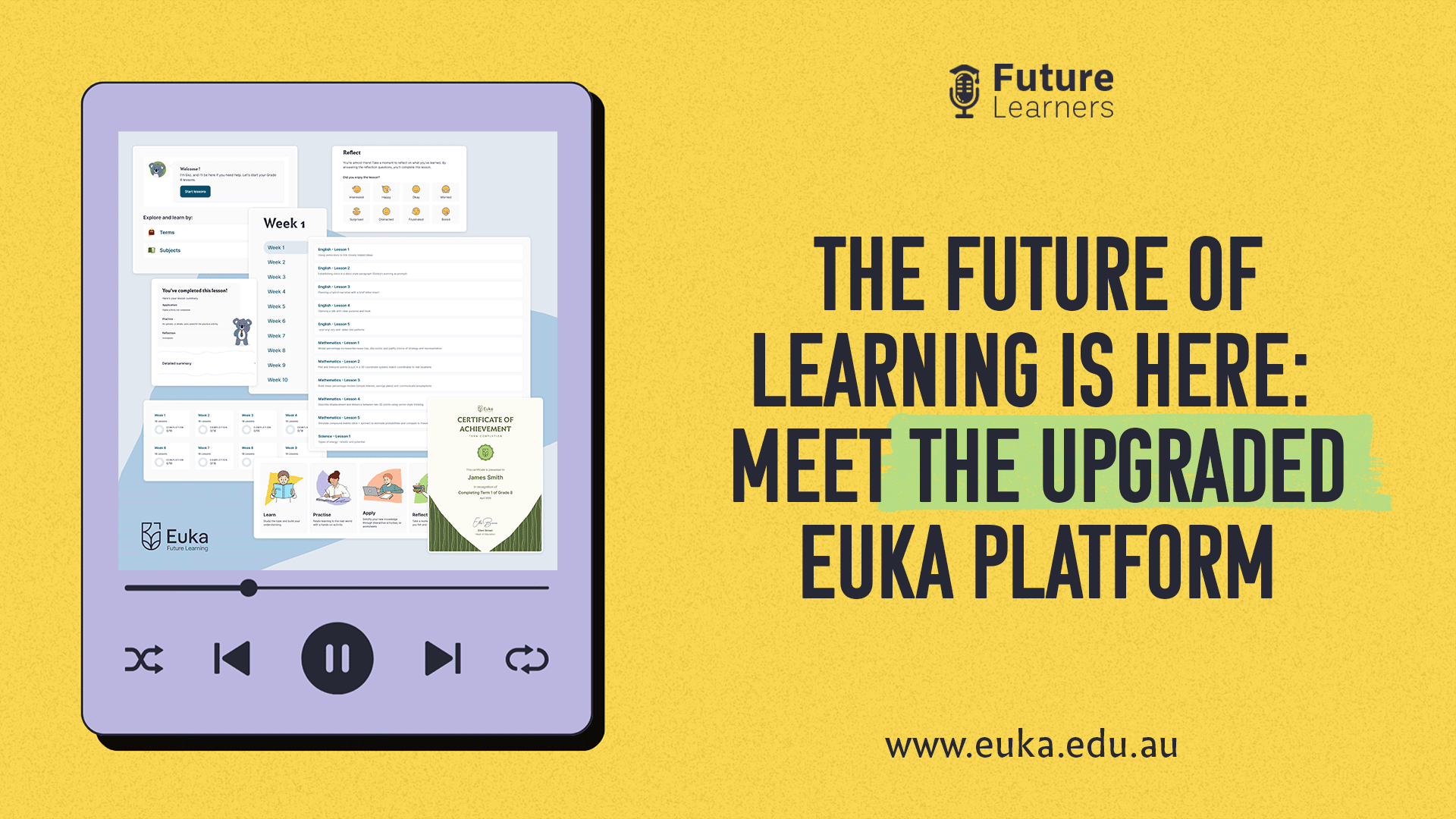
meet-the-upgraded-euka-learning-experience-episode-41

Episode 041

Meet the Upgraded Euka Learning Experience

Episode 040

The World Is Your Classroom: Travel Schooling with The Slow Road

Episode 039

Inside the NSW Homeschooling Audit: What It Means for Families

Episode 038

He earns 30K a year and homeschools

Episode 037

What you need to know about homeschooling in 2025

Episode 036

Is School Going “WOKE”?

Episode 035

The “True” Reasons families homeschool?

Episode 034

What you need to know about Registration and Reporting when Homeschooling

Episode 033

Travel Schooling: Everything you need to know

Episode 032

Raising young boys

Episode 031

Sleep! Are you and your kids getting enough?

Episode 030

Setting your pre-schooler up for success

Episode 029

Should children under 16 be banned from using social media?

Episode 028

Should children learn handwriting in this digital world?

Episode 027

The #1 Skill for children to learn

Episode 026

When should your child do work experience?

Episode 025

How to build a strong family unit

Episode 024

How to retain 90% of everything you learn!

Episode 023

Homeschooling with Dyslexia, ASD, and ADHD: A Mother’s Inspirational Journey

Episode 022

Unlock funding for homeschooling

Episode 021

Moving from School to Homeschooling in term 2

Episode 020

Homeschooling on a budget

Episode 019

The Importance of Raising Risk Takers

Episode 018

Empowering Girls: Building Confidence and Self-Esteem

Episode 017

3 Major Obstacles Parents Face when Homeschooling

Episode 016

The most important skill a child can learn

Episode 015

Cultivating Financial Literacy and Mindful Parenting

Episode 014

Physical and mental health tips for homeschooling families

Follow Euka on social platforms

Meet our hosts

Brett Campbell, CEO Euka Future Learning

Brett Campbell is a leader in education, serving as the CEO of Euka, an innovative company building the future of education. He’s a successful entrepreneur and author with a passion for lifelong learning. Beyond his professional achievements, Brett is a devoted family man and the host of the Future Learners Podcast, where he shares his ideas about education’s potential to empower people and create a brighter future.

Follow Brett on:

Ellen Brown, Founder Euka Future Learning

Ellen Brown is the founder and driving force behind Euka’s educational philosophy. With over 25 years of teaching experience, she designed Euka’s curriculum for grades 1-12, emphasizing individualized and practical learning. Her expertise is recognized by major media outlets, and she is frequently sought after for her insights on the future of education.