
Is Homeschooling Worth It? David’s Story of Homeschooling 3 Kids Over 8 Years | 48
Listen to this episode on

Watch this episode on

Listen to this episode on

About this episode
Is homeschooling worth it? It’s the question almost every parent on the fence keeps asking, and in this episode of the Future Learners podcast, Ellen Brown puts it to someone with eight years of answers. David Smith, a long-time Euka parent, talks through what it was really like to homeschool three children.
David’s family didn’t come to homeschooling looking for something better on paper. They came looking for a way out of a school where his eldest son, who is on the autism spectrum and has ADHD, was being bullied and wasn’t thriving.
David covers the whole journey: deciding to leave, telling the school, the first six to twelve months, keeping learning fluid rather than recreating school at home, discovering hidden strengths in subjects like maths, using AI as a patient tutor, and watching an eldest son who once “wasn’t working at all” move confidently into the workforce.
He also shares the small, practical things that worked for his family. A whiteboard maths race with his middle son. Letting the kids build their own timetable. Staying involved even after a long day at work.
Want to have a positive impact on thousands of families like you?
Leave us an audio question or share your homeschooling journey — anonymously if you like. Real questions from real families help us bring more value to every episode.


Key Points
David’s homeschooling journey, in brief:
- Why they started: persistent bullying and an eldest son on the autism spectrum with ADHD who wasn’t fitting in, with a year-three teacher warning he wouldn’t thrive at high school.
- Telling the school: the family quietly ran homeschooling in parallel at first, and found the school more supportive than they’d feared.
- The first six to twelve months: hidden strengths surfaced fast, including an undiscovered passion for maths, once the pressure of the classroom was gone.
- Keeping it fluid: letting the kids choose subjects and build their own timetable so homeschooling never felt like “school again.”
- AI and the internet as tools: using ChatGPT to break maths down step by step, and giving kids the freedom to research anything.
- From homeschool to the workforce: an eldest son who “nailed it” from day one in a customer-facing job, and a middle son mapping a pathway towards becoming a GP.
- Advice for parents on the fence: you know your kids better than anyone, so don’t leave the decision too long.
Practical ideas from David’s family:
- Use a whiteboard “who can solve it first” race to make maths feel like a game rather than a chore.
- Let a child keep going in a subject they love rather than holding them to one week at a time.
- Use “misdirection” when a subject stalls. Switch to PE, the park, or arts and crafts, then come back to it.
- Learn alongside your child when a subject scared you at school, instead of pretending to know it all.
Where the homeschooling journey started
Like a lot of families, David’s homeschooling journey didn’t begin with a plan. It began with a problem the school couldn’t solve. His eldest son, a “beautiful, beautiful kid” who is on the autism spectrum and has ADHD, was being bullied, wasn’t fitting in, and David was being called into the office a lot. (If that’s your family’s starting point too, our guide to homeschooling on the spectrum and special needs homeschooling walks through what it can look like.)
David describes a trap many parents fall into: assuming that because someone trained to be a teacher, they must be able to teach your child better than you can. When he searched online, most options overwhelmed him with “oodles and oodles of material” that wouldn’t work around his job and his wife’s day at home. Then the family found Complete Education Australia, which evolved into Euka, with the work laid out in manageable weekly chunks.
Once his son started working through it, David could see a change straight away. He was focussed and giving far more of himself than before.
| “The outcome was phenomenal… we could see that he was focussed, that he was actually giving a lot more of himself to his work.” — David Smith, Euka parent |
They applied for homeschool, and, as David puts it, “the rest, literally eight years later, here we are now.”
Telling the school
One of the most common worries for parents leaving mainstream school is how the school will react. David’s family were concerned enough that they ran homeschooling in parallel at first, without telling the school, worried that fighting the system would only invite roadblocks.
In the end, the school was more supportive than they expected. David believes that, deep down, the teachers had his son’s best interests at heart and could see this was something they couldn’t control.
The moment that made the decision for him was a teacher warning that his son, leaving year three, wouldn’t thrive at high school. It was the kind of comment that makes alarm bells ring and sends a parent into overdrive, asking what they can do to make sure their kids get a good education, and a safe one.
Ellen is careful to add that a supportive response isn’t a given for every family. But she reframes the underlying issue warmly: schools often do care, yet the system simply isn’t built for the individual child, with one teacher and 28 children in a classroom. Where a family can share their concerns and get a supportive response, she says, it’s a wonderful thing.
Making homeschooling fluid, not another school
The turning point in David’s story is a mindset shift. Homeschooling only worked once the family stopped trying to recreate school at home. The kids didn’t want to do maths every Monday, David explains, because if they knew maths was coming every Monday, it suddenly became almost like school again. So they let the children choose their subjects and build their own timetable.
Ellen connects this to a deliberate design choice in the Euka program. The lessons are grouped into weeks rather than pinned to named days. There are five maths lessons and five English lessons a week, with no days attached, precisely so families can flow with what suits their child.
David is honest that the first couple of weeks are an adjustment for everyone, and it’s easy to hit the panic button. His advice is to persevere, and to use what his wife calls “misdirection.” If maths isn’t working, go outside, do PE, or get the arts and crafts out, and come back to it later. Nothing, he says, is set in stone.
When maths stops being scary
Maths is the subject that scares parents most, and it’s where David’s story offers the most hope. At school, his eldest was “average, borderline on everything,” and sometimes below. At home, within weeks, a completely different picture emerged.
| “We found out he had a passion for maths that had gone undiscovered.” — David Smith |
Two things made the difference. The first was time and patience, without the classroom rushing on to the next thing.
The second was technology. Where a school lesson moves on whether or not a child understood it, AI will wait. David describes sitting down with ChatGPT and asking it to “hold you by the hand,” breaking things down very easily with no rush, especially where maths is concerned.
Ellen builds on this for parents who fear maths themselves. Missing one “little nugget” in maths snowballs, she explains, because maths needs its building blocks, which is why so many adults wrongly decide they’re “hopeless” at it.
Her encouragement is to model curiosity instead of certainty. Even saying to your child, “I actually don’t know that either, let’s have a look together,” is a fantastic lesson in itself.
David’s own family lived this out. His wife, who’d also been left behind in maths at school, learned alongside the kids. And for his middle son, the tool that worked best was low-tech: two whiteboards and a race to see who could solve the question first, because kids love the bragging rights. (For more hands-on ideas along these lines, see our 8 tips for homeschooling with ADHD.)
Fostering a love of learning
Beyond any single subject, what David values most is that homeschooling fostered a love of learning “everything and anything.” His middle son now gets on his laptop after school finishes and researches whatever he’s curious about, something David says would have been far harder to nurture in mainstream school.
That freedom produced one of the episode’s most charming stories. David’s middle son came up with his own theory of time travel off his own back, ran it past AI, and the AI gave the playful theory a name of its own: the Van Gogh paradox. It’s a fun anecdote rather than a scientific claim, but David’s point is serious. Homeschooling gives kids the freedom to look at a problem and go and research it themselves. Ellen loves the contrast with a classroom where the teacher is “the facilitator of all knowledge.” Seeing David’s eldest shift from average school reports to blossoming at home, without other kids asking “what are you learning that for?”, is, she says, remarkable.
David is equally clear that this doesn’t happen on autopilot. The program does a lot for you, but a parent still needs to play a part where they can. It isn’t as simple as handing kids the work and letting them do it all themselves.
From homeschool to the workforce
The proof of the journey, for David, is watching his eldest son move into the workforce. Given how his son started, “literally not working at all,” the family wondered how he’d cope with full days in a customer-facing role.
He exceeded everyone’s expectations. On day one, after his interview, the manager told David, “Yeah, he nailed it. I don’t know who you’re worried about.”
His son now has no issues with customer service or talking to anyone, and the job is giving him life experience and the means to fund whatever he chooses next, whether that’s university or study from home. His middle son, meanwhile, is mapping a pathway towards becoming a GP, and even asked AI to help plot the subjects and states involved.
Ellen reflects on why the transition went so smoothly. You can never change “sliding doors,” she says, but making the decision early gave David’s son all these years to build confidence, self-worth, and communication skills away from the situation he’d been in at school. That’s probably part of why he’s been able to adapt so nicely into the workplace.
Advice for parents on the fence
Asked what he’d say to a parent still deciding, David keeps it simple. No one knows a child better than their parent, so trust that and take the step.
| “You know your kids better than the educator. You’ve birthed them, you’ve raised them, you see them on a regular basis. You’ve got to go and just take that plunge.” — David Smith |
He frames the decision not as a leap out of school forever, but as a chance to see how a child responds to learning where their voice is heard and they’re not stuck at the back of the classroom. His strongest advice for families already living what his family lived through: don’t leave it too long.
David also points parents to community. His details are on the Euka Facebook group, where he’s happy to answer questions, and his kids have documented years of their work on the family’s Happy Homeschool page on Facebook, which he offers as a resource for parents unsure how far the program can take a child.
His closing message to parents who can is to be part of it, even if it’s just five or ten minutes after a long day’s work. Give it that time, have a look through, and be amazed.
Answered Questions
Real questions Australian parents ask about homeschooling children with additional needs and whether it’s worth the leap.
Yes. David’s eldest son is on the autism spectrum and has ADHD, and homeschooling gave the family a way to move him out of an environment where he was being bullied and wasn’t thriving. Within weeks at home, hidden strengths surfaced, including a passion for maths that had gone undiscovered. Years later, that same son has moved confidently into the workforce.
Ellen notes that schools often do care and have rules requiring action, but the system isn’t built for the individual child, so a supportive response isn’t a given. In David’s case, the family decided homeschooling was the safest course after a teacher warned his son wouldn’t thrive at high school. Ellen’s wider point is that bullying should be taken as seriously as it would be in any adult workplace.
David’s answer is to keep it fluid. His family found that scheduling maths every Monday made homeschooling feel like school again, so they let the kids choose subjects and help build their own timetable. When a subject stalls, his wife uses “misdirection,” switching to PE, the park, or arts and crafts, then returning to it later.
David uses AI as a patient tutor. Where a classroom moves on whether or not a child understood the lesson, he says you can sit down with ChatGPT and ask it to “hold you by the hand” and break a concept down step by step, with no rush. Ellen adds that parents who fear maths can ask AI to explain a topic “as though I was 10 years old,” and keep it simple until it clicks.
After eight years and three children, David’s biggest regret is not starting sooner. He wishes he’d known “it would have been this simple,” and his advice to parents on the fence is that no one knows a child better than their parent, so don’t leave the decision too long.
In David’s family, yes. His eldest son went from “literally not working at all” to a customer-facing job where, in the manager’s words, he “nailed it” from day one. Ellen suggests the years spent building confidence and communication skills away from a difficult school environment are part of why he adapted so well.
Why This Episode Matters
Most conversations about homeschooling stay theoretical. This one doesn’t. David Smith offers eight years of lived experience, including the hard parts: the doubts, the adjustment, and the fear that a child with autism and ADHD might not cope. Then he shows what became possible on the other side.
For any parent whose child is struggling in a system that can’t be built around the individual, David’s story is a reminder that a different path exists, that hidden strengths often surface once the pressure lifts, and that the hardest part is often simply deciding not to wait.
Your Family, Your Journey
David’s biggest regret was not starting sooner. He wishes he’d known “it would have been this simple.” If you’re on the fence, the hardest part is usually just knowing where to begin, and that’s exactly what our free Complete Guide to Confident Homeschooling is built to solve.
It’s a free online course that walks you through everything a new homeschooling parent needs to feel confident from day one: how to legally register, how to choose and structure a curriculum, how to build a daily rhythm that fits your family, how to support a child who learns differently, and how to know your child is progressing. No guesswork, no wading through “oodles and oodles of material,” just clear, step-by-step guidance from the team that has helped thousands of Australian families make the leap.
You don’t need to have it all figured out before you start. You just need a first step. Enrol in the free Complete Guide to Confident Homeschooling and give yourself the same head start David wishes he’d had eight years ago.
Other episodes
Episode 056
Planning Your Homeschool Week: How Many Days, Hours and Lessons You Need
Episode 055
NAPLAN Results 2026: Is Screen Time to Blame?
Episode 054
Raising mentally healthy kids: What a psychologist wants you to know
Episode 053
NSW 2026 draft homeschooling policy: What does it mean for families?
Episode 052
The Social and Academic Advantages of Homeschooling
Episode 051
You’re Not Alone: Finding Support on Your Homeschooling Journey
Episode 050
Do I need to be a teacher to homeschool?
Episode 049
The Real Benefits of Homeschooling: A Euka Graduate’s Honest Answer
Episode 048
Is Homeschooling Worth It? David’s Story of Homeschooling 3 Kids Over 8 Years
Episode 047
Preparing Your Children for the Real World: 6 Life Skills Homeschooling Can Teach
Episode 046
Starting Homeschooling Mid-Year in Grade 11 or 12: Senior Pathways Available at Euka
Episode 045
School Refusal in 2026: What It Really Is, and How to Help Your Child
Episode 044
Can I Start Homeschooling in the Middle of the School Year?
Episode 043
From School Bullying to Homeschooling Across 40 Countries as a Single Mum with 3 Daughters

Episode 042
How Young Athletes Train Full-Time Without Falling Behind in School
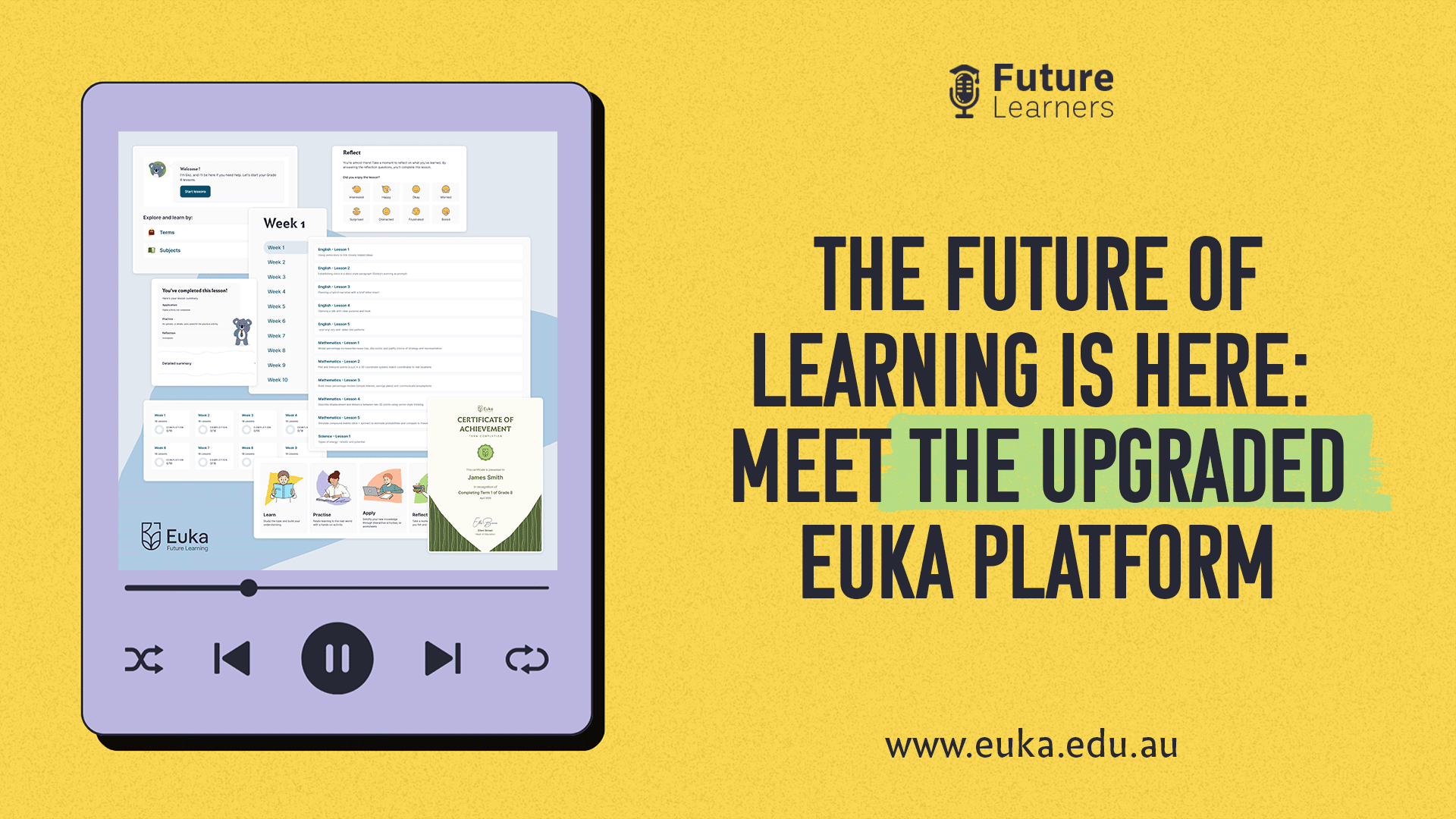
Episode 041
Meet the Upgraded Euka Learning Experience

Episode 040
The World Is Your Classroom: Travel Schooling with The Slow Road

Episode 039
Inside the NSW Homeschooling Audit: What It Means for Families

Episode 038
He earns 30K a year and homeschools

Episode 037
What you need to know about homeschooling in 2025

Episode 036
Is School Going “WOKE”?

Episode 035
The “True” Reasons families homeschool?

Episode 034
What you need to know about Registration and Reporting when Homeschooling

Episode 033
Travel Schooling: Everything you need to know

Episode 032
Raising young boys

Episode 031
Sleep! Are you and your kids getting enough?

Episode 030
Setting your pre-schooler up for success

Episode 029
Should children under 16 be banned from using social media?

Episode 028
Should children learn handwriting in this digital world?

Episode 027
The #1 Skill for children to learn

Episode 026
When should your child do work experience?

Episode 025
How to build a strong family unit

Episode 024
How to retain 90% of everything you learn!

Episode 023
Homeschooling with Dyslexia, ASD, and ADHD: A Mother’s Inspirational Journey

Episode 022
Unlock funding for homeschooling

Episode 021
Moving from School to Homeschooling in term 2
Follow Euka on social platforms


Meet our hosts

Brett Campbell, CEO Euka Future Learning
Brett Campbell is a leader in education, serving as the CEO of Euka, an innovative company building the future of education. He’s a successful entrepreneur and author with a passion for lifelong learning. Beyond his professional achievements, Brett is a devoted family man and the host of the Future Learners Podcast, where he shares his ideas about education’s potential to empower people and create a brighter future.
Follow Brett on:


Ellen Brown, Founder Euka Future Learning
Ellen Brown is the founder and driving force behind Euka’s educational philosophy. With over 25 years of teaching experience, she designed Euka’s curriculum for grades 1-12, emphasizing individualized and practical learning. Her expertise is recognized by major media outlets, and she is frequently sought after for her insights on the future of education.