Brett Campbell:
Welcome to another episode of the Future Learners podcast. My name is Brett Campbell. I’m the CEO and co-founder of Euka Future Learning, and as always, joined by my wonderful co-host, our co-founder and Head of Education, Ellen Brown. How are you, Ellen?
Ellen Brown:
Very well, thank you.
Brett Campbell:
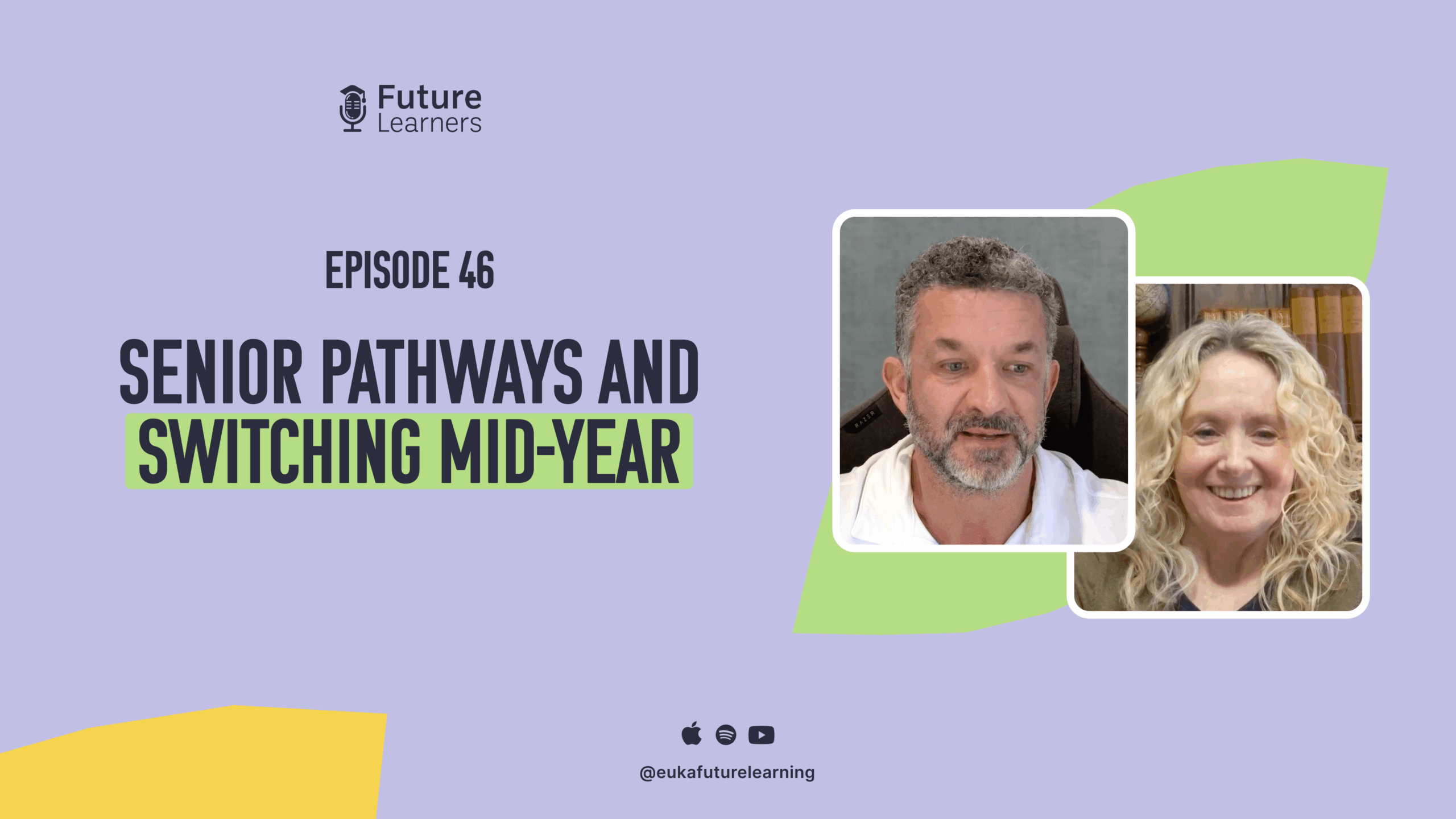
Excellent. Continuing on the theme of our last handful of podcasts, that’s the last three, we’re doing a bit of a grand tour right now on the topic of what is most important right now. As we’re sitting here recording this episode, we are nearing Term 3, we’re in the middle of the year. In a previous episode, we talked a little bit more broadly about what it takes and things you need to consider when switching mid-year and so forth. But as you know, we have a primary school, we have a secondary school, and we have senior school students. So there are nuances to each of those. And today what I want to do is I want to tackle more the conversation of those senior years. So for those students who are currently middle of the year, they’re almost approaching Term 3, this is where the start of the exams and a whole heap of pressure starts to occur. And as we know, and we talked about this again in previous episodes, that rise of anxiety, the rise of school refusal, etc. It’s a very, very common topic right now as it relates to those teenage years. So in this episode, we want to tackle predominantly, and we’ll put that focus and put the lens on around switching mid-year as a senior. What does that mean? And then of course we’ll talk about how does that then possibly affect their post years, meaning pathways on how they can proceed forward. So Ellen, let’s set the scene, and let’s talk about firstly Grade 11 and 12 as a cohort for Euka. Because again we are the only organisation right now that has a Grade 11 and 12 pathway for homeschooling students, which can lead to university pathways, future curriculum pathways, etc. So let’s give a bit of a high-level overview of the Grade 11 and 12 program itself at the moment.
Ellen Brown:
Absolutely. So we have two streams of Grade 11 and 12 students. One is a non-assessed stream where they’ll do the same subjects and have access to the same assessments, but they won’t actually get that feedback from our teaching team. So they won’t upload those. It’ll be completely up to them, a sort of help-yourself kind of journey. And then we have our assessed program, which is same subject, same assessments, but they have the opportunity of uploading those and getting that feedback. That’s very valuable in the learning experience. It’s really important to note that we have a full curriculum program. So all our students have to do English. That’s the only mandatory subject. And then they can choose five other subjects that they want to add to their learning as well. Just as a side note, the flexibility of homeschooling: we even have students sometimes who are doing exams in piano or ballet or something external, and that allows us to also give them credit for those things and one less subject that they need to do.
Brett Campbell:
Excellent. Let’s roll off a few of the subject choices that they get to choose from.
Ellen Brown:
Oh, we actually have 20 subjects. So we have a lot to choose from.
Brett Campbell:
History. Ellen, give us all 20. No, I’m kidding. Let’s write a few nuances, because I know there’s obviously the standard subjects. But then one beautiful thing about what we offer with Euka is that ability to choose a subject. It is the beautiful thing about if you embark on the homeschooling journey in these years, is that you might choose one of these subjects, you might get into it in a few weeks and go, you know what, this actually isn’t what I want to do. Can I please change? You just can’t do that in the schooling system as well. So beautiful inbuilt flexibility there. So let’s maybe share a better question. What are some of your favourite subjects that you’re proud that got incorporated into the program? I think it’s a good place.
Ellen Brown:
Yeah. Look, I guess my favourite subjects are the ones that I’ve had a bit to do with personally. My own kids have gone through Grade 11 and 12 with Euka, and I certainly loved when they did food technology because there was a lot of cooking going on, and that was great for me. But I also love some of the open-ended subjects like design technology. So one of my kids is really into AI and technology, and he was able to fuse together what he was doing in information technology or enterprise computing with Euka and design technology. So being able to blend things together, I find really wonderful for the students. Also business studies was very practical. So being a bit entrepreneurial, one of my sons really enjoyed doing business. Because part of that is not only looking at case studies, and that gave them the opportunity to call businesses that they were actually interested in and ask questions, which then led to work experience. So the practicality of the Euka subjects, even if it’s business studies, is really good. Modern history is also really alive with things to do that are quite practical and interesting, certainly, because what Euka does is tries to say, why is this important now? And links to things that are happening in the world now. So modern history was also one of the favourites in this house as well.
Brett Campbell:
Yeah, great. So again, just to recap, what Ellen said is we currently offer two pathways: the assessed pathway and the non-assessed pathway. Ellen, why would someone choose the assessed pathway over the non-assessed pathway? If we can break apart the differences there.
Ellen Brown:
Yeah. Look, most students do choose the assessed pathway, not because they want to go off to university but because feedback is really helpful. Now when you’re at school, sometimes feedback feels like criticism, and often is, oh, you’ve got 47 out of 100, you should have done this. The Euka feedback that is received for the assessments is part of the learning journey. So when they do an assessment and they upload that, they’ll get feedback with a mark and it’ll say, these are the areas where we can see your strengths, these are the areas where you could improve. And then the onus is on the students. So then it’s up to them to say, actually, I really would like to do better than this, or I really can see the changes that I need in my learning. And they can actually redo their assessment and upload it again to be marked again. Because our idea is that assessment shouldn’t be a judgment right now on how you learn. It should be part of the learning process. So that means that a student’s final results are up to the student, not up to what they know on a particular day. So most of our students will pick the assessed pathway because the feedback is so valuable. The other thing is that when you finish the end of Grade 12, you get an academic transcript that’s useful into anything now or in the future. It is not uncommon to be in Grade 11 and 12 and not know what you want to do. It’s not uncommon that a year out of school you think, you know what, actually I would have liked to study this, or I would have liked to get into this, and an academic transcript is required at that point. So that is a real shame when you get to the end and you don’t have that. So a lot of students do it because you never know. And it keeps the door open for future things, whether that’s uni, whether it’s TAFE, whether it’s a vocational college. Lots of options that that opens the door to.
Brett Campbell:
Yeah. And look, feedback is how we as human beings progress and orient ourselves in the world. So absolutely. So in relationship to the current status, we’re nearing Term 3, and well, that’s the next term. So the next cab off the rank. And what can happen with a lot of students is, and again it’ll be slightly different for Grade 11 versus 12, but let’s just assume right now Grade 12. Because I know this can almost get thrown in the bucket of, oh well, you’ve already, you’re halfway through, you might as well finish the year. So let’s talk to that specific cohort where we’re nearing Term 3. Maybe the start of this year hasn’t gone the greatest, or maybe just haven’t enjoyed it, or maybe just don’t want to finish it in that schooling environment, whatever the reasons. What’s your feedback to those parents and students considering that? Well, I’m nearing Term 3, which is essentially now I’m going to start going through all these exams and even the higher-pressure stakes, etc. versus what would happen if they come to Euka, because we actually don’t do exams. That’s one of our unique differences, is we remove all of that pressure and we don’t have exams. So it’s like, what would they do?
Ellen Brown:
Yeah. So we actually are seeing more and more of this. As you say, the stakes are getting higher, the pressure is turning on. There’s kids that have been unwell or have had family situations that have happened, that means that Grade 12 hasn’t gone according to plan. And it’s a very stressful time where relationships, even between students, there are frictions happening everywhere. So we do find a lot of students get to this point and they’re starting to withdraw, and parents are saying, what’s going on, how can I help them? If they come out of Grade 12 now in third term in school, they really only got this one more term and then they’re finished. Then they get the results. And the decision that they can make for their future is based on the results that have come from a very difficult time. We have students that start with us in Term 3. And the good news is that whatever they’ve done in Term 1 and 2 at school can be brought forward in that they’ve got their knowledge. We don’t take their marks. So if they’ve really struggled and they’ve had some problems, or they didn’t even get the results through because they haven’t been at school in Term 1 or 2, they can start with us in Term 3. We can make sure that they have enough opportunity to have assessments and feedback and things that they need to finish with a full academic transcript at the end of the year. So they’re still completing their learning with peers, and they still have the same opportunity as if they had done very well in Grade 12 at school. So that’s where Grade 12 would be if they decided now to move over.
Brett Campbell:
Yeah, excellent. So again, the reason why I really want to press upon this is, it’s a double-edged sword. Sometimes we can find ourselves in situations where it’s like, oh, I’ll just stick it out and I’ll just push through. And it’s also okay sometimes to not adopt that mentality of, oh, I’ve just got to, to talk to my own sort of language. As I was growing up, I heard a lot as a young man, as a young boy, just harden up and get through it and figure it out and so forth. But the beauty is there are options there. And again, we have many students in this current timeline joining, starting Grade 11, starting Grade 12, etc., or starting all grades to be fair. But as it relates to that grade, some of what you said, Ellen, resonated a little bit earlier: there’s pressure around feeling like you need to know what you want to do. I mean, I sit here and I’m a fully grown man, I’ve got children, I’ve got family and all this stuff. And I’m like, sometimes I wonder to myself, okay, what do I want to do when I grow up? I think it’s something that, and now being in this landscape of such significant change in society, opportunities that were never around, they’re going to start presenting themselves in the coming months and years and so forth. And the best thing that we would ever say is prepare yourself. If you don’t know right now what you really want to do, don’t worry. I don’t think many people do, to be fair. Or you might be going through a season of, I want to do this, I want to do that. My daughter the other day, five years old, she goes, yeah, I want to be a policeman. I’m like, oh, I remember when I wanted to be a policeman too, you know? It’s like, just foster the curiosity around that thing and just know that you don’t need to put any extra pressure on yourself. But one of the beautiful things I’ll just double-tap on again is when you come to Euka in Grade 11 or 12 and you’re choosing your subjects, we have some students that might come in and they might swap two or three subjects. And we have the ability for you to be able to look into that. And we’ve got ways on how that can happen. And you know what it’s like? It’s like reading a book. I now have a philosophy where when I started reading books and I got into this world of educating myself, I was on my own pathway of, okay, I heard someone talk about that book, I’m going to go and read it. I’d start the book, and I knew in the first chapter that I’m like, I’m not enjoying this, but I painfully put myself through reading the whole book. Now, my entire philosophy of it changes: if I’m not grabbed in the summary of the book, then I won’t even read it. Or I’ll start the first chapter and halfway through it I’m just like, oh no, put the book on the shelf. It’s okay. And the reason why I’m labouring on about this is, I don’t think it’s talked about enough. It is okay to start something and actually stop it. In fact, I would recommend it in some cases. Now, if that’s your default and you’ve got a library full of books and you’ve read one page of each, there’s probably more of a different consideration you need to have. So Ellen, if we move on, we’ve got Grade 11, Grade 12 students, senior students considering the switch. And they’ve got the Grade 12, we’ve got the Term 3, they don’t really know what they’re doing. Let’s talk about the pathway for a student who is currently at school and they have aspirations for university. Let’s talk about our pathway program, what that looks like and what access they have available to be able to maximise their outcomes with that.
Ellen Brown:
I’m so excited to talk about this. I’m excited about it because I can see what a huge bonus it is for students who are studying with Euka. So we have a partnership with over 100 universities across 18 countries. There’s all these different places where you can go and study, as well as every state around Australia. So students who study with us, what we’ve done is we’ve worked very hard with the university colleges that are attached to the universities, and we’ve had their academic team go through our program and say, yes, this is an equivalent to Grade 12. The younger students, we’ve had them going through for a couple of years now. So it’s taken some time for the university colleges to go, yeah, we know the calibre of the students coming out of Euka. They’re self-motivated, they’re driven. They know how to study on their own. They don’t need a teacher chasing them up all the time. They’ve learned all these really important skills, like the soft skills that are needed to do very well in university. And they do. So what happens is that the students will move into and do, within their first year of their degree, they’ll do a diploma. Now, that means that if they got to the end of their first year and they said, you know what, I actually don’t think I want to go on and do my full degree, they still finish with a diploma that they can use in any way, as far as employment and things like that. So it’s better than a Grade 12 certificate. A diploma is higher than a Cert III or Cert IV. And they get that in that first year. Now, if you were straight out of Grade 12, did your ATAR, went into uni and you did your first year there in the main course, and you decide not to continue, you finish with nothing but a debt. So that’s one huge bonus of our pathway. So you do your first year as a diploma at the university in the college section. You’re still sitting in the same lecture rooms and things like that, but you also get a few other bonuses. You get extra academic support. So you’ve got smaller tutorial groups. You’ve got someone you can go to and ask advice from. And there’s all these different features in the college that you just don’t get when you’re in the first year. And then when you finish your diploma, you walk straight into, so these are all guaranteed steps, straight into your second year, your degree. So what they actually say is, you’re not picking a degree when you’re going on this Euka pathway, you’re actually picking a route. And the reason they say that is, what you’re going through first year, if you’re doing business studies, you know you want to do something in business but you don’t know, do I want to major in marketing, do I want to major in finance, what do I want to do? I don’t know. And you would not believe how many students in first year uni go, oh, I’ve picked the wrong major, I’ve done the wrong, you know. Well, when you’re doing this through the university pathway that we’ve got for you, you make that decision at the end of first year, which majors to go into. You don’t have to decide before you even start. So that’s another big bonus. But like I said, every state of Australia is covered. We’ve got universities everywhere in Australia. And if you wanted to study overseas, we have that option for you as well.
Brett Campbell:
Yeah, excellent. I want to just highlight again, because this is something that we see quite often as a fear from parents, is that there’s this assumption that by your child not having an ATAR or an HSC, that it is perceived as basically a closed door to any competitive uni courses. So just again, to highlight that: it’s actually the opposite. We can remove the stress from the ATAR and HSC. And we’re not saying there’s no value in doing that if that’s a pathway you want to do. However, it is not a requirement. And there actually is, I’m on the path of least resistance type of guy, and for me this is such a beautiful path of least resistance if any senior students are looking to, or even considering, moving forward into that university pathway component as well. So I love that at the end of the first year, you get to decide on your major, versus going on. It’s already pressure enough considering only university. Let’s get in there and have a little bit of a play around, so to speak, and then we can make the decision. So that’s fantastic.
Brett Campbell:
Now I want to circle back on and talk about one thing that is in relation to Grade 12 students, where there’s this concept of free terms. So with Euka, the program itself is, again, there’s lots of flexibility. We have some students finish it in two terms, some finish, take the four terms to complete the three terms, etc. So let’s talk about that structure of the three-term structure and then what we’d recommend in that timeline of where Term 4 would generally sit.
Ellen Brown:
Yes, sure. So in Grade 11 we do four terms. You’ll find often in mainstream school they’ll do three terms of Grade 11, and in the fourth term of Grade 11 they start Grade 12 work. And then they get to Grade 12 and they do three terms. What we do is we really take the time in Grade 11. Grade 11 has four terms and it is Grade 11 content, because that’s the foundation, the building blocks for Grade 12. The reason that even schools finish in three terms is because they have that space for exams. And then the university applications all pile into that before the end of the year as well, where they need their results back so they can put in their applications. Now, one of the huge bonuses about the pathway with Euka is that we’re actually doing those applications for our students. So you don’t have to finish with Euka and then try and solve the world and be contacting different universities and things like that. Euka does that part for you. So that’s a big plus. But when they’re doing Grade 12, they have Term 1, 2 and 3. It’s spaced out the same as all other grade levels. And then they will finish early at the end of Grade 12. And like you said, Brett, just because they finish, like the school date finishes, Euka just works to school dates. So some might continue on for another month or two to finish off how they want. They might look back at assignments that they did in Term 1 and say, I really want to improve that one, I’m going to reload that one. So there’s a few things that happen in that last term where students just get their results exactly where they want them and finish off just when they want to, because assessments don’t have due dates on them. With Euka, assessments are uploaded when they’re ready, not when all of a sudden the teacher is ready to mark them.
Brett Campbell:
Yeah. And I think a great thing about this flexibility in relationship to the terms, of doing three terms of core work, so to speak, is that in that fourth term, and I air-quote that because again, whilst Euka doesn’t, to your point, operate exactly on you have to be in the portal on this date because this is when school’s going back, like some families like to operate just in accordance to that, and that works, so that’s totally fine, but what it also does is it leaves breathing room. And I don’t think breathing room is talked about enough in regards to its absolute benefit. Meaning, we often as humans compact everything we possibly can into every minute of the day. I mean, my entire life is organised by a calendar. I could tell you what I’m doing next week, Tuesday at 7 p.m., and if it’s not in my calendar, I’m going to be sleeping. But even to the point where I program when I’m aiming to go to bed for these reasons or these things. Now, again, I’m probably a little bit on the spectrum when it comes to making sure we want to get these things dialled in, simply because I do have lots of different responsibilities and so many things, and I couldn’t function personally without having some structure. However, just because I have structure, I have a number of areas inside of my calendar per se, and my days and my weeks, that’s blocked out for absolutely nothing. Meaning it is a, I’m having a meeting with myself to do nothing, and whatever may fill that space could be something that helps moving forward. Meaning, how does that even relate to Grade 12 students? Is that you come into that fourth term, you may have a real strong ambition to get into the workforce. So for me, when I was 11 years old, I was door-knocking, wanting to do jobs. I’m an entrepreneur at heart. I just love doing and building things and being involved in the world of commerce. And so for me, I would have after-school jobs, I’d have before-school jobs, I’d do paper runs. And any time I could work, I was trying to find an opportunity. This provides that sort of breathing space as well, for those type of children who want to go and explore different opportunities. You might be interested in being a mechanic. And in that term you go and get to work at a mechanic shop for a month or so and you can do a little internship, or you can just do some work experience. And you might, through that experience, go, actually, I really don’t like this, I thought this thing was something different than what it was. So it allows you to explore those things if you are interested in that working component. Now, if you’re not so much interested in the work experience, you might have a deep passion for photography, and you might set yourself some extracurricular work to go and explore photography further, go and look into different cameras and different shots and this and that. And through that exploration, you might find that that might not be what you want to explore further. However, you might also go, oh my gosh, this is exactly what I want to do, which gives you more certainty and a little bit more comfort around what happens next. As you’re considering possible university pathways or other vocational pathways or other job pathways as well. So I think that’s something that I want to make sure we touch on and really highlight, the benefit of having that breathing space. So you’ve seen it a lot, and obviously with your children going through Grade 11 and 12, and the students we’ve already had go through Grade 11 and 12. Share with me your thoughts around, and share with the listener, your thoughts and benefits that you’ve seen from that being a component.
Ellen Brown:
Yeah, totally agree that having that space to try things has been absolutely invaluable. I know in school you’re lucky to get one week’s work experience, and it’s usually with your uncle so-and-so or someone next door. But we have the younger students do a lot of work experience by choice. One of the things that can sometimes hold parents up there is, you know, what happens with insurance? Because it’s the first question in this day and age that a work site asks, and usually that’s covered by school. You’ll be very, very glad to know there’s very simple work experience insurance that you can get hold of for your child that will cover them for a three-month period. So that’s a perfect term’s worth of work experience. There’s a couple of companies that offer that. It’s less than $100 for the three months, and that will cover your child if they want to do mechanics or if they want to go and do something else. So trying things out in that fourth term is wonderful. And look, I always have said to my kids, learning is valuable. So sometimes I feel like we live in a world where everything seems to have a price tag. And they said, what, you’re doing something for free? You’re doing something for free, that’s not useful. And I’m the total opposite to that. I say to my kids, you know what, it costs a lot of money to go to university and study or to learn things. If you have the opportunity to volunteer somewhere and learn some skills, the value in that is beyond money, because you’re making wonderful connections and you’re gaining really fantastic skills. So I really encourage our senior students in Grade 11 and 12 to get out there and do some volunteering. People love to see it, and there isn’t a door that has not opened for my own children when they just simply sent off an email saying, this is what I’m interested in doing.
Brett Campbell:
And to that point, Ellen, I’m a massive advocate of that. And it’s very rare in this day and age. When I was younger, I would go and ask for jobs everywhere and I said I’d do it for free. I got pushback, people going, oh no, no, no, when I was asking to do it for free almost. But to your point, the world in which we live in now, and as business owners ourselves, is we value the work ethic of someone. Because you don’t go to university, you don’t go to school and learn subjects such as your work ethic. That’s something that’s a behaviour that’s built internally, that creates habits that produce you as a weapon into the world. I can tell you right now, with all this AI technology and all these things that are happening, the thing that I know, and a lot of friends in business who we hire, you know, thousands of people, one of the biggest attributes that they look for and I look for is the work ethic, your willingness to roll up your sleeves, get involved, and let your actions determine your outcomes. Show your worth first. We live in a world where that is sort of a rarity now. So I’m glad you touched on that, because any high school students listening to this, I assure you it’s an unfair advantage right now if you were to put your hand up and just reach out to people. And now you can do it on social media, you don’t even need to go door-knocking, you can save yourself some energy there. But even that is such a huge opportunity. But also prepare yourself for lots of no’s. Like just because you ask, you’re like, oh, Brett said it on the podcast and I got denied by this one place. Look, you might need to go to 20 jobs. And here’s another thing that I’d highlight on this: really challenge yourself to go to a job that you don’t really see yourself doing. It’s very nuanced, because you’re like, well, why would I do that? Because you’re going to learn so much about yourself, and you’re probably going to learn things through the process of being in a business or doing certain work, that you might actually get a different perspective of. And it’s about being able to put yourself in uncomfortable places that doesn’t feel right, because you might be going, oh, I want to be a builder. So like, cool, you want to be a builder. Now, I assure you, by you going up to a builder and saying, hey, I’d like to come and build houses with you, the first job you’re going to get is you’re going to be on the broom, and you’re going to be picking up timber and stacking it. That’s all I ever did in my first year even of my apprenticeship. I was a broom technician. I wasn’t a cabinet maker. I was good at sweeping the floor, though. But it’s through those circumstances and experiences where you learn so much about yourself. You learn what you can tolerate, what you won’t tolerate. Because everyone goes in with a preconceived idea of what they think something is, or what they think something should be, or what we think we’re entitled to, and this is how I should get x, y, z. And now I’m not saying we shouldn’t go into it with an overarching understanding of that, but it’s such a missed opportunity for students as you’re preparing yourself for the big, big, wide world. As you’re preparing yourself for the later years, whether it’s university, vocational studies, the workforce, or you might even take a gap year and go travel around the world, who knows? By putting yourself and doing things in those early years, it’s easy because, as you get older, decisions become a little bit more important, because you might not have the flexibility like you do when you’re younger, to jump from a few things, get out there and try as many things as you possibly can. So Ellen, I’m going to fire a couple of quick questions at you from audience members. I know we have touched on it in some cases, but we can probably answer them quite directly. So this one here is from Angie, and she asked, does Euka provide a report card or transcript for Grade 11 to 12 students?
Ellen Brown:
Yes, absolutely. So when you are with the assessed program, it’s an academic transcript that will have your grades on there. Remember, your grades are up to you when it comes to the student and how much effort they want to put in. If they want great grades, they’ll upload and re-upload some of their assignments as they’re learning. If you are in the non-assessed program, you’ll get a completion certificate. So yes, you’ve done Grade 11 and 12. And that’ll be enough because obviously you have chosen not to get an academic transcript.
Brett Campbell:
This question here from Sandra says, can my child get into university after completing Grade 12 with Euka?
Ellen Brown:
Oh yes, absolutely. As we said, we talked about that already, that we have lots of guaranteed entry. And when we say guaranteed entry, we can guarantee that because the university colleges have looked at our program and said, if your students reach a benchmark, now that means there’s a certain academic benchmark. You can’t just do Grade 12 and not do any work and say, now I’m guaranteed entry. You have to meet the benchmarks. Like it might be a 70% mark, for example, in particular subjects. But remember, you have control over the marks that you get. So making sure that we’re working with you to get where you want to go. So yes, we guarantee that students who are keen to get into uni are able to do that anywhere in the country, or even if they want to go study in the US, they can do that too.
Brett Campbell:
Excellent. All right. Well, with that said, Ellen, that’s a wrap on this episode. I will just hand to you if there’s anything else that you would like to share in relationship to the senior pathway, switching mid-year, etc., that we haven’t covered already.
Ellen Brown:
Probably just reiterating the fact that coming out of a bad experience in Grade 11 and 12 at school does not change the fact that you can have a very positive experience, and any opportunities that would have been coming out of school, you still have coming out of homeschooling. And one last thing: if you’ve done your Grade 11 and you didn’t like those subjects, something that you can do in homeschooling that you cannot do in school is you can change your subjects for Grade 12. You don’t have to continue on. In school they are a two-year course, in homeschooling they’re a one-year course, so you can start fresh if you want to.
Brett Campbell:
Excellent. All right. Well, thank you very much. Thank you for tuning into this episode. And if you’ve gotten value, please give us a thumbs up, write us a review. And if you have any questions that you’d like to have shared on future episodes, please send them in, and we’ll see you on the next episode.