[00:00] Brett Campbell: Once upon a time, NAPLAN was done on pen and paper. Right, 2 to 3 years has been digitised and now results are declining.
[00:07] Ellen Brown: Numeracy rates. So how well they’re doing in maths it’s actually increased but we haven’t heard about that.
[00:13] Brett Campbell: A petition at 25,000 signatures in two weeks already. Effectively they’ve got five demands. Is device-free primary schools, including homework, handwriting restored as a core priority.
[00:24] Ellen Brown: I would say not all screen time is equal.
[00:28] Brett Campbell: Schools are now considering banning arguably the number one technological advancement that we have ever seen in our lifetime.
[00:39] Narrator: Welcome to the Future Learners podcast, the home for parents and students thriving with homeschooling in Australia. Your hosts, Brett Campbell and Ellen Brown, are the co-founders of Euka Future Learning, Australia’s largest online K-12 homeschooling provider. Join them as they guide you from uncertainty to complete confidence. Let’s get into it.
[01:01] Brett Campbell: Hello and welcome to another episode of the Future Learners Podcast. I am your host, Brett Campbell, co-founder and CEO of Euka, and I’m joined by my amazing co-host and co-founder, as always, the one and only, the wonderful, the magnificent. Ellen Brown. How are you doing, Ellen?
[01:18] Ellen Brown: Very well, thank you. Brett.
[01:20] Brett Campbell: Excellent. Today’s topic. Another juicy one that we have. A few things mixed in. One here. It’s going to be like a recipe of a beautiful chocolate cake or a very, very bland, non-self rising, chocolate cake. So we’ll see where we end up. All delicious, no matter how you how however it’s presented. But jokes aside, we’re going to be talking about, NAPLAN results. So NAPLAN results, and not just NAPLAN results. What has, I guess, been sparked from that? Right. We’re going to talk about NAPLAN results and how it has sparked this call for a digital detox for our children.
So lots to talk about. There are lots of opinions. I know you have some strong thoughts. I’ve definitely got some strong thoughts as well, not only from an education perspective, but from a parent perspective we have talked about in future past episodes. That’d be interesting if we’d talked about it in a future episode, wouldn’t it? For the past episodes, we have talked about, you know, the social media ban, for 16 year olds here in Australia. So there’s, there’s some sort of carry on effects here because that leads into screen time and a whole heap of other things.
But, really interested, first of all, to get your take straight out of the bat, Ellen, as it relates to NAPLAN. And look, not everyone knows what NAPLAN is. If we can just sort of give a brief premise of what is NAPLAN, what’s the study showing? And let’s, let’s get our engine started.
[02:51] Ellen Brown: Absolutely. Well, NAPLAN is, testing that we do across the country so that we can kind of judge one area with like people at the same age and have a look at where their learning is. And the handy part, I suppose, is that we can compare, you know, in a broad view where students are at this year compared to where they should have been or where they were in the past, and, and make some plans about, you know, make some decisions based on that. So they do NAPLAN in grades three, five, seven and nine.
And in those years we get to really get a snapshot of the learning. And that’s what it is. Up until recently, that’s been a pen and paper test. And we’ll talk about that because only in the last 2 or 3 years have they actually also provided that as an online test.
[03:37] Brett Campbell: So anytime there’s a problem, you know, whether it’s in business or life or in anything, you know myself I sort of pride myself on being a problem solver, which again I joke as to why so many problems land on my doorstep. But again, whenever there’s a problem And I’m going to frame this NAPLAN current situation as the problem. And the problem stated as in the NAPLAN results itself, shows that 1 in 3 students below literacy and numeracy benchmarks. So what’s happened is, to your point, once upon a time, NAPLAN was done on pen and paper.
The last two years it’s been digitised, right? 2 to 3 years has been digitised and now results are declining and it’s easier to do. Cause and effect. You’re like, oh, it used to be pen and paper. So the results must be predicated on them doing it on a computer or on screens, etc. So there’s there’s been this uproar of let’s call it blame. Right? And I totally understand that because as humans, we want to be able to try and have an answer to something straight away like this happens.
So it must mean this, right? And that allows us as humans just to move on and continue on with life without stressing or overthinking about things. Myself, I probably take the latter approach and I don’t. I’m looking at things to try and get as close to the truth as I possibly can. Right. So what has happened here is the result of decline. And we can get into a little bit of that. And but it’s created an uproar, to the point where a petition is being started.
On August the 10th, a petition had 25,000 signatures in two weeks already. Which was run by Heads Up Alliance, I believe it’s called and effectively they’ve got five demands that they are stipulating as part of this petition. Is device free primary schools, including homework, handwriting restored as a core priority, end routine one-to-one laptops in high school and EdTech independently proven before use. That one makes sense. No generative AI in school learning at all. So they’re they’re basically trying to throw the kitchen sink at this as the ultimate solution to a decline in a test that may or may not be directly related to, and I will state this.
There is currently no evidence directly tying computer use or screen time to the decline in NAPLAN. And I’ll also go out on record and say I’m not here. First of all, to try and defend computer use. Whether I do or I don’t like it, that’s irrelevant. What I’m stipulating is that there’s an enormous amount of noise currently right now where there’s this conflating of two situations, there’s the NAPLAN decline results, and then there is this screen time. So let’s let’s tackle from there. Ellen, where do you want to go?
[06:31] Ellen Brown: Yeah. Look, I wanted to just look back at this whole idea of NAPLAN results. Firstly, it’s not a surprise that the media jumps on any movement at all, and especially if it’s negative, because that provides a great headline if you really dig down in the numbers the numeracy rates. So how well they’re doing in maths is actually increased. But we haven’t heard about that. But what we’ve heard about is that the reading levels, the literacy levels have dropped. So that’s an important thing too. But I guess that just sort of it always comes back to that thing.
As soon as you see these big headlines and before you get the big stress out, you have to stop and go, what is it actually? Let’s look closely at that. And like you said, Brett, even the fact that they’re saying in the last couple of years these literacy results have really dropped. In the last couple of years, we’ve used computers to do the tests on. So it’s a big leap from. You know, let’s stop having any computer usage to how about we look at what’s happening during the test itself.
You know, we have seen I’m pretty sure it’s last year. We’ve seen schools that weren’t able to connect. They had kids halfway through tests and the test dropped out, like all the computer tech problems involved with getting every child across the country onto a computer to do a test at the same time. We can’t even do that for voting, let alone for kids doing this testing and then trying to make decisions based on something that we already can see technologically isn’t working very well. Yeah. It’s a big leap to start making big decisions based on this one test on these three days.
[08:15] Brett Campbell: Yeah. And it’s and it’s very hard because, you know, again, I always try and put myself in this situation or in the position of those who are at the will of making decisions in how this is shaped. Right? As you know, I could only imagine what it would be like. Actually, I don’t even want to imagine what it would be like to be a politician, to be honest. It’s going to be a unique individual to tackle that. But the desire to try and create change or to be showing that you are doing something about something creates what I call the pendulum effect.
Right. So this is happening now. We need to go and do this to make it seem like we’re fixing something. And we’re just going to go from one extreme all the way to the other versus something like this. There really is no immediate solution, right? There is no immediate solution to how do we fix NAPLAN. It’s not like, oh, I wonder if we remove the screens from the classes, that we will see an uplift in our literacy next year, right. It’s it’s a it’s really is a multi-year approach to a number of things.
Right. Something that you said as well is, you know, you want to start in the backyard of comparing apples to apples, right? Is how the environment of the classroom has been in the last 2 or 3 years. Like you want to you don’t want to just go. There’s one indicator which is NAPLAN. That’s it. It’s like what other environments, what other things are happening socially? What other things are happening environmentally that could also play a part in that as well? Right. There’s no it’s not news that students, kids now have more distractions than you could even consider.
Right. When I was a kid, I got home from school. I’d be out kicking the football for most of the afternoon until it was dark. And I got the call that dinner was on the table. Right. Pretty simple life. Now kids can and this does a lot of it does stem into technology as well. Right. Because we’re talking about schools are now considering banning arguably the number one technological advancement that we have ever seen in our lifetimes that can, if used correctly, under the right conditions, could exponentially increase your ability to learn faster, better, retain more information now.
I could debate that till the sun comes down. Right. That’s just that’s just I believe a core truth. However, also on the other side of that, you know, as Spider-Man says, I’ll quote Spider-Man, you know, with great power comes great responsibility, right? These tools need to be governed and managed and worked extremely well where I think. And I’m going to throw another curveball. And I’d love to get your thoughts on where I believe the effects of screen time may, if it is impacting students, is when they walk out of that schoolyard and they are then exposed to whatever technology is from 3 pm in the afternoon to 9 am the next morning.
Right. I drove past the school the other day at about 3 pm and this just not. It wasn’t a surprise to me, but it made my heart do a backflip. It was all the you could see secondary senior students all standing out waiting to catch on the bus. There’s about 50 of them, and I could not find a student who didn’t have a phone with their head down looking into the phone. Right. I was just like, oh my gosh, like it just reminded me because it’s so easy to go, oh yeah, it’s bad.
And then you’re like, okay, what’s the next thing like? But we really need to look at the totality of this and banning arguably a device. It’s like if you were a mechanic, imagine being a mechanic before an electric drill or an air drill was around. You’d be using a crescent or a spanner to try and get the wheel nut off. They’re basically saying, let’s ban electric drills to make your to be able to help you learn better and faster and more efficiently. Right. And I personally think and give me your thoughts on this that and there’s not one answer.
It’s not ban devices forever outside of school. But it’s like I personally think and I’m a big proponent on this. And a lot of parents sort of don’t really like me saying this, but I’ll say it anyway is the parents must take personal responsibility of what’s happening to your child from a device perspective, from that 3 pm to that 9 am, right? One other thing as well, I’ll say, because this again, this is a passionate topic to me because it comes back to everyone wants to throw out the thing.
And AI is something we’re going to talk about as well, like, because there’s a part of it is people want to ban AI and it’s like, why would you try and ban the most advanced, best technology that we’ve ever had that could help humanity because you don’t truly understand it or you don’t truly understand how to use it to the best ability. So I’ll stop there, or else I’ll just keep going on. Ellen, give me your thoughts about that.
[13:43] Ellen Brown: Oh, look, it does come down to passive consumption, doesn’t it? Like, you know, it’s not, you know, the technology they’re using. It’s how they’re using it. So there is certainly a place and a really important place and many studies that have shown that being able to use technology to be able to research, to make spreadsheets, to save information and files, all those things are absolutely vital things to be able to know. And our kids need that moving into the workplace. They need that in their future.
But it’s that passive consumption. You can’t you can’t think to yourself, and I think we’re all to blame for this. Like I’ve always sort of thought, because they’re growing up with technology, that somehow that means that they’re technologically literate. But that’s not necessarily the case. Just because they’re spending time on a screen doesn’t mean that they’re actually gaining any skills that are useful. So it’s more than just banning something. It’s that whole, like you said about the pendulum. It’s more about saying, what skills do we need them to know that technology allows and helps us to be able to deliver.
And then, you know, making sure that we limit the time, that it’s that it’s used for entertainment. Because an hour of scrolling, what you’re getting for an hour of scrolling or entertainment is very different than what you’re getting when you’re researching something or creating a digital product or, or working on a tool that’s online. So it’s what are they doing with the tools. So don’t don’t like, you know, it’s a real shame if all of a sudden they say, okay, kids. And they have said now they’re allowed to have 15 minutes during the school time on screen, you’re not going to get any useful skill building in 15 minutes.
And there are really important skills to learn. But 15 minutes, it takes 15 minutes to just settle down, to sit still. You know, when they’re younger. And so it’s a matter of saying these are the skills we want to build and we will make time for that. That’s more relevant.
[15:51] Brett Campbell: Yeah, absolutely. And I just want to fact check myself because I said two years NAPLAN. It’s actually since 2022. I’ve just lost a couple of years time. So it was fully digitised. NAPLAN was fully digitised in 2022. And interestingly, you know, we can have our opinions, but there are people who are sitting in positions of let’s call it power in the country that have their own opinions. And Prue Car, who is the New South Wales education minister, she says, I’m really keen to see what comes back about pen and paper, because I think it may show that it may be a good way forward.
Interesting. So, you know, now, could pen and paper be the best way forward? To what degree are you going to go all the way back to, you know, 1B4, 1B5 books? And that’s the only area in which you’re utilising it. I’ve got some thoughts around that we’ll jump into. Also Jason Clare, who’s the federal education minister. Yeah. He said when I was a kid, there was a computer room at school. Now they’re everywhere, basically in every room, from morning till night. I think there is a good argument our kids need a digital detox.
He’s been inundated with support. Now, I don’t know what his definition of digital detox is, if it is simply in the classroom, or if it is everywhere in general, I believe he’d probably be saying everywhere because, you know, that is the key thing here. From morning till night, screens are around us everywhere. One other thing before I jump back into that as well, is I don’t want to make this seem like the blame of NAPLAN is solely on screens in class. I just want to make sure that that’s the case.
There has been another big indicator, and I think this has absolutely got some credibility within it is misbehaviour was a key issue that has been blamed for declining results as well. So 41% of Australian students reported there was noise and disorder in their classrooms, compared to the OECD average of 31%. Right. Which again, so quite a large increase. And that was from the Centre for Independent Studies. So yeah, if students can’t learn effectively in a classroom, it doesn’t matter if you’ve got a device or not a device.
Right. And that’s a hard thing. And I’ll always keep coming back to this is, you know, teachers got 25, 30 students that they are needing to help assist and keep on a similar path every single day. And it only takes one, two, three people. You know, I put my hand up here. I was the kid who distracted my friends in class. I don’t know if you’re allowed to do this now, but fun fact, Ellen, when I walked into my English class, My desk was already in the hallway.
The teacher goes, you’re out there, and I’m like, oh, it allowed me to get my work done very quickly, which actually made me even more of a disruptor because I’d get my work done quickly in the hallway, and I’d be standing, looking through, trying to get everyone’s attention. But anyway, that’s a side note. That’s more about my problems I got to work through. So if we jump back to the banning of devices. So there’s, there’s a few things that have come out with that. There’s a Victorian school, Castlemaine Secondary College have scrapped bring your own devices with 98% support from parents.
So that’s great. Right. There’s a WA school, that have put, basically banned devices and just go moving back to pen and paper. Right. So it’s going to be very interesting to see how this happens. Firstly, I think logically I can understand how someone might have the feeling of I’m going to ban devices in general, and I’ll go to pen and paper, and that’s generally because they don’t know how to work through the problem of devices. So what we’ll do is we’ll just get rid of it in general.
Right? We’ll just get rid of the problem that we well, we think that’ll create the solution by just getting rid of one of the major artefacts versus how do we actually sit down and use this and how do we maximise its output. So there was another. Presbyterian Ladies’ College in WA. IPads no longer going home in years 1 to 6. I was actually surprised they sent iPads home. To be fair, it’s like it’s probably feeds back more into the homework debate that I know we’ve had a couple of times as well.
But, overall, I think what really needs to happen is these two conversations need to be pulled apart. There needs to be and I believe there is. There’s there’s research going into, how have the NAPLAN results declined? You’re never going to get an exact answer. But also on the flip side, the screens conversation, I think is, is one of the most important conversations that we can and should be consistently having, and not just for our kids, for us. Right. If you don’t know how to digital detox, or if you can’t get up off your lounge and walk to the kitchen without grabbing your phone to come with you.
Right. Which is what most people like. If you’re if you get anxiety because you’re more than two metres away from your phone and you don’t know where your phone is. That’s the old adage of it probably starts with you, right? If your kid, all they do is see you on your phone, you watching TV, you on a laptop, it is going to become a natural habit for them to want to adopt. Right. My problem, Ellen, is this is if schools swing this pendulum and ban screens and just go, let’s go back to pen and paper.
I do believe there is a place for pen and paper. However, what I could tell you right now, I have a pen on my desk, but I don’t even. I don’t even have a pad around me anymore. Like I don’t even use a pen and paper now or when I do, it’s very, very seldomly like, you don’t even need to sign documents now with pen and paper, although there are some that are still, you know, historically they’re everything as you become an adult is now digitised.
So is this a we’re going to just slow the ability for the person to get exposed to this technology and try and put a bubble around them versus creating initiatives of here is our rules of engagement with these devices, and I personally don’t think outside of an education perspective. Schools and education ministers should not be even remotely responsible for anything outside of that learning experience. Whilst they’re in that learning journey with the actual governance school and or homeschool.
[22:50] Ellen Brown: Yeah, I’d really like to start by saying NAPLAN should go back to pen and paper. Like, that makes total sense. The results, you can’t really even count on the results for starters, because there’s been so much problem with the technology. So first of all, if NAPLAN goes back to pen and paper, then we get oranges with oranges when we’re going to be looking at what are the results here, we’re going to get more accurate results. The other thing that we know is that the act of writing down what a child’s learning as they’re as they’ve learned it or they’re recalling it, can be very, very helpful because it slows that process down.
And we know that really helps. So to say now that the kids are not doing as well. Is it that their literacy skills are not so well? Digital literacy skills are not so good, and so they get slapped in front of the computer to do their NAPLAN results and their NAPLAN tests, and they’re not as good at doing that as they would, as if they’d sat down and had to write a story or whatever it is that’s part of NAPLAN or write their short answers or tick the boxes, you know, and that kind of thing.
So, so I think that needs to go back to pen and paper. And it would be a very interesting exercise to see the results if all those same kids did that. Now that’s definitely the first one.
[24:06] Brett Campbell: Let me double let me double tap on that. I’m going to play devil’s advocate for a minute.
[24:09] Ellen Brown: Go on, go on.
[24:10] Brett Campbell: Because if you look at the rate of technology in the last six months, 12 months, 18 months, 24 months, the like, given that we’re like, I spend all my day in, in the forefront of this technology world and where it’s moving. So I have sort of an unfair advantage of seeing the things that are coming and down the pipeline, the things that are currently here that generally pick up in general society 12, 18 months later. Right. The speed of turnaround now is happening even faster. Now, what I mean by that is if we go back to pen and paper and I’ll play a devil’s advocate.
[24:46] Ellen Brown: For NAPLAN.
[24:47] Brett Campbell: Yeah. For NAPLAN. So, but why for NAPLAN? Why would we not keep moving forward with this digital world that we are and just create better to your point, better technology that can build in these things, these constraints that we think are the causation of a student not doing as well. Meaning, do we put in every 15 minutes there’s a two minute screen break. And yeah, making things up here though, but to remove the digital parameters that are there or do we do part of it on paper, where it relates to the written context on a story or this or that.
But my point that I keep swinging back to is I don’t like it’s going to in the next one year or two years, or in another five years. I don’t believe we’re going to have a pen and paper even around, like it’ll be an artefact. It’ll be like a historic artefact that you’re going to go to a museum and you’re going to be able to go, oh my God, there’s a 1B4 book and a pen, a Bic biro, you know, like in ten years you’ll be like, that’s $1,000 because it’s a it’s a historic piece. But I’m, I’m joking a little bit here. But what like help me understand why you think it should go back to the hand.
[26:04] Ellen Brown: I want to be. I want to be clear. My reasons for saying that I think they should be doing NAPLAN using pen and paper is because, yes, the technology is not there. We’re not doing year 12, HSC or QCE, we’re not doing those on exam on computers. We’re still doing those on paper, but if we’re going to make big, sweeping changes to the way we educate children, we need to make sure the results are right and the results are not right, because the technology hasn’t been used well enough to.
And there’s plenty of people who’ve said, we’ve got whole classes of kids who couldn’t log on to do NAPLAN, like the results that we’ve got. The data isn’t right. So that concerns me. The other thing is, a lot of the time it is a multiple choice. And you know what it’s like when you’re you’re doing a multiple choice. It’s and especially online, it’s.
[26:56] Brett Campbell: Yeah, I’ve got a 25%, I’ve got a 25% chance of getting it right.
[26:59] Ellen Brown: And so you’ve got young kids on there. Click. And that’s now it takes longer. I mean yes, you can just go circles, circles, circles, but it takes longer to read that question and to get your pen and make that, and it may give you a little bit more time. So there’s that. Yeah. So I think it’s more about if you want to get if you’re going to make changes based on these, make sure the results are good. The other thing is I. I kind of smiled to myself because I think if they decided tomorrow to do NAPLAN again with pen and paper and look at those results, then some of the problems you mentioned before about what’s happening in the classroom, that then the spotlight goes on to that rather than technology, which is an easy one for the government to be able to go, oh, quick, we can change that.
But if they could say all of a sudden, oh, okay, they’ve done pen and paper, they couldn’t like it. They would then be going, oh, now, now we’ll still blame technology because there’s still computers. You do realise our teachers in the school are very skilled. They don’t sit the kids on a computer all day long. Haven’t you seen the school bags those teenagers are carrying? They’re full of textbooks. Honestly, they’re ten kilos of, school bags. They’re not only for the elite schools that are running around with a laptop in their bag.
The rest of the kids have got textbooks. They have got pens and paper like. I really feel like it’s been a real quick, let’s make this the answer, because I can tell you, most children are spending most of their time in textbooks and pen and paper, and they’re not getting enough good digital literacy skills in the classroom that if they open their laptop at all, it’s to do a little bit of research, jump onto Google. That’s about it. They not they’re not learning the skills that they need.
And here we’re going to have a situation again where, you know, these kids will grow up and they’ll be like, oh, they’ve never taught us how to use computers at school. And the parents who are saying, I’m signing up to that, I don’t want my kids to be. You don’t have to go to the supermarket. Every kid that’s sitting in a trolley, he’s got a he’s got a an iPad in front of them, you know, they’re there. It’s very I mean, I, I’ve been a parent.
I know how hard it is to go shopping with your kids. But all I’m saying is it’s not changing the behaviour outside the classroom. And if you’re not changing it outside the classroom, the small amount, they’re actually online in the classroom. Yeah, it’s going to make no difference whatsoever. But it just ticks a box for the government. They can move on and say, we’ve we’ve solved that problem about the, you know, declining literacy skills, you know.
[29:40] Brett Campbell: Yeah. My concern as well is if you sort of pull the thread a little bit, if the schools are going to implement technology bans, I would make an assumption. And this is just a thesis. I’ve got zero evidence to back this up, but I would assume that that would. If I was a betting man, I would say that that would not increase the chances of parents then reducing screen time. Now, of course, meaning they’re like, oh, the schools have done it. Schools have already reduced screen time, so, sure, when you’re at home you can watch it.
Whatever you can. You can now do XYZ. So it’s that. But if it’s if you’re on a screen at school and studies are coming out going, look, your child shouldn’t be exposed. And this isn’t a study, I’m making this up, but because it depends on who does the study and who’s backing the study. Right. But if research did come in and go, you know what, 2 or 3 hours is maximum screen time for a student. You’re like, okay. And if you’re doing zero at school, you’re like, oh, they could do three hours here at home, right?
Versus, oh, you’re you’re using your maximum usage. It’s just like when you buy food and it goes, your daily average calories 8700 kilojoules for each. And this piece of food that you’re about to buy is 30% of that. It’s like, okay, I’m using up 30% of my calories right now with this one thing. I’ve only got this much leeway left. So by removing it from one area can just naturally, and I guarantee people and parents will be thinking and subconsciously going, oh yeah, well, I’ll just they’re still within their quota.
But it’s not just it’s not the it’s because we get questions all the time. And one of our questions here is, you know, how much screen time is too much. And that’s how long is a piece of string. You know, I mean, I sat on my screen yesterday for about 12 hours. Like that’s. For me. That’s pretty much.
[31:36] Ellen Brown: But you weren’t passively consuming content. This is the, this is the difference. And if parents are saying oh thank goodness like I want, I want to I want to know like I don’t want my children sitting on computers all day and, and that’s certainly something we’ve been very, very careful about. And yeah, because we want our kids to be able to get the skills they need and then move on and do their learning practically. But if you’re, if, the school is not teaching those digital skills, they’re not going to go home and the parents are going to let me show you how to do a spreadsheet online here.
Let me show you how you can use AI here to maximise the time that you do so. The school’s not teaching it. The parents can’t be expected to teach it. And so we’re going to have the situation where my generation came out of school and said, well, how come they didn’t teach us anything about tax? How come they didn’t teach us how to make money? How come they didn’t teach us about finance and how can they? And so we’re going to have another situation where we’ve got these kids who’ve grown up in a technological age but actually don’t know how to use it.
They can watch TikTok and they can game and they can do lots of really fun things, but they don’t know how to use it. And that’s that’s the important part. We should be really, really careful about saying, let’s be deliberate in the time that they are online to make sure that they are really gaining the skills they need for their future. But then, yeah, let’s have a digital detox at home, because that that passive consumption is not very useful for anybody. We all know that as parents.
And like you said, you know, it’s just as hard as a parent to not be sucked into that because it’s so comforting and easy and it’s, you know, it’s just enjoyable, you know, to be able to watch whatever you like on the phone. But your kids are watching.
[33:28] Brett Campbell: And, and something you said earlier as well that that’s sort of triggering this thought for me is the ability to when you’re not showing how to, you’re not showing how to operate a computer mostly like you, you get given here’s your computer, open it. Right. Go through this process. You know, when you are put in front of, a educationally designed, as we call it, an edtech product, a lot of them are designed to create the stickability and keep you on the screen. And partly rightfully so, because that’s how they’re going to help you get through the learning experience, through the learning journey.
Right? But that’s the trap for many, is a lot of these tools and technologies are created to keep you there. YouTube is created to keep you there because it says, hey, you might also like this. It’s like, how do you know that? Right? All these other apps, you know, Instagram, TikTok especially like, I ban it. I have all the reasons to have TikTok to see and what’s happening in the marketplace and all these things. And I don’t even have it on my phone. I’m like, it is the most addictive piece of technology that’s ever come across.
And what concerns me is a lot of parents do. And again, this is my personal opinion here. A lot of parents do feel that, oh, it’s good because my daughter, she loves to dance and she’s doing these TikTok dances. It’s like, yeah, but think about all the other things that it’s doing. It’s like, yes, in that moment it is giving them a fun little dance to do and jump around. And you know, those trends and like, they nailed that. They nailed that piece of, of virality.
And but what it does is you’ve now got young people lining up at a restaurant, standing there doing a TikTok dance, like it’s changing their social fabric of how they operate in society and the things that they’re doing. And, and it’s creating like, that’s the things that, that I’m personally concerned about is where our students or where our kids spend time outside, even down to the point of what videos they’re watching on YouTube, what they’re saying, why they’re saying it. It’s important as parents to vet that because you’re going, is this making my child smarter or is it making them dumber?
Like, is my daughter getting less intelligent. By watching this, what is deemed to be. Oh, it’s fun. She’s enjoying it. But why is she enjoying it? She’s enjoying it because there’s like, lots of bright colours and sounds. She’s not picking up the words or understanding it per se, especially for the younger, younger kids. Right? But I’ll talk about, you know, we’ve said the word AI a handful of times, and, you know, I don’t know if you’ve been looking at the news lately, but New York’s had a transformation of its own of sorts.
And they are out leading the way with banning AI use for pre-K to grade eight. Right. So they’re basically saying, classrooms are going to keep students off laptops and tablets until third grade. Right? So just the couple of first years, I can understand that, but this concept of banning AI, up until sort of that secondary, grade levels seems like a pendulum swing that they’re really missing out on the opportunity. So the details to give them so and then we can talk to it. The AI platform.
So you know most people probably heard of ChatGPT right. And maybe Claude, but that’s more from a business perspective. Or most business professionals will know that. But any of these sort of frontier AI labs are blocked on school networks, so teachers can’t use them, for grading, but they can use them for lesson planning. And that’s an interesting one. We’ll come back to, and high school does retain very limited access to any of these platforms. Anyway. So this topic of AI, I think it falls back into the I give you a very, very, very, very sharp knife.
Are you going to give it to a two year old? No, but you’ll give it to a five star Michelin chef who’s got ten years experience and knows how to slice and dice because he’s going to give you the best cut of meat you’ve ever experienced, right? The tool has been put into the hand of the person who can wield that sword, so to speak. What are your thoughts around AI itself, because I have some very strong opinions around that topic.
[38:22] Ellen Brown: I know, you’ve probably got more strong opinions around the topic than I do. I tend to think it’s another tool, and I’m all for ensuring that our kids have the opportunities to learn how to use tools wisely. I want kids learning and experiencing learning in a practical way, in a hands on way. I want them, I want them to be able to learn at their optimum way, which is using learning in a practical way. AI is another tool to be able to do that. So I think it’s a shame to say this is bad for everyone.
It’s bad all the time. I think it’s it’s a very powerful tool that I don’t even begin to think I, I fully understand, but I do know that the kids are moving into a world where AI is part of, and even when we don’t understand it, it’s still part of everything we’re doing without even knowing that. So, you know, knowledge is power, and it’s important for kids to understand what AI is and how to use it well, otherwise they’ll be a victim to it. So you’ve got you can’t just go, I’m just not going to know we’re not doing it because then they become a victim to it. They don’t have enough understanding to be able to recognise it and use it where needed. That’s my thoughts on it.
[39:35] Brett Campbell: Yeah. So I’m going to I’m going to share some information. And this is quite unfortunately it’s not a surprise, but it’s it’s sad for me as an Australian who loves Australia and I want Australia to be like a leading country, in, in the, in the world. And look, you can argue we are, but, you know, I just think that there’s and this, this information might give you a little bit of a where we’re staring to. So the in studies that have been conducted and surveys that have been conducted, only 38% of Americans say they’re excited by AI.
Versus, do you reckon Australia, and I’ve pre-framed this very wrong because I’ve led you to the water to know the Kool-Aid to drink. But do you think Australia has a higher sentiment or a lower sentiment than 38%.
[40:32] Ellen Brown: Oh, I’d definitely say lower.
[40:33] Brett Campbell: So 36%, 36% of people say they’re willing to trust AI applications. Okay. More than 75% of Australians want AI regulation. I probably don’t argue with the premise of that, but what type of regulation is a very different story versus. And here’s the here’s the clincher. 84% of Chinese say they’re excited by AI. 84%. Now you’ve got to go. Why? Because they’re pro AI and they’re not on the news. They’re not. They’re not doing NAPLAN studies and going, oh, our children are being. Are getting worse results.
So we need to ban AI and ban screens and ban. Like there’s just such a negative sentiment towards AI. And I can understand why. Because if I didn’t know AI and I wasn’t up to date with all the platforms and where it’s going. And I’ve been obsessed about AI for the last four years. Before even GPT was even five years before even GPT was even a consideration. Right? It’s just now taking that exponential curve of growth because crazy things are happening. Most maths problems have been solved.
There was a recent maths problem that just got solved, and it had been open. It had never been solved. Right. Hundreds of years they couldn’t get to the bottom of this. OpenAI deployed 10,000 agents, and just consider it, imagine. They got 10,000 people. 10,000 of the world’s best PhD mathematicians. They got them together and they worked on this problem together. Went backwards and forwards. Yes. No. What about this? What about that? Da. And they crushed it out over it. Over days, which would have taken thousands of years of time for humans to solve.
What they were able to do with this technology was truncate time. Right? That’s an example where the device and the technology is being used. Great. But like I always say, the higher the high, the lower the low, right? The more you love deeply, the more you get hurt. When that love disappears. The same thing here, the better the technology. The other side is equally correct and the ability to use that technology for evil. Right. So same thing with social media. You can argue social media was one of the greatest inventions ever.
And you could equally say it’s the worst invention ever. Like, there’s pros and cons to all of these things. And, you know, that’s why I’m not adverse to the concept. And I say the words very loosely regulation. Because that that well, there needs to be considerations of how things are rolled out and considered. But I’ve never been more excited about the future and the ability. Like most parents I talk to are scared about how their kids are going to grow up and what a world they’re growing up in.
Don’t get me wrong, there are some crazy things going on. However, if you can teach your children great morals, good values, how do you how do you stay on the front and understand what these technologies are versus just sort of leaving and going? I’ll let other people figure it out. You’ll see the positive sentiment that can come from that. So I personally think that, the narrative needs to change quite considerably. And even Euka as an example is there are lots of people throughout the world. AI right?
We have a customer support system. Okay. So you come to Euka. Your first message will be with Echo, who is our mascot, our koala. Right. Echo the koala. It’ll be with. Hey, how can I help you? First and foremost. What does that allow us to do? It allows us to end 90% of our queries that come through Euka can be solved within a couple of minutes. By the assistance of the technology. That that knows everything about us, knows everything how to do what we need to do.
Now there are some cases where you have to, you know, you do connect with our team and we have a team for that and so on and so forth. But my point is this if we said no to AI because it’s it’s not human or it’s inhuman or it’s not right, we wouldn’t be able to help 90% of our customer base. And we have thousands of people reaching out a month asking questions. Right? Like just that’s one little example of how you can use the technologies to help.
Now, of course, in that, though, there’s always a person or a couple of people. There’s like, I don’t want like, I can’t believe you have an AI bot that is that I’m talking to is like the other side of that, though, is if we didn’t have it is we wouldn’t be able to have such a high satisfaction score of families who were able to help very quickly. Now, I’ll jump back out of that for a second because I take responsibility to educate. I think we need to where we can.
We you know, we’re a we’re not an AI, frontier lab, but everyone who understands AI needs to have conversations with their friends and families and help educate people on what AI actually is. Right? It’s not the Terminator. The robots come in to take us over. We can easily get programmed by these, these films and so forth, and these things can happen. Like, Elon Musk is building Optimus, the bots, and they’re going to come and take over. Like, that’s not the case from my perspective. I cannot see us in that, that situation at all.
But I can see how it can create a dystopian outcome for a lot of people because they may see a few headlines. They’re trying to ban AI data centres being built because it’s taking up too much water. Again, there’s headlines for all these things. They’re not. They bring prosperity to communities. They create jobs. They bring like there’s so much goodness that can come from it too. But I’m going to jump off my high horse because like I said, I’ve got some strong opinions around this AI stuff, but like everything else, and if we’re trying to wrap this up a little bit, is what I think needs to happen, is we need to look at these pieces in isolation and then bring them into the circle and look at them in tandem as well, because one thing can impact the other.
Can it be true that screen time in schools can affect NAPLAN? Sure, I’m sure it can. To what degree? We don’t know. It’s going to need to be looked at. Screen time in general, can that affect the child’s wellbeing and welfare and social dynamic and learning ability and ability to want to learn. Like if you’re growing up on TikTok, you’ve got a five second dopamine hit that you just need to keep feeding, and reading a book ain’t going to feed that for you. You need more and more of the dopamine drip, right?
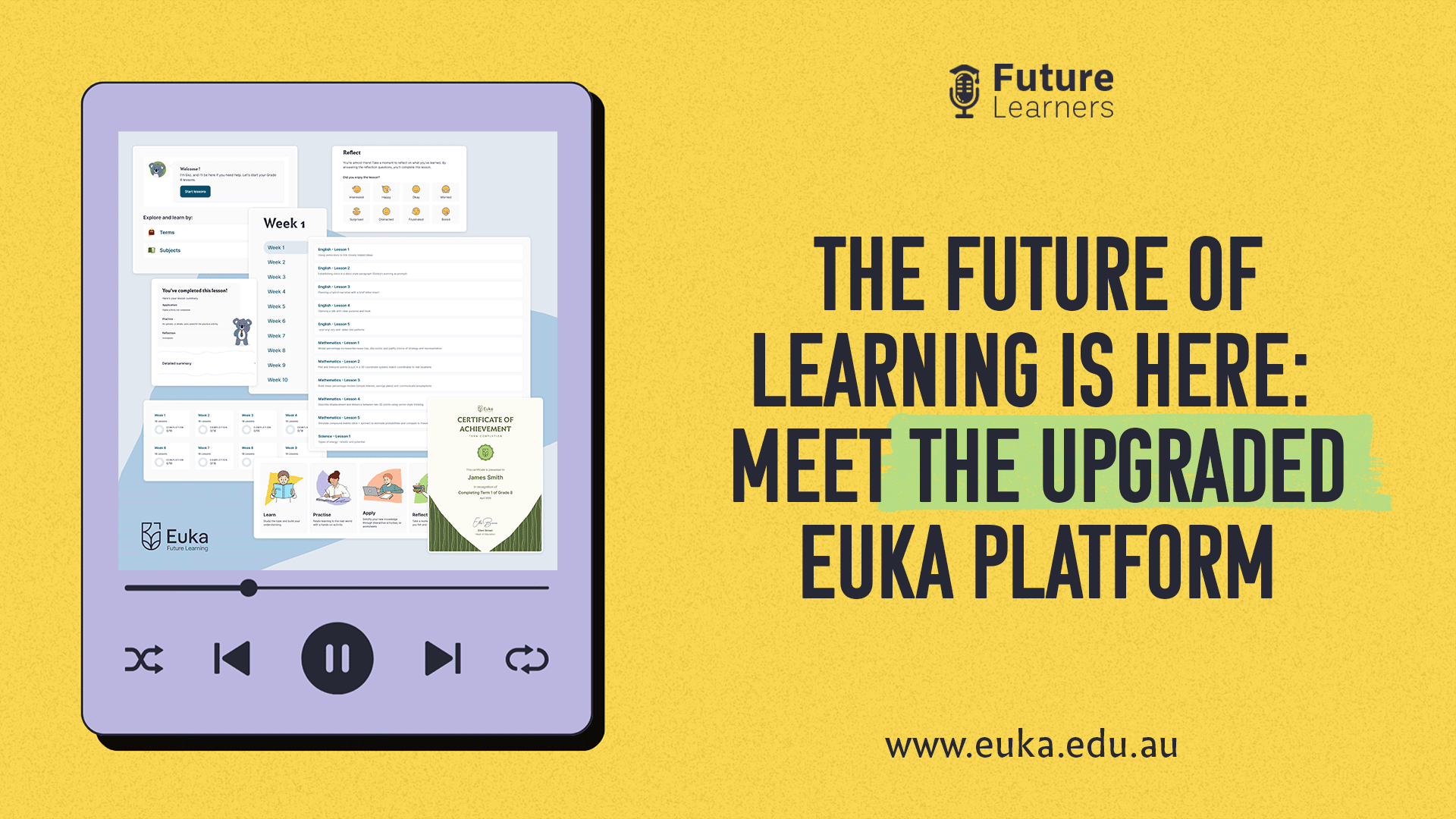
So these things need to be taken into consideration. That is why we’ve built Euka the way we do. And I think it’s important to highlight that because I’ve said, yeah, we’ve got a we do utilise, artificial intelligence for our support team and help with that, of course, in conjunction with a full support team that we have. But Euka has been built in such a way that yes, we are an educational platform. You have to log into our learning management system. But maybe I’ll, I’ll hand to you to give, give the overview of how we’ve designed the program and what I’ve done to design the program and if any, for those parents who are listening, going, you know, you’re talking about all the screen time and we may need to reduce it, but your program is on a screen. Like what? What do you mean? So let’s let’s sort of tackle that a little bit.
[48:14] Ellen Brown: I’m glad that you asked about that actually. Well, I’m glad that I had the chance to talk about that. I totally agree, I don’t want my children on the screen all day. The wonderful thing about homeschooling is with 2 or 3 hours maximum for high schoolers that they’re actually doing their learning, a smidgen of that is done online. So we have the opportunity of being able to say, here is your learning material here for you to read here on the screen. So that’s a really important tool because we have for kids that are struggling with their reading ability, but they certainly have a good cognitive ability.
We have a read aloud program, that you can click on to, and it’s reading it to you if you’re needing that kind of support, which obviously we couldn’t have if we were having a book. The cost also would be very different if you were having to have a book for every subject. So here’s your learn material. But that isn’t it. Learning isn’t just reading that lesson. Learning is what you do with that information that the child’s taking in. And that’s where they move into the practical part, the offline part of their lesson.
And in that practical part, they’ll be using that learning that they did here in the initial part of the lesson. And they’re putting it to practical use. They’ve learnt about a chemical reaction there in the kitchen. And they’re putting things together and they’re seeing the results. So they’re actually, having that connection between what they read. That was theory based to what they’re doing here. That’s quite practical. And then after that they have the opportunity to record and reflect on that in the apply section of a lesson.
And they can do that in two ways. And this is where parents can make a decision on how does my child learn best. They have the opportunity to do that in the online where they’re actually getting instant feedback. And for some children, getting that instant feedback. Most of us, that’s very important. You know, you’re in a classroom, you write it down and you’ve written down the wrong answer to the question. You don’t find out about that till the next day, and you get your piece of paper back and it’s got the cross through it and it’s wrong.
But then you’re on to the next activity. There’s no time to go. Well, why was that wrong? Let me have a look at that again. Do I need to check on anything here? Like what? What can I try again over. So we have made sure that using this digital platform, we have the apply section where the child is starting to ask questions or they’re being asked questions where they have to apply the learning that they’ve done. So it’s not just what was the date of, it’s not just recall.
It’s like if this happened in the past, what would happen in this situation. So it’s applying their learning. They can get that instant feedback because it’s marked. Or if you’re a parent who says, you know what, my child needs to slow that down. We want to write their information down so I can check it. They can download that activity sheet, do the same activity, but they can do it on pen and paper. They can work it out here on the site. So there’s the opportunity of making sure that the learning is adapted to the child.
We’re not all the same. We can’t just say everybody only gets 15 minutes to learn online because that’s their optimum for everybody, because some kids take a lot longer to be able to click into their learning gear than others. And so being able to, as a parent, make decisions on how much time are we working online and how much are we not? Or do we want to do everything? We’re just going to read our lesson and then jump off? Totally fine. So flexibility and making sure that learning is fitting your child is how you get the very best for your child’s learning.
[51:44] Brett Campbell: Excellent. So there you have it. Hopefully you have gotten some value from this. And obviously, this is a topic that there’s lots of opinions. And I love to hear people’s opinions around this topic. You may say something that I haven’t considered them, and it may swiftly shift my perspective. So what I’d love for you to do is leave us a comment. Wherever you’re watching this or listening to this show, leave us a comment below. Give us your thoughts. Give us some feedback. We’d love to know all about it.
But as always, you know, as parents, I’ll say this. We must be the bastions of accountability ourselves. We can only expect so much from our schools, right? They are not the saviour of everything to do with our children and our ability to be able to do our best where we can, of course, to help set our children up to be thinking and acting in the right way will go a long way to help a lot of teachers and families at school as well. But secondarily for same thing for all our homeschooling families here, you know, as you are very well aware of, or if you’ve just started, you’re going to be very well aware of is, yeah, the world is your oyster of sorts.
You do have the power and the flexibility to, make the decisions on screen times, how you want to learn, how you want to read. Do you want a book? Do you want an audiobook? Do you like this? One thing I would always say, though, and if you look at learning in general and studies around learning, your ability to learn on multiple modalities is important, right? So when Ellen was talking about you can read the context, but when you read and listen to the context, you’ll retain between retain 20 to 30% more right when you can read, listen and then you actually teach it.
Your percentage of absorption from this material goes even higher. So if you’re really concerned about is your child learning, start uncovering. And I’ll say this go and go to one of these AI tools. Go to ChatGPT and go, hey, I want to try and create an environment where my child learns and retains to the best of their ability. What can you tell me about the history of learning when it comes to listening, applying, hands on, etc. And you’ll be blown away by the percentage increase in how do you retain information?
Because I had a problem, I would read heaps of books, and I thought the act of reading books was making me intelligent until I looked at my list of books I read. And like, I couldn’t even tell you one thing out of that book that I remember right. And most kids are going to be like this. They’re like, I don’t even know what I learned. I just skim read it. I fast read it or I. I didn’t even know how to read it. I just went through the words, I haven’t because there’s one thing doing the act of it.
But if you forgot about it, did it really happen? Right. So what I went on the quest of is how do I become a better learner? How do I retain more information? I found that by because I would shrug it off going, I really I said I struggled to read, I just didn’t really enjoy reading because I was I’d rather just listen to it. Why would I prefer to listen to it? Oh, because I was doing other things at that same time. But then the same thing happened.
Just because I was hearing the words, it didn’t mean I was retaining it in. So there is an art to and we probably do a podcast actually on this. And I think this would be good. I’ll tell you what, if we get enough interest and you let us know that that you want to do a podcast. We’ll do a podcast purely on the art of learning. But the ability to cross modality on your ways of learning is unbelievably important. And I’ll challenge you to go out there and try that yourself. But, Ellen, that’s enough for us today. Any final words from you?
[55:46] Ellen Brown: I would say not all screen time is equal, so use screen time for learning. Let’s, let’s let’s take what’s useful. But if you want a digital detox on, that passive consumption of, of, digital tools, then I think go right ahead. That would be a fantastic idea.
[56:07] Brett Campbell: And I because I can’t help but I’m going to throw a challenge out to you as, as the parent or even if you listening and you’re one of our students. And if you are on screens, it’s going to be a small challenge just to start out with, because I could easily say go the whole day without picking up your mobile phone, but you’ll probably have panic attacks just hearing that, right? Set a specific two hour window where you normally would use your phone or a device and not the learning like this isn’t your opportunity, if you’re a student, to go, Brett said to not use my device for two hours, and you choose your learning time.
That’d be. That’d be very cunning and very clever of you. But what I’m suggesting is, let’s all do this. I’m going to challenge you to pick a two hour window, and if you normally when you go to bed, this is generally a good time. If you whatever your bedtime is when you hop into bed. Don’t have your phone. Most people go to bed and lie on their phone for two hours and scroll. My challenge to you is tonight when your head hits the pillow. Don’t even have your phone in the room.
That’s for the advanced. Honestly, too much. You could put it next to you, but if you want to go advanced here and get some extra bonus points, put your phone and leave your phone out in the kitchen and lay in bed and see how you feel and what happens in your body. And consider that when you’re trying to put your child through a detox of a technology that they’ve been exposed to, okay, because that’s when you start to truly get some, some understanding. And on that note, thank you very much. We hope you’ve enjoyed today’s episode. We will see you on the next one.