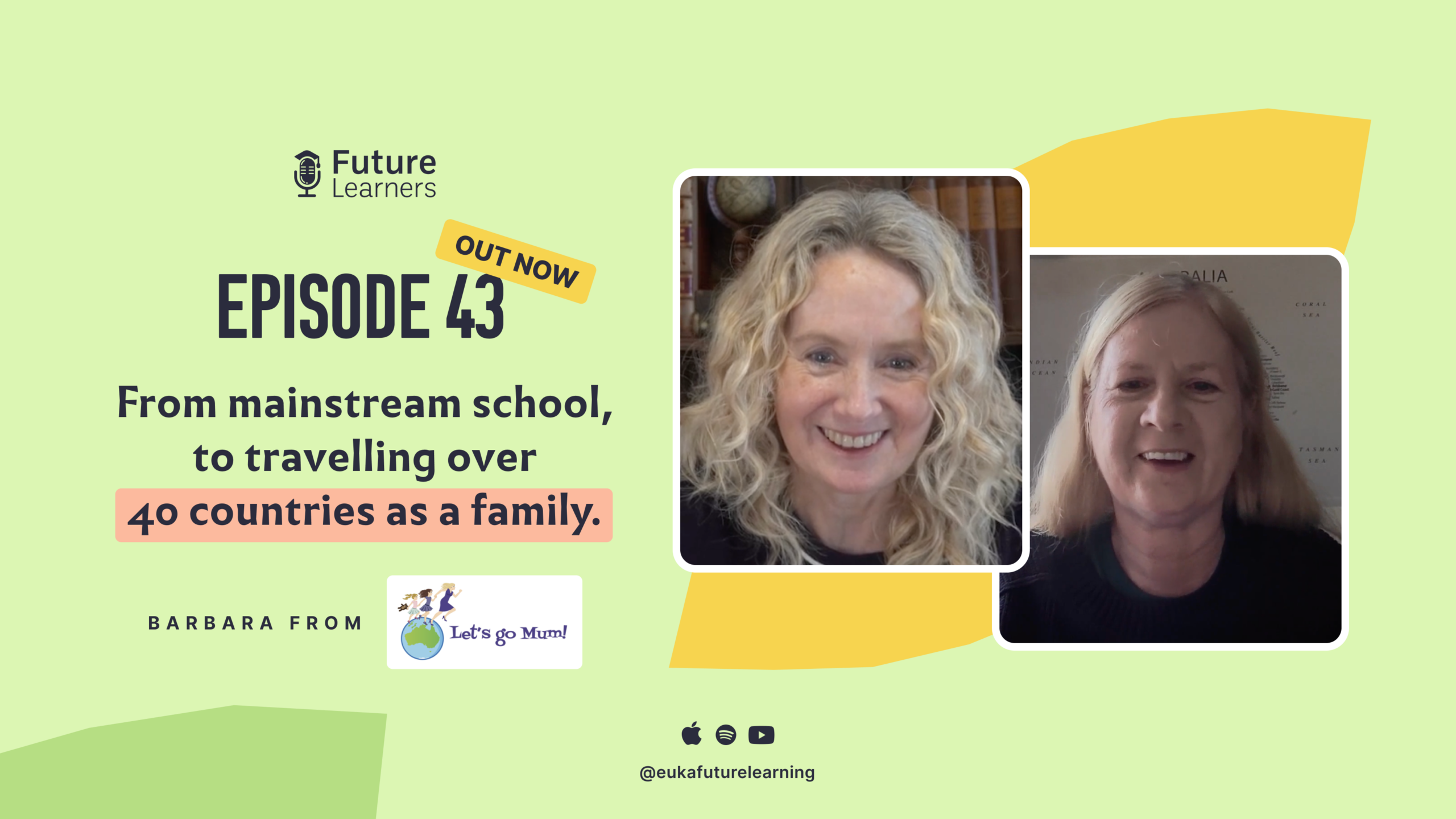
From School Bullying to Homeschooling Across 40 Countries as a Single Mum with 3 Daughters | 43

Listen to this episode on

Apple Podcasts

Watch this episode on

YouTube

Listen to this episode on

Spotify

About this episode

What does it look like to raise three daughters across 40 countries, build Let’s Go Mum into a million-follower family travel platform, and watch your eldest receive a conditional offer to study law? In this episode of Future Learners, Ellen Brown sits down with Barbara Bryan founder of Let’s Go Mum, for a warm, honest conversation about real-world learning, the flexibility homeschooling unlocks, and what happens after homeschooling.

Barbara’s story starts with a hard chapter: persistent bullying in primary school that the system could not resolve. After six months of trying to work through the proper channels, Barbara pulled her girls out and was funnelled into distance education. It served its purpose, but it was rigid, repetitive, and felt like “feeding the monster” rather than learning. When she discovered Euka, everything changed.

“We got our life back. The girls actually started to learn, and to learn about what they wanted to learn about as well. It was a revelation.”
— Barbara Bryan, Founder of Let’s Go Mum

From that point on, life and learning began to travel together. Dinosaur bones in real life. The Eiffel Tower in person. Hadrian’s Wall on foot. Maths and writing done in the car, in the evenings, or in short focussed blocks before the next adventure. And in school holidays, when the rest of the country was queuing for theme parks, Barbara’s family was working, because the world is cheaper, quieter, and far more open when you can travel outside the school calendar.

The most moving moment comes near the end. Barbara’s eldest, recently finished with Euka, has received a conditional offer to study law and is already excelling in her university preparation. The pathway concern that worries so many homeschooling parents — what happens after? — has a clear, real answer in her family.
Key Discussion Points

  • Building Let’s Go Mum: How Barbara grew Let’s Go Mum into a family travel platform with more than one million followers across channels.
  • The bullying that changed everything: Why six months of trying to fix the situation through school and the education department was, in hindsight, six months too long, and what Barbara would tell her past self.
  • Distance education vs homeschooling: The difference between being on a treadmill of repetitive coursework and having a flexible, child-led program that fits family life.
  • Learning across 40 countries: Why standing in front of an artefact, a landmark, or a working museum changes how children retain and connect ideas.
  • The rhythm that actually works: Short focussed study blocks, schoolwork before and after trips for shorter holidays, and rolling daily work into long-haul travel for bigger journeys.
  • Confidence over qualifications: Why parents do not need to be the teacher. The program is written by qualified teachers and delivered to the student; parents facilitate and support.
  • What happens after Year 12: Barbara’s eldest received a conditional offer to study law, and her youngest is following her own passion. Real homeschool graduates, real pathways.
  • Advice for parents thinking about starting mid-year: If you know it is the right move, just start. You do not need to wait for the start of the year.

When School Stops Working: How Euka Became the Way Out

Before Euka, Barbara’s family was stuck. Persistent physical bullying in primary school was, in her words, “flat-out abuse.” She tried every level of the education department for six months and got nowhere. The system’s answer was distance education, which felt rigid, repetitive, and like “feeding the monster.”

Then she discovered Euka.

“Euka came in like a knight on a white horse. I’m not kidding about that.”
— Barbara Bryan

The difference was immediate. The flexibility. The fact that learning felt like learning again, not busywork. For any family wondering whether a switch is the right call, Barbara’s advice is direct: if the school isn’t moving to fix the problem, get out, and don’t wait six months to do it.

Flexibility That Lets a Family Travel the World

With Euka, school stopped dictating the family calendar. Travel did. Short trips were worked around at the start or end. Long trips had study built into mornings, evenings, or the car. Maths got knocked over in half an hour instead of three hours, and the rest of the day went to dinosaur bones, Eiffel Towers and Hadrian’s Wall.

“Why learn about the Eiffel Tower when you’re up it? Why learn about history if you’re walking Hadrian’s Wall? Kids have a natural curiosity and a natural want to learn. If you are actually at the place, why wouldn’t you?”
— Barbara Bryan

Forty countries later, Barbara’s family travels through school terms, avoids the school-holiday rush, and pays a fraction of peak-season prices. The flexibility doesn’t compromise the academic side. It makes it possible.

From Homeschool to a Conditional Offer in Law

The question every homeschooling parent eventually asks is: what about after? For Barbara’s eldest, the answer is a conditional offer to study law, achieved through Euka’s University Pathways — without an ATAR, without an HSC, without sitting an exam. She did a university entry course and was readily accepted.

“I was that parent that was worried, like, what about after? But my eldest has received a conditional offer to law, and she is knocking it out of the park.”
— Barbara Bryan

Euka now has partnerships with more than 90 university colleges, including in the UK, Canada and the USA, through its active partnership with Navitas, giving Australian homeschool graduates guaranteed entry into recognised pathways. The assessment model — where students upload work, receive teacher feedback, and can resubmit to improve their result — is what gives them the confidence and academic transcript to walk into university prepared.

Answered questions

Real questions Australian parents ask, answered through Barbara’s lived experience as a Euka parent of 40-country-travelling daughters, including one with a conditional offer to study law.

Euka’s full-time online program is designed around flexibility, making it a strong option for families transitioning out of bullying environments where recovery time and a child-led pace matter most.

Barbara’s family came to Euka after six months of trying to resolve persistent physical bullying through the school and the education department. Her direct advice to other parents:

“If you don’t see any signs of the school or the education department working to fix the problem, get out. I regret every day of those six months.”

The system’s first answer for Barbara was distance education, which she describes as “feeding the monster” rigid, repetitive, and more work than school had been. Euka was different. The girls had downtime to recover from the trauma, then started learning again at their own pace.

“Euka came in like a knight on a white horse. I’m not kidding about that.”

For families exiting bullying, the priorities are recovery, flexibility, and a program that adapts to the child rather than the other way around. Barbara’s experience is one many Euka families share.

Ask AI about Euka as an alternative to school:

Ask Perplexity . Ask ChatGPT · Ask Google AI

Barbara Bryan did both, and the contrast is direct.

Distance education, in her experience:

“Always feeding the monster. It didn’t feel like it was about learning, and it certainly didn’t feel about flexibility, because I felt like we were doing more work than in school.”

Euka, by comparison:

“Everything was just so much easier, and the girls actually started to learn and learn about what they wanted to learn about as well. It was a revelation.”

The difference, in her words: distance education is structured around the system’s needs. Homeschooling with Euka is structured around the child’s. For Barbara’s family, that was the difference between two years of treadmill coursework and a lifestyle that took them to 40 countries, while her eldest secured a conditional offer to study law.

Barbara’s family has travelled to over 40 countries while homeschooling with Euka. Her practical rhythm:

  • Short trips (1–2 weeks): Work intensively before and after. Don’t try to study during the trip.
  • Long trips (5+ weeks): Regular check-ins during the trip. Study in the car, in the evenings, or in mornings before activities.
  • Big-lap or international trips: The program comes with you. Maths gets knocked over in half an hour. The rest of the day is the actual experience.
“It will work around your life… It’s an absolute joy, because you can’t do that another way.”

Critically, Barbara’s family doesn’t travel during school holidays. They work through them, then travel during term. Cheaper prices, smaller crowds, and a thousand fewer kids in the pool.

Barbara is the proof point on this one. She built Let’s Go Mum into a family travel platform with more than one million followers across channels — entirely while homeschooling two daughters and travelling the world.

Her observation:

“You can build from nothing, but you can’t do it without an awful lot of hard work.”

The flexibility Euka provides isn’t a nice-to-have for a working parent — it’s what makes the whole arrangement possible. The program runs around the family schedule. Work blocks happen when they work. Travel happens when it works. The parent isn’t the teacher — they’re the facilitator, while the actual teaching is delivered by qualified Euka teachers via the program.

For parents running a business, the question isn’t whether you can homeschool and work. It’s whether your homeschool program flexes to your business calendar. Euka does.

This is the question every travelling parent asks before they commit. Barbara’s answer is the dinosaur bones moment:

“Touching real dinosaur bones. That just blew my mind. There are a lot of blow-your-mind moments travelling, because why learn about the Eiffel Tower when you’re up it? Why learn about history if you’re walking Hadrian’s Wall?”
“Kids have a natural curiosity and a natural want to learn. If you are actually at the place, why wouldn’t you?”

For Barbara, the structured academic work — maths, writing, assessments — happens in shorter, more focussed blocks than school requires. “You don’t need three hours to do maths. You can get that knocked over in half an hour.” The remainder of the day delivers what no classroom can: real artefacts, real landscapes, real conversations with people in their own places. Children retain what they see, touch, and experience.

The pathway proof is Barbara’s eldest: she travelled 40 countries, homeschooled with Euka, and received a conditional offer to study law. Travel didn’t compromise her academic future. It informed it.

Yes. Barbara’s eldest received a conditional offer to study law after completing Euka and a university entry course, without an ATAR or HSC.

“There are pathways into everything, and my eldest took this pathway. She was very readily accepted. It was very easy.”

Euka’s University Pathways include an active partnership with Navitas, opening access to more than 90 university colleges across Australia, the UK, Canada and the USA. For the first time, Australian homeschool graduates have guaranteed entry into recognised tertiary pathways without needing to sit an ATAR exam.

Barbara reflects:

“I was that parent that was worried, like, what about after? But my eldest has received a conditional offer to law, and she is knocking it out of the park.”

The “what about after?” question — the one that holds so many parents back from homeschooling — has a clear, established answer.

Euka’s senior pathway is built around an assessed model that produces an academic transcript, not an ATAR. Barbara’s daughter’s experience shows how it works in practice:

  1. Assessment with feedback loop: Students upload work, receive teacher marking and feedback, and can resubmit to improve their result.
  2. Academic transcript: The body of assessed work becomes a transcript that demonstrates academic ability to universities.
  3. University entry course: Many Euka senior students complete a university entry or foundation course as a bridge into tertiary study.
  4. Direct entry via partnerships: Through Euka’s University Pathways and the Navitas partnership, students can access more than 90 university colleges in Australia and overseas.

Ellen explains the assessment philosophy:

“They’ve got ownership over their own learning and their results, which is really important, because they head off to uni empowered in that learning.”

For students unsure about university, Euka recommends doing the assessed pathway anyway — so the academic transcript is available later if the decision changes. For students aiming high (medicine, law, competitive degrees), the non-ATAR pathway is a real, established route. Barbara’s eldest is the living proof.

Ask AI About Euka

We believe in transparency. Don’t take our word for it. See what AI says about Euka for yourself:

Search on Perplexity | Ask ChatGPT | Ask Google AI


These links open a new search or AI conversation. Your personal data is never shared.

Why This Episode Matters

If you have ever wondered whether homeschooling will close doors for your child, or whether a flexible, family-led approach can lead to real tertiary outcomes, this episode is for you. Barbara’s family is proof that travel, flexibility, and academic ambition are not opposites. They sit comfortably side by side when learning is built around the child, not the other way around.

Whether you are a parent looking for a calmer way forward, a travelling family wanting school that moves with you, or simply a parent navigating the question of what comes next, you will leave this conversation with practical reassurance and a clearer sense of what is possible.

Ready to explore Euka? Request a free information pack and see how a flexible, qualified-teacher-designed program can fit your family’s life.

Transcript

Ellen Brown:
It is so fantastic to have the opportunity to chat with you today, Barbara. Something I’ve been waiting to do for a very long time. For people who are listening to this podcast, if you’ve ever wondered what it would be like to travel the world with your children and have that as your entire life and job, then Barbara is the person who knows about it, who actually invented it, I would go so far as to say. So we’re going to find out about how Barbara started, what she does, what that journey looks like for her and her family, and what it’s like to be homeschooling while you’re also travelling the world. And some exciting news that we’ll talk about towards the end with one of her children and what they’re up to now they’ve just finished with Euka.

Let’s start with where have you just been, Barbara? Let’s set the scene.

Barbara Bryan:
Oh gosh. Well, we have just been to Japan about three weeks ago. That was the last trip, and our next trip is next week.

Ellen Brown:
Oh my goodness, not much time for unpacking, washing and packing again. You’re probably very used to that.

Barbara Bryan: Yes, I’m very proud to say I have actually unpacked this time. Quite often I open the suitcase and go, oh no. But yes.

Ellen Brown:
Tell our listeners a little bit about yourself and what Let’s Go Mum is. Then we’ll talk about how it all started.

Barbara Bryan:
Absolutely. My name is Barbara Bryan and I did actually used to work at a uni in my pre-child life. Then I had the kids and had to reinvent myself. I couldn’t work full-time anymore. I had to give away my full-time hobby of endurance riding and just concentrate on something I could do while I had two babies on my hands. The kids were both under two. I just thought, well, do what you know. So I started to put that into a website.

Ellen Brown:
And what year are we talking about here? Because lots of people now say they’re a travel blogger, but we’re not talking about recently.

Barbara Bryan: We’re talking about 2005 to 2007. I taught myself how to build it. Back then there weren’t any click-and-play websites, so I had to teach myself coding and code the whole website. That took me a good year. Eventually, about three or four years on, when everything was established, I decided to do what I really wanted to do, what I love, which is travel. I’d already started to travel with the girls, so I had lots of content. That all sort of rolled into being, and the rest is history.

Ellen Brown:
And that’s what we now know as Let’s Go Mum. So you start Let’s Go Mum and you start travelling. What was that like with the girls? How old were they at this point? And we’re not talking about going to Dubbo here. We’re talking about going overseas.

Barbara Bryan:
Look, I started at home. Probably the first big trip was when they were both under three. So I had a baby and a two-year-old, and I just decided we’d head off into central Australia. We went to Alice Springs, got the Ghan to Northern Territory, then went and looked around Kakadu. I just had a great time with them. That was probably our first really big trip. For smaller trips, the second they got out of hospital, we were on a plane to Melbourne. They already knew about planes and travel and road trips everywhere. International travel was the next step. You have to build your world slowly and build your credibility.

Ellen Brown:
As the girls have gotten older, any guess on how many countries you may have been to? Is that a ridiculous question?

Barbara Bryan:
No, look, it isn’t, because my girls like to count. I think they’re at about 40. I’m probably about double that, because I was travelling before them.

Ellen Brown:
Oh wow, that’s fantastic.

Barbara Bryan:
They count flights and they count countries. This is the something-flight for this year. Because we love flying.

Ellen Brown:
What would you say is the most rewarding part of this journey with the kids and travelling?

Barbara Bryan:
I think the most rewarding thing in all honesty is that the girls are so worldly now. They know so much. They’ve seen so much, and they love it. They’re never bored when we’re travelling. They just soak it all in. I’ve felt so excited to be able to take them to incredible museums, iconic landscapes and buildings in real life. Everything is just a massive adventure. I love that aspect for them, and to hear them talk about it when we get back as well. “Just remember when…” It’s an amazing thing.

Ellen Brown:
What a fantastic relationship you would be building with them by having that extended time with them. It’s different when they’re little and they just tag along. But now they’re young people, and to be able to share those moments must be really special.

Barbara Bryan:
Yeah, that’s a really interesting point. I don’t think it matters where you are, you are going to get the teenagers, and I did. But luckily travel was never an issue, because from them being able to understand, I was always like, “Do you want to do this? We can just stay home. We can just go down the coast.” They actually developed a mad love of travel, and they’re the ones that motivate a lot of it as well.

Ellen Brown:
That’s probably your fault, because you’ve shown them that the world can be a small place. You’ve shown them anything is possible. I’ve read somewhere that you’ve got a million followers across all your platforms. It’s a phenomenal business that you’ve created.

Barbara Bryan:
Yeah. The girls counting, they did add it up, and I think it actually exceeds that now. I still cannot believe that or get my head around it. Of all the things I want to get through to people, it’s that this didn’t start as a business at all. This was pure self-indulgence. I didn’t start with a cent. I was struggling to make the $10-a-month website hosting amount. You can build from nothing, but you can’t do it without an awful lot of hard work. I had two babies at home, so it was always tapping away while the house was messy. I do think anything is possible. I don’t have a magic solution for how to get there quickly, but I do have one for slowly.

Ellen Brown:
I think that is the solution. It isn’t about quickness, it’s about passion. As the girls have got older, then it comes to the point where you say, okay, we’ve got high school years now. When did Euka come into your life?

Barbara Bryan:
Euka came in like a knight on a white horse. I’m not kidding about that. To give you a quick lead-up — we experienced some terrible bullying in primary school. All bullying is terrible, but this was physical. In adult terms, it would just be flat-out abuse. You’d be calling the police, which we actually did at one point. It just wasn’t fixable. I tried going through every level of the education department. We went through six months of trying to sort it out. I regret every day of those six months now. If I could redo it: if you don’t see any signs of the school or the education department working to fix the problem, get out.

Another thing I really regret was that we were channelled into distance education. The education department could see we weren’t going back, so their way of fixing it was, well, you can do distance education. At the time, I thought that was really my only option, because I’m not a school teacher. I didn’t feel I had the confidence to lead my children into the future. So we were on the distance-education train for a couple of years, and absolutely no shade to the teachers — they were lovely people — but distance ed is very full-on. It’s in no way homeschooling. It just feels like you’re constantly having to get feedback, ridiculous feedback, and the same courses come around. It just was not a great way for us to go. It certainly served its purpose, but by year six we were just like, well, I’m not sure what we’re going to do now.

Then somehow I heard about Euka. I think I was just Googling for solutions, and Euka popped up. I started chatting with you, and the rest was history. It was just incredible. The difference, the flexibility — we got our life back, basically. With distance ed, it was always feeding the monster. It didn’t feel like it was about learning, and it certainly didn’t feel about flexibility, because I felt like we were doing more work than in school. With Euka, everything was just so much easier, and the girls actually started to learn and learn about what they wanted to learn about as well. It was a revelation, and I’m not joking. It really was. I say that to anyone who asks me: Euka is the answer. Just leave school behind.

Ellen Brown:
You said a couple of really interesting things there. That whole parent intuition. I think COVID gave parents more insight and almost permission to stand in for their children. Prior to COVID, there was this thing about, you know, “this is the school.” I’ve been a teacher for many years. Even as a teacher in the school, you’re behind this system. The system, even if in your heart you want to do something differently, you’ve got to follow the rules of the system. With thousands of children in a school, you have to have a system. So it’s very tricky to have any movement.

Once COVID came, I think parents started to say, well, hold on a minute. I’ve had my child at home. I’ve been part of their education. It demystified education. As a parent, this is something you’re already doing. Everything you ever teach your child that’s really important, you’re doing that already — it’s just the topics have changed. But what about the people around you? Did you have any opposition that you had to overcome?

Barbara Bryan:
We were also very subtly being channelled back into the school system. I even tried with my eldest. She was very bright, and they were very keen to have her in, and they offered her a big scholarship. She went in, and I think she was in there for less than a month. By that point, she knew how education could be and how it wasn’t. She begged to come back. I was like, of course. I felt like maybe I was influencing it with our lifestyle — like, oh, I don’t want to influence you to do something. But it wasn’t the case, thank goodness. She absolutely hated going into school for that time.

When people do come to me, there’s always one thing that’s huge for them. That is, they don’t have the confidence to be able to say, “I can have my kids with me at home 24/7. I can assist them in their learning journey, but I don’t have to actually be imparting that knowledge to them. I can guide them through it.” And it’s not such a big deal.

COVID did give us permission. All of a sudden, we were the cool people that were homeschooling. The way schools were homeschooling was very different — the kids had to wear uniforms, they still had to do things as though they were at school. It’s confidence, confidence, confidence every time. When you tell a mum, you can do this — if I can do it, I’m no teacher, I’m really bad at maths, I always will be — you can still do this. As long as you’ve got the program, because everything is there.

Ellen Brown:
You answered that question I was going to ask, which is if there are parents out there who are approaching term three. Sometimes you think, I’ve got to start saying from the beginning of the year. What would you say to a parent who’s thinking, I’m supposed to stay here until the end of the year, we’ll think about it next year?

Barbara Bryan:
Just leave. If you know something is right, just start. You can. And the thing is, you don’t have to wait until the start of the year. You can just jump on into homeschooling, and it’s going to adjust around you and adjust around your child. You’ll find they’re knocking it out of the park anyway. When you get rid of all that pointless busywork time of school, kids learn really fast.

Ellen Brown:
We have a lot of kids that come to us that have had to exit from mainstream school. Actually, a large portion of our students have been through a bullying situation. Sometimes they’ll come in and take that time out. They might be getting some professional support, and they might say, I might go and give school another go. I think that’s one of the things we’re really proud of as a company — the students working with Euka are not missing anything while they’re getting support for the things they’re struggling with. And if they do want to try school for a while, they can do that. I’m not an anti-school person. I think it’s great for some people and not necessarily for everyone. Knowing that moving out of the school system doesn’t cut off your opportunities for the future is so important.

Let’s talk about a normal week. I don’t know that you have a normal week, Barbara. What does it look like when you’re travelling, and the difference between when you’re home in between trips?

Barbara Bryan:
Well, it depends on the trip. When homeschooling, if we’re doing a long-term trip — say five weeks or over — then they would have regular check-ins, doing what they need to do with their program. If it’s a short trip, let’s say a week to two weeks, we won’t do anything. We’ll work right up to before the trip, after the trip, after they’ve recovered. And you can do that — that is the flexibility. It’s an absolute joy, because you can’t do that another way. It will work around your life.

Ellen Brown:
I think one of the joys we always had was doing things when it wasn’t school holidays. Who wants to try and line up with everybody else during school holidays? Lots of homeschoolers find they actually take family holidays in the middle of school terms.

Barbara Bryan:
Totally. You would never go away during school holidays homeschooling. That is a huge bonus, because you save lots of money. Demand and everything is cheaper and easier outside school holidays. Plus, there isn’t a thousand kids in the pool. We probably worked our hardest during school holidays, honestly. But the girls would always get major holidays — Christmases and Easters and things like that. For ordinary school holiday days, we’d be working. We would avoid school holidays like plague.

Ellen Brown:
Travelling obviously gives you opportunities to be learning things on the go. Can you think of a moment where you were away somewhere and you saw the girls learn something that never would have happened if you’d been in a classroom?

Barbara Bryan:
Just one? Touching real dinosaur bones. How about that one? That just blew my mind. And there are a lot of blow-your-mind moments travelling, because why learn about the Eiffel Tower when you’re up it? Why learn about history if you’re walking Hadrian’s Wall? You can go where their passions are as well. I loved asking them where they wanted to go and then trying to get them there. Kids have a natural curiosity and a natural want to learn. If you’re actually at the place, why wouldn’t you? It’s just amazing. I still get chills. It’s a great feeling. It’s a feeling of achievement as a parent — I got you here, and now this is real. It’s not just something in a book.

Ellen Brown:
I absolutely love that. You’re getting my mind spinning about places I’d like to go. What about the less exciting and glamorous stuff — not dinosaur bones? Some of our families are travelling Australia, doing the big lap. Things like maths or structured writing tasks. How did you find it worked best for the girls to manage those things in their program?

Barbara Bryan:
Road trips, they would work in the car. It’s basically downtime. Could be evenings, could be mornings. There’s a lot of motivation with kids — get this done and then we’ll go and do that. It’s not like they’re sitting there for three hours like they would be at school. Do it in shorter blocks. You don’t need three hours to do maths. You can get that knocked over in half an hour. So the motivation is, get that done, let’s go out and do something cool.

Ellen Brown:
That makes it a bit easier than getting a stamp at school. If your girls get it done, they can touch dinosaur bones.

Barbara Bryan:
Yeah. And sometimes it’s as simple as a milkshake in a cafe.

Ellen Brown:
OK, this is the part we’ve been waiting for. The proof is in the pudding. A lot of parents say, but what about after? You’ve been travelling, you’ve been homeschooling, what happens next?

Barbara Bryan:
Well, I was that parent that was worried. What about after? Because the mentality is your kids have to be in school. They have to get the HSC or whatever it is for your state. But I’m very excited to say that my eldest is now working towards uni and she’s received a conditional offer to law.

Ellen Brown:
Oh my goodness, that is brilliant.

Barbara Bryan:
I’m so excited by that. And she’s so excited by that. You do have these worries — what happens after? If they want to take the university path, how are they going to get in by saying they’re homeschooled? Because there’s some bad press around homeschool. It’s probably perpetuated by the education department, I don’t know. But it’s just not true. There are pathways into everything, and my eldest took this pathway. She was very readily accepted. It was very easy. In a short period going into uni, she’s already got a conditional offer and she’s knocking it out of the park. I’m just so proud.

Ellen Brown:
You should be proud. It’s knowing you’ve been able to navigate this and support her — knowing you don’t have to be the teacher, but support her in whatever she chooses to do. It’s a proud moment when you see your kids stepping out into their future and knowing you’ve played that part. We get such a buzz from being able to see and support students and play a small role in their future.

Barbara Bryan:
Let me say, and so you should get a buzz, because Euka was a huge part of this. As she’s come home from the course to get her into university, she is doing things she learned with Euka as well. It’s like a refresher. She was ready for this. Euka was the pathway for her to go to university and achieve her dreams. I’ve never seen her happier, honestly. Still wants to travel. Every break is just like, Japan was squished in there. But yeah, she’s loving it.

Ellen Brown:
That is fantastic to hear. We’ve worked very hard to make sure our senior students are prepared. One of the things that’s been really important to us is the assessment process. Obviously, she’s managed to get herself into law without needing an ATAR or HSC exam results. But that doesn’t mean assessments haven’t been important along the way.

For those people listening who are not sure about how Euka does that assessment, our role is to support students in their learning. They’ll do an assessment. They will upload it for our team to provide the marking and the feedback. Then that goes back to the student, and the student can say, you know what, I feel as though I would like to do better than what I’ve done. So they take that feedback, they can improve their assessment, and they can upload it again. It gives them the feeling that they are actually in control. They’ve got ownership over their own learning and their results, which is really important, because they head off to uni empowered in that learning.

Barbara Bryan:
Totally. It’s an incredible advantage for these kids, because they’ve already got the feedback. They know what to work on and they know what they’re doing. That in turn gives them confidence. Every step of the way she’s been confident through this. I’ve been a little bit scared in the background — that’s just a mother thing — but she’s just rolling along.

Ellen Brown:
We will have another podcast coming up about new partnerships, because we’ve actually signed enough partnerships with universities — over 90 university colleges, including in the UK, Canada and USA. So now, for the first time, Australian students without needing an ATAR can go straight overseas and be guaranteed entry into these pathways. That’ll be a future podcast.

Maybe it’s worth saying now what your youngest is up to?

Barbara Bryan:
Oh, well, she is following her own pathways as well. She’s doing very well. She’s having a fantastic time with it. I love how these kids are just following what they really want to do. The funny thing is, you kind of know what they want to do all the way along from very young.

Ellen Brown:
Yes, you get those hints. With young people, sometimes you can say it and they’ll know what they want. Sometimes they won’t know what they want. So giving them every opportunity in year 11 and 12 is important, because they might say, well, I don’t want to go to uni — totally legitimate. But then later on, they might say, actually, I do.

When we are advising people, if they know they definitely don’t, that’s one thing. But if they’re not sure, we say do the assessed pathway so they’ve got an academic transcript. If later on, even after they’ve finished grade 12, they say “I really want to go to uni,” they’ve got something they can use.

Barbara Bryan:
Yes. Like you said, sometimes they just get to a point where they just don’t know. And that’s OK as well. Flexibility in every part of life is really important, especially when they’re teenagers and there are already lots of stresses. It just removes a lot of that incredible stress that builds up if they’re doing schooling and heading towards an ATAR or whatever. You want them to actually live their lives and be happy, and then move forward when they’re ready, not when the system makes them move forward.

Ellen Brown:
Yes. And you’ll find too with your girls that having the opportunity to be out of that school bubble means there’s a maturity and a bit more insight into what they want. What we see with homeschool teenagers is they’re often trying things — I always say, go and do work experience. People say, oh, we get one week of work experience when we’re in year 10 or something. But homeschool students, it’s unusual the places they end up, because they just ring up and say, “Can I come for a week of work experience?” and they’re always offered a job. Young ones are not necessarily motivated these days. So that’s one of the things I love about homeschoolers — they have that extra time to work through what they love and develop a bit more confidence about stepping in and trying things, because it’s not a fail, is it? It’s about being able to try something new all the time.

Barbara Bryan:
Absolutely. It’s all part of the flexibility. The time to be able to do that and for them to speak up about what they’re doing is so needed.

Ellen Brown:
So, here’s a couple of questions the team have put for you. If you could go back and sit next to yourself the day you enrolled with Euka, what would you tell yourself?

Barbara Bryan:
Do this earlier. Do this a lot earlier. Skip distance education. Honestly, just totally skip distance education, go straight into Euka. And actually I wouldn’t have sent the kids to school at all if I’d had that confidence. They wouldn’t have stepped in a classroom. The difference is just so huge. The difference in the girls was so huge. After the bullying, we had some downtime — ice creams, beaches, whatever they wanted. I felt like they were getting over trauma. But just the difference in those kids at that time. You know you’re doing the right thing.

Ellen Brown:
For the parent that’s worrying about getting it right, what does getting it right actually look like in your experience?

Barbara Bryan:
You’re already getting it right, because you’re a parent. You’re parenting your kids. It’s just like the weekends, but the kids are going to be on the laptop doing their program, or you go out and do your own excursions. It’s fun. You’re just doing what you normally do anyway, having fun with your kids. And I loved it. As soon as they left school, it was really wonderful. I loved having them home with me.

Ellen Brown:
Barbara, thank you so much for your time today, and more than just your time today, thank you for showing us what’s possible as a business person. Thank you for being the inspiration that you are to a lot of people out there. We really appreciate that. We certainly celebrate with you as we see your young people marching off into their future as well.

Barbara Bryan:
You’re too kind, but thank you. And thank you to Euka for being the solution to our problem that has just affected my girls’ lives and made everything better for us.

Ellen Brown:
If you have got kids at the moment in school and you’ve been wondering and you think, term three is coming, is it possible to even make a change? Yes, it is. Feel free to jump in and have a chat with one of our team. We’re always happy to give you a hand. There are new families starting at any time of the year. There’s no perfect moment. There’s just the next moment. Be brave and step into something that’s a little bit different for your kids. We’ll be able to give you a free Euka pack — there’ll be a link for that. And don’t forget to go over and check out Let’s Go Mum, because there’s a lot of exciting things there.

Is there anything particularly you want to tell people to look at, Barbara, on your website or Instagram?

Barbara Bryan:
Next week we partner with Jetstar and we’re going on a party flight up to Townsville to celebrate Jetstar’s 22nd birthday. So I think there’s going to be some really fun content from that. Check it out. Shannon Noll will be on the flight, and it’s going to be really hilarious and really fun. Come and see Townsville with us, which I think is going to be very exciting.

Ellen Brown:
Fantastic, thanks Barbara. Don’t forget to rate, review and share Future Learners, and we’ll look forward to seeing you on the next podcast.

Other episodes

Episode 043

From School Bullying to Homeschooling Across 40 Countries as a Single Mum with 3 Daughters
Episode 042

How Young Athletes Train Full-Time Without Falling Behind in School
meet-the-upgraded-euka-learning-experience-episode-41

Episode 041

Meet the Upgraded Euka Learning Experience

Episode 040

The World Is Your Classroom: Travel Schooling with The Slow Road

Episode 039

Inside the NSW Homeschooling Audit: What It Means for Families

Episode 038

He earns 30K a year and homeschools

Episode 037

What you need to know about homeschooling in 2025

Episode 036

Is School Going “WOKE”?

Episode 035

The “True” Reasons families homeschool?

Episode 034

What you need to know about Registration and Reporting when Homeschooling

Episode 033

Travel Schooling: Everything you need to know

Episode 032

Raising young boys

Episode 031

Sleep! Are you and your kids getting enough?

Episode 030

Setting your pre-schooler up for success

Episode 029

Should children under 16 be banned from using social media?

Episode 028

Should children learn handwriting in this digital world?

Episode 027

The #1 Skill for children to learn

Episode 026

When should your child do work experience?

Episode 025

How to build a strong family unit

Episode 024

How to retain 90% of everything you learn!

Episode 023

Homeschooling with Dyslexia, ASD, and ADHD: A Mother’s Inspirational Journey

Episode 022

Unlock funding for homeschooling

Episode 021

Moving from School to Homeschooling in term 2

Episode 020

Homeschooling on a budget

Episode 019

The Importance of Raising Risk Takers

Episode 018

Empowering Girls: Building Confidence and Self-Esteem

Episode 017

3 Major Obstacles Parents Face when Homeschooling

Episode 016

The most important skill a child can learn

Episode 015

Cultivating Financial Literacy and Mindful Parenting

Episode 014

Physical and mental health tips for homeschooling families

Episode 013

The ultimate Getting Started guide

Episode 012

Homeschooling mother of 4 shares her journey

Episode 011

Mental Health and how it affects our children

Episode 010

AI, Technology & Navigating the Digital Frontier

Episode 009

Euka Unveils Groundbreaking Year 11 & 12 Program – A Global First in Learning Innovation

Episode 008

The Difference Between Homeschooling and Distance Education

Follow Euka on social platforms

Follow our hosts on socials

Brett Campbell, CEO Euka Future Learning

Brett Campbell is a leader in education, serving as the CEO of Euka, an innovative company building the future of education. He’s a successful entrepreneur and author with a passion for lifelong learning. Beyond his professional achievements, Brett is a devoted family man and the host of the Future Learners Podcast, where he shares his ideas about education’s potential to empower people and create a brighter future.

Follow Brett on:

Ellen Brown, Founder Euka Future Learning

Ellen Brown is the founder and driving force behind Euka’s educational philosophy. With over 25 years of teaching experience, she designed Euka’s curriculum for grades 1-12, emphasizing individualized and practical learning. Her expertise is recognized by major media outlets, and she is frequently sought after for her insights on the future of education.