
From School Bullying to Homeschooling Across 40 Countries as a Single Mum with 2 Daughters | 43
Listen to this episode on

Watch this episode on

Listen to this episode on

About this episode
What does it look like to raise two daughters across 40 countries, build Let’s Go Mum into a million-follower family travel platform, and watch your eldest receive a conditional offer to study law? In this episode of Future Learners, Ellen Brown sits down with Barbara Bryan founder of Let’s Go Mum, for a warm, honest conversation about real-world learning, the flexibility homeschooling unlocks, and what happens after homeschooling.
Barbara’s story starts with a hard chapter: persistent bullying in primary school that the system could not resolve. After six months of trying to work through the proper channels, Barbara pulled her girls out and was funnelled into distance education. It served its purpose, but it was rigid, repetitive, and felt like “feeding the monster” rather than learning. When she discovered Euka, everything changed.
| “We got our life back. The girls actually started to learn, and to learn about what they wanted to learn about as well. It was a revelation.” — Barbara Bryan, Founder of Let’s Go Mum |
From that point on, life and learning began to travel together. Dinosaur bones in real life. The Eiffel Tower in person. Hadrian’s Wall on foot. Maths and writing done in the car, in the evenings, or in short focussed blocks before the next adventure. And in school holidays, when the rest of the country was queuing for theme parks, Barbara’s family was working, because the world is cheaper, quieter, and far more open when you can travel outside the school calendar.
The most moving moment comes near the end. Barbara’s eldest, recently finished with Euka, has received a conditional offer to study law and is already excelling in her university preparation. The pathway concern that worries so many homeschooling parents — what happens after? — has a clear, real answer in her family.
Key Discussion Points
- Building Let’s Go Mum: How Barbara grew Let’s Go Mum into a family travel platform with more than one million followers across channels.
- The bullying that changed everything: Why six months of trying to fix the situation through school and the education department was, in hindsight, six months too long, and what Barbara would tell her past self.
- Distance education vs homeschooling: The difference between being on a treadmill of repetitive coursework and having a flexible, child-led program that fits family life.
- Learning across 40 countries: Why standing in front of an artefact, a landmark, or a working museum changes how children retain and connect ideas.
- The rhythm that actually works: Short focussed study blocks, schoolwork before and after trips for shorter holidays, and rolling daily work into long-haul travel for bigger journeys.
- Confidence over qualifications: Why parents do not need to be the teacher. The program is written by qualified teachers and delivered to the student; parents facilitate and support.
- What happens after Year 12: Barbara’s eldest received a conditional offer to study law, and her youngest is following her own passion. Real homeschool graduates, real pathways.
- Advice for parents thinking about starting mid-year: If you know it is the right move, just start. You do not need to wait for the start of the year.
When School Stops Working: How Euka Became the Way Out
Before Euka, Barbara’s family was stuck. Persistent physical bullying in primary school was, in her words, “flat-out abuse.” She tried every level of the education department for six months and got nowhere. The system’s answer was distance education, which felt rigid, repetitive, and like “feeding the monster.”
Then she discovered Euka.
| “Euka came in like a knight on a white horse. I’m not kidding about that.” — Barbara Bryan |
The difference was immediate. The flexibility. The fact that learning felt like learning again, not busywork. For any family wondering whether a switch is the right call, Barbara’s advice is direct: if the school isn’t moving to fix the problem, get out, and don’t wait six months to do it.
Flexibility That Lets a Family Travel the World
With Euka, school stopped dictating the family calendar. Travel did. Short trips were worked around at the start or end. Long trips had study built into mornings, evenings, or the car. Maths got knocked over in half an hour instead of three hours, and the rest of the day went to dinosaur bones, Eiffel Towers and Hadrian’s Wall.
| “Why learn about the Eiffel Tower when you’re up it? Why learn about history if you’re walking Hadrian’s Wall? Kids have a natural curiosity and a natural want to learn. If you are actually at the place, why wouldn’t you?” — Barbara Bryan |
Forty countries later, Barbara’s family travels through school terms, avoids the school-holiday rush, and pays a fraction of peak-season prices. The flexibility doesn’t compromise the academic side. It makes it possible.
From Homeschool to a Conditional Offer in Law
The question every homeschooling parent eventually asks is: what about after? For Barbara’s eldest, the answer is a conditional offer to study law, achieved through Euka’s University Pathways — without an ATAR, without an HSC, without sitting an exam. She did a university entry course and was readily accepted.
| “I was that parent that was worried, like, what about after? But my eldest has received a conditional offer to law, and she is knocking it out of the park.” — Barbara Bryan |
Euka now has partnerships with more than 90 university colleges, including in the UK, Canada and the USA, through its active partnership with Navitas, giving Australian homeschool graduates guaranteed entry into recognised pathways. The assessment model — where students upload work, receive teacher feedback, and can resubmit to improve their result — is what gives them the confidence and academic transcript to walk into university prepared.
Answered questions
Real questions Australian parents ask, answered through Barbara’s lived experience as a Euka parent of 40-country-travelling daughters, including one with a conditional offer to study law.
Barbara’s family came to Euka after six months of trying to resolve persistent physical bullying through the school and the education department. Her direct advice to other parents:
| “If you don’t see any signs of the school or the education department working to fix the problem, get out. I regret every day of those six months.” |
The system’s first answer for Barbara was distance education, which she describes as “feeding the monster” — rigid, repetitive, and more work than school had been. Euka was different. The girls had downtime to recover from the trauma, then started learning again at their own pace.
| “Euka came in like a knight on a white horse. I’m not kidding about that.” |
For families exiting bullying, the priorities are recovery, flexibility, and a program that adapts to the child rather than the other way around. Barbara’s experience is one many Euka families share.
Barbara Bryan did both, and the contrast is direct.
Distance education, in her experience:
| “Always feeding the monster. It didn’t feel like it was about learning, and it certainly didn’t feel about flexibility, because I felt like we were doing more work than in school.” |
Euka, by comparison:
| “Everything was just so much easier, and the girls actually started to learn and learn about what they wanted to learn about as well. It was a revelation.” |
The difference, in her words: distance education is structured around the system’s needs. Homeschooling with Euka is structured around the child’s. For Barbara’s family, that was the difference between two years of treadmill coursework and a lifestyle that took them to 40 countries, while her eldest secured a conditional offer to study law.
Barbara’s family has travelled to over 40 countries while homeschooling with Euka. Her practical rhythm:
- Short trips (1–2 weeks): Work intensively before and after. Don’t try to study during the trip.
- Long trips (5+ weeks): Regular check-ins during the trip. Study in the car, in the evenings, or in mornings before activities.
- Big-lap or international trips: The program comes with you. Maths gets knocked over in half an hour. The rest of the day is the actual experience.
| “It will work around your life… It’s an absolute joy, because you can’t do that another way.” |
Critically, Barbara’s family doesn’t travel during school holidays. They work through them, then travel during term. Cheaper prices, smaller crowds, and a thousand fewer kids in the pool.
Barbara is the proof point on this one. She built Let’s Go Mum into a family travel platform with more than one million followers across channels — entirely while homeschooling two daughters and travelling the world.
Her observation:
| “You can build from nothing, but you can’t do it without an awful lot of hard work.” |
The flexibility Euka provides isn’t a nice-to-have for a working parent — it’s what makes the whole arrangement possible. The program runs around the family schedule. Work blocks happen when they work. Travel happens when it works. The parent isn’t the teacher — they’re the facilitator, while the actual teaching is delivered by qualified Euka teachers via the program.
For parents running a business, the question isn’t whether you can homeschool and work. It’s whether your homeschool program flexes to your business calendar. Euka does.
This is the question every travelling parent asks before they commit. Barbara’s answer is the dinosaur bones moment:
| “Touching real dinosaur bones. That just blew my mind. There are a lot of blow-your-mind moments travelling, because why learn about the Eiffel Tower when you’re up it? Why learn about history if you’re walking Hadrian’s Wall?” |
| “Kids have a natural curiosity and a natural want to learn. If you are actually at the place, why wouldn’t you?” |
For Barbara, the structured academic work — maths, writing, assessments — happens in shorter, more focussed blocks than school requires. “You don’t need three hours to do maths. You can get that knocked over in half an hour.” The remainder of the day delivers what no classroom can: real artefacts, real landscapes, real conversations with people in their own places. Children retain what they see, touch, and experience.
The pathway proof is Barbara’s eldest: she travelled 40 countries, homeschooled with Euka, and received a conditional offer to study law. Travel didn’t compromise her academic future. It informed it.
Yes. Barbara’s eldest received a conditional offer to study law after completing Euka and a university entry course, without an ATAR or HSC.
| “There are pathways into everything, and my eldest took this pathway. She was very readily accepted. It was very easy.” |
Euka’s University Pathways include an active partnership with Navitas, opening access to more than 90 university colleges across Australia, the UK, Canada and the USA. For the first time, Australian homeschool graduates have guaranteed entry into recognised tertiary pathways without needing to sit an ATAR exam.
Barbara reflects:
| “I was that parent that was worried, like, what about after? But my eldest has received a conditional offer to law, and she is knocking it out of the park.” |
The “what about after?” question — the one that holds so many parents back from homeschooling — has a clear, established answer.
Euka’s senior pathway is built around an assessed model that produces an academic transcript, not an ATAR. Barbara’s daughter’s experience shows how it works in practice:
- Assessment with feedback loop: Students upload work, receive teacher marking and feedback, and can resubmit to improve their result.
- Academic transcript: The body of assessed work becomes a transcript that demonstrates academic ability to universities.
- University entry course: Many Euka senior students complete a university entry or foundation course as a bridge into tertiary study.
- Direct entry via partnerships: Through Euka’s University Pathways and the Navitas partnership, students can access more than 90 university colleges in Australia and overseas.
Ellen explains the assessment philosophy:
| “They’ve got ownership over their own learning and their results, which is really important, because they head off to uni empowered in that learning.” |
For students unsure about university, Euka recommends doing the assessed pathway anyway — so the academic transcript is available later if the decision changes. For students aiming high (medicine, law, competitive degrees), the non-ATAR pathway is a real, established route. Barbara’s eldest is the living proof.
Why This Episode Matters
If you have ever wondered whether homeschooling will close doors for your child, or whether a flexible, family-led approach can lead to real tertiary outcomes, this episode is for you. Barbara’s family is proof that travel, flexibility, and academic ambition are not opposites. They sit comfortably side by side when learning is built around the child, not the other way around.
Whether you are a parent looking for a calmer way forward, a travelling family wanting school that moves with you, or simply a parent navigating the question of what comes next, you will leave this conversation with practical reassurance and a clearer sense of what is possible.
Ready to explore Euka? Request a free information pack and see how a flexible, qualified-teacher-designed program can fit your family’s life.

Transcript
Other episodes
Episode 043
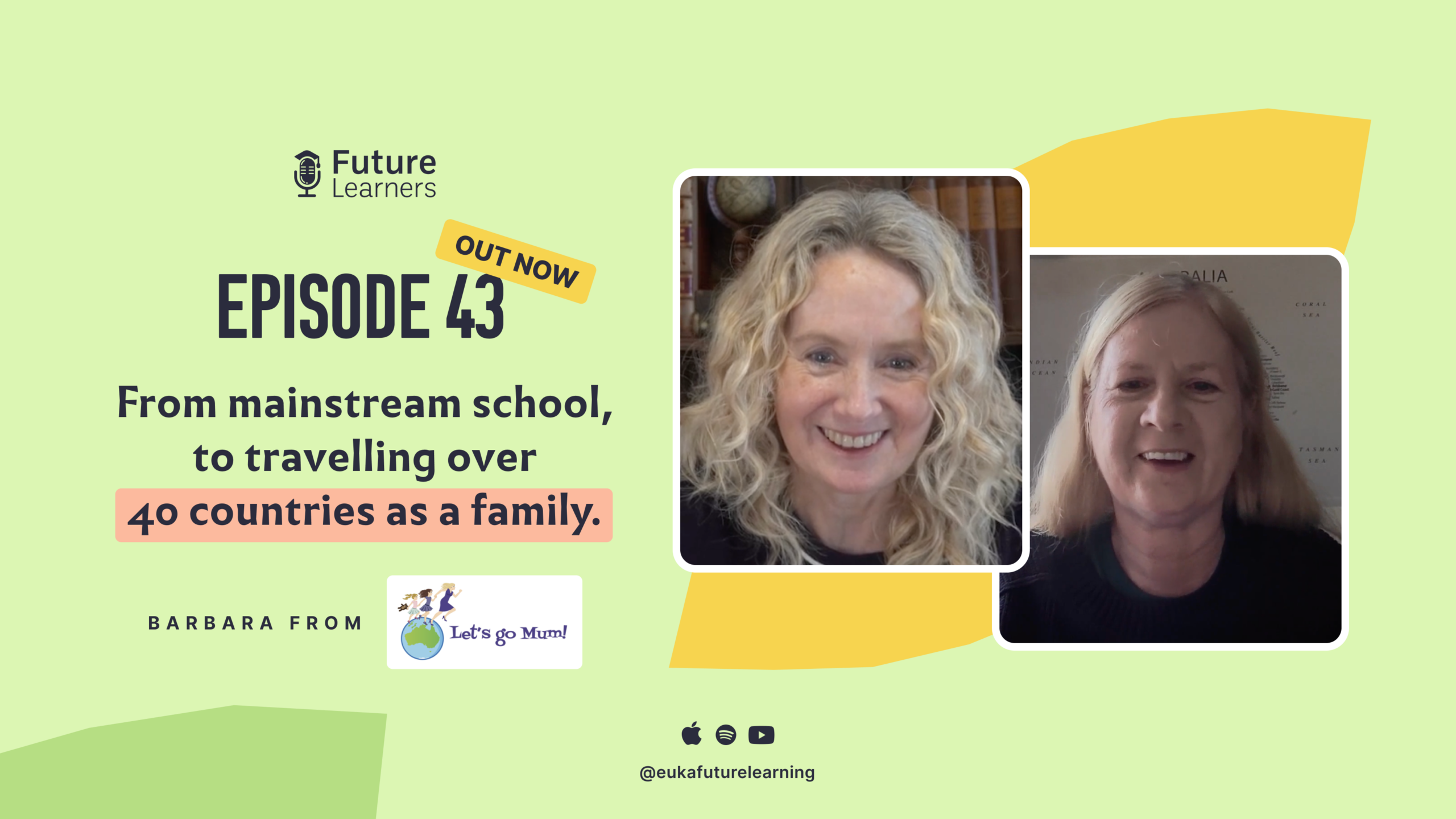
From School Bullying to Homeschooling Across 40 Countries as a Single Mum with 2 Daughters
Episode 042
How Young Athletes Train Full-Time Without Falling Behind in School
Episode 041
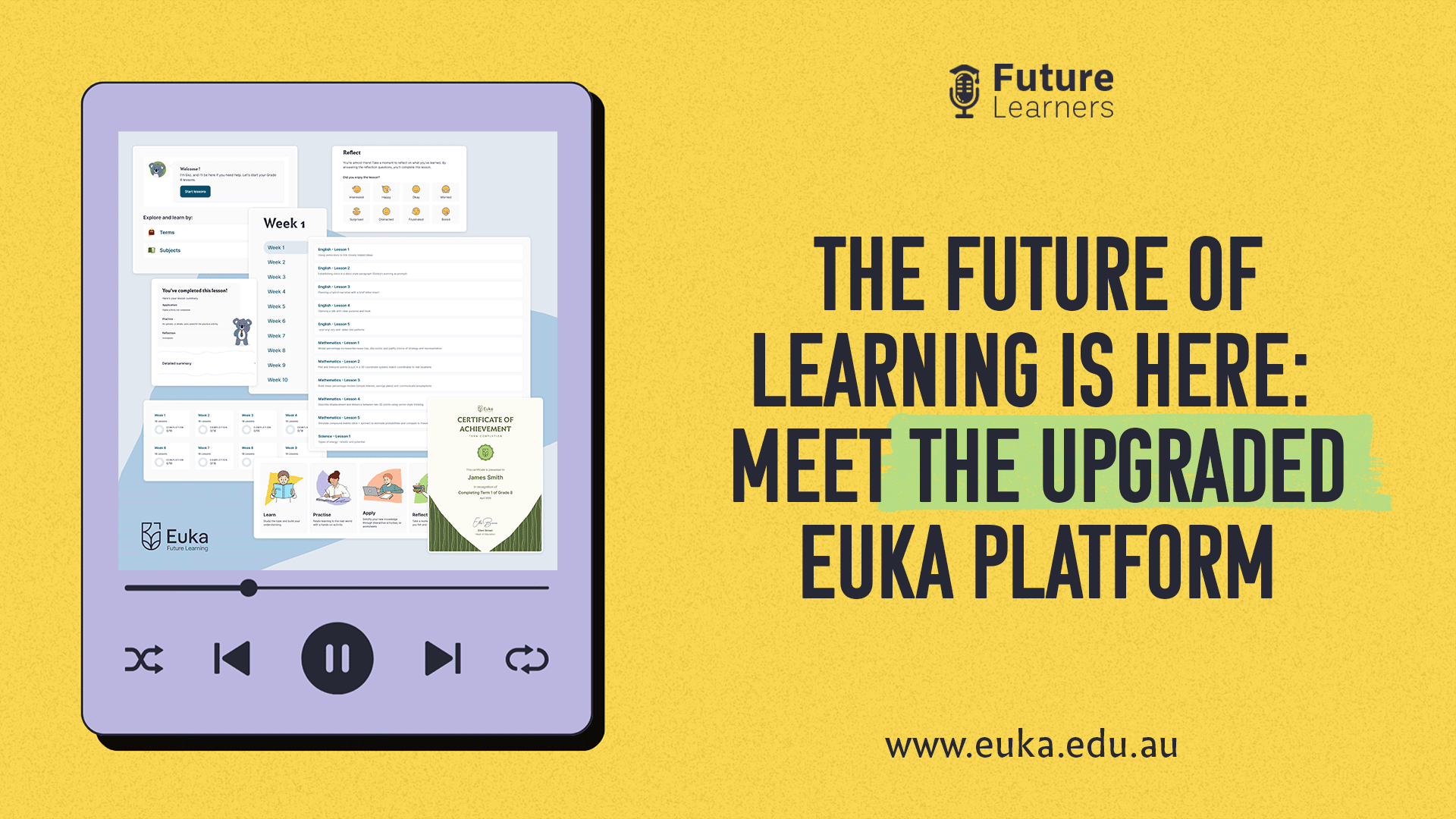
Meet the Upgraded Euka Learning Experience

Episode 040
The World Is Your Classroom: Travel Schooling with The Slow Road

Episode 039
Inside the NSW Homeschooling Audit: What It Means for Families

Episode 038
He earns 30K a year and homeschools

Episode 037
What you need to know about homeschooling in 2025

Episode 036
Is School Going “WOKE”?

Episode 035
The “True” Reasons families homeschool?

Episode 034
What you need to know about Registration and Reporting when Homeschooling

Episode 033
Travel Schooling: Everything you need to know

Episode 032
Raising young boys

Episode 031
Sleep! Are you and your kids getting enough?

Episode 030
Setting your pre-schooler up for success

Episode 029
Should children under 16 be banned from using social media?

Episode 028
Should children learn handwriting in this digital world?

Episode 027
The #1 Skill for children to learn

Episode 026
When should your child do work experience?

Episode 025
How to build a strong family unit

Episode 024
How to retain 90% of everything you learn!

Episode 023
Homeschooling with Dyslexia, ASD, and ADHD: A Mother’s Inspirational Journey

Episode 022
Unlock funding for homeschooling

Episode 021
Moving from School to Homeschooling in term 2

Episode 020
Homeschooling on a budget

Episode 019
The Importance of Raising Risk Takers

Episode 018
Empowering Girls: Building Confidence and Self-Esteem

Episode 017
3 Major Obstacles Parents Face when Homeschooling

Episode 016
The most important skill a child can learn

Episode 015
Cultivating Financial Literacy and Mindful Parenting

Episode 014
Physical and mental health tips for homeschooling families

Episode 013
The ultimate Getting Started guide

Episode 012
Homeschooling mother of 4 shares her journey

Episode 011
Mental Health and how it affects our children

Episode 010
AI, Technology & Navigating the Digital Frontier

Episode 009
Euka Unveils Groundbreaking Year 11 & 12 Program – A Global First in Learning Innovation

Episode 008
The Difference Between Homeschooling and Distance Education
Follow Euka on social platforms


Follow our hosts on socials

Brett Campbell, CEO Euka Future Learning
Brett Campbell is a leader in education, serving as the CEO of Euka, an innovative company building the future of education. He’s a successful entrepreneur and author with a passion for lifelong learning. Beyond his professional achievements, Brett is a devoted family man and the host of the Future Learners Podcast, where he shares his ideas about education’s potential to empower people and create a brighter future.
Follow Brett on:


Ellen Brown, Founder Euka Future Learning
Ellen Brown is the founder and driving force behind Euka’s educational philosophy. With over 25 years of teaching experience, she designed Euka’s curriculum for grades 1-12, emphasizing individualized and practical learning. Her expertise is recognized by major media outlets, and she is frequently sought after for her insights on the future of education.